

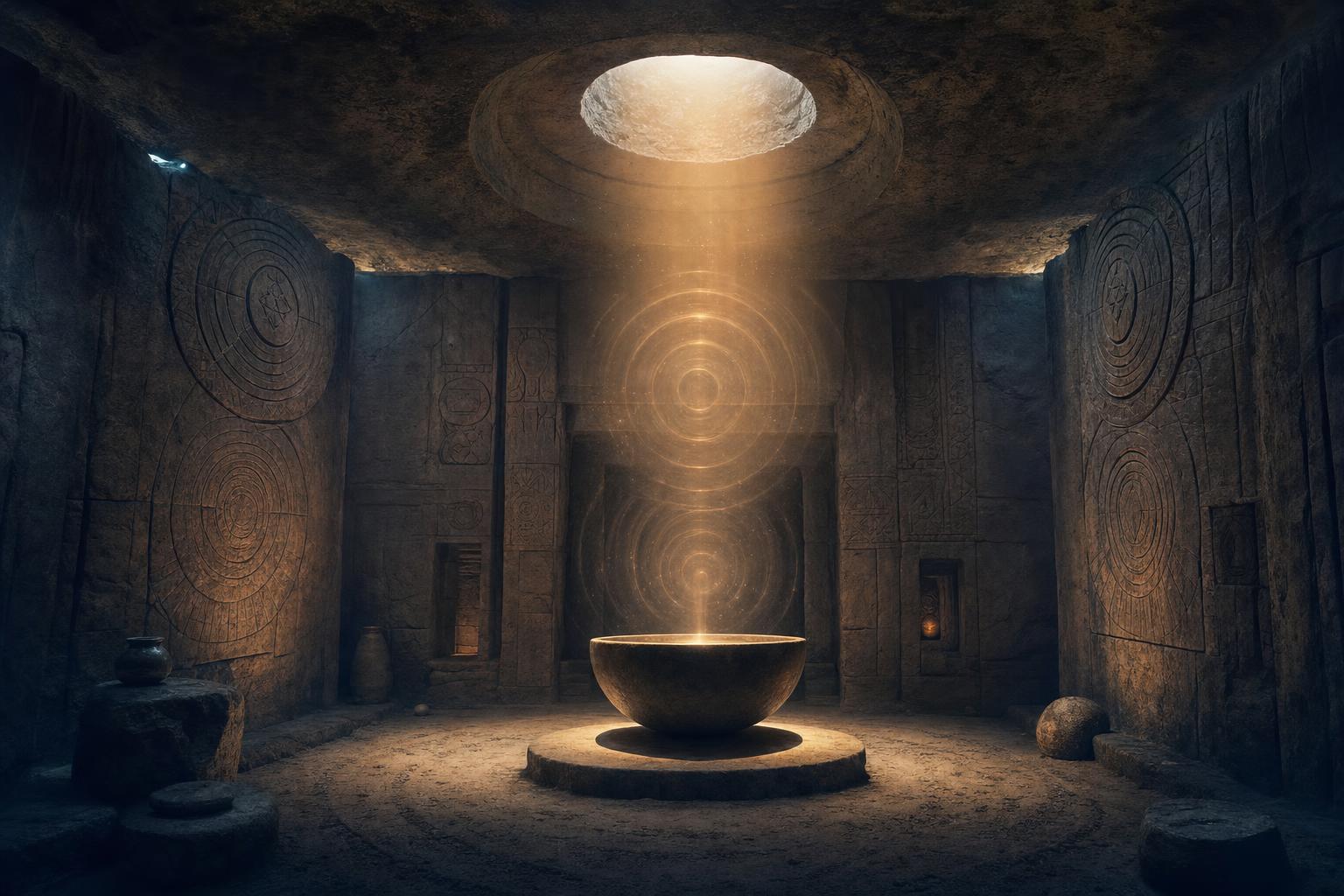
- 110 Hz is the archaeoacoustics frequency: ancient chambers from Malta's Ħal Saflieni Hypogeum to Newgrange resonate near 110–111 Hz, and small studies suggest this tone shifts brain activity toward right-hemisphere, meditative processing.
- This is the rare frequency with an archaeological story.
- 110 Hz is also close to A2 — deep chant territory — which is why it pairs beautifully with om chanting and low-voice toning.
- The specific study: in 2008, Ian Cook and colleagues at UCLA ran EEG on volunteers listening to tones at 90, 110 and 130 Hz.
- Hear 110 Hz instantly in our free tone generator, or listen inside full 432 Hz-tuned compositions
- Daily 10–20 minute sessions outperform occasional long ones — consistency builds the response
What Is 110 Hz — the Ancient Temple Tone?
110 Hz is the archaeoacoustics frequency: ancient chambers from Malta's Ħal Saflieni Hypogeum to Newgrange resonate near 110–111 Hz, and small studies suggest this tone shifts brain activity toward right-hemisphere, meditative processing.



110 Hz Frequency Benefits & Uses
This is the rare frequency with an archaeological story. Researchers measuring 6,000-year-old ritual chambers kept finding the same resonance — about 110 Hz, squarely in the range of a low male chanting voice. A small EEG study then found that listening at 110 Hz reduced left-hemisphere language activity, the signature of a mind slipping out of words and into state.
110 Hz is also close to A2 — deep chant territory — which is why it pairs beautifully with om chanting and low-voice toning.
The Science, Honestly
The specific study: in 2008, Ian Cook and colleagues at UCLA ran EEG on volunteers listening to tones at 90, 110 and 130 Hz. At 110 Hz — and only there — activity in the left temporal region (language processing) dropped, with a relative shift toward right-hemisphere patterns associated with emotional and spatial processing. It's one small pilot, but it matches the archaeology uncannily: the chambers were built where the measurement later landed.
110 Hz and Its Neighbors
110 Hz and 136.1 Hz are both chant-anchored tones, but from different worlds: 110 Hz from measured stone (archaeoacoustics of Malta, Newgrange, megalithic chambers), 136.1 Hz from calculated sky (the Earth-year octave). Chant sits naturally on both — 110 Hz favors low male-range toning, 136.1 Hz classical OM work.
The Best Moments to Use 110 Hz
Voice toning — hum or chant near A2 over the tone; the chamber effect was built around the human voice.
Dark, quiet meditation — the closest modern recreation of the spaces this frequency was discovered in.
Deep-listening sessions — headphones, eyes closed, attention on the sound itself as the object.
Hear 110 Hz Right Now
Play the pure tone free in our tone generator — set it to 110 Hz — or the full solfeggio generator. Pure tones show you the frequency; composed music lets you actually rest inside it, which is where the benefits live. Our playlist below is tuned for exactly that.
How to Use It
1. Pick one intention. 110 Hz works best attached to a single, repeated practice — the association is the active ingredient.
2. Keep it low and long. Volume just above a whisper, 10–20 minutes, eyes closed if you can. Headphones deepen immersion; speakers let the body feel the lower tones.
3. Repeat daily. Nervous systems learn by repetition; one consistent week beats one long Sunday.
Frequency music supports rest and wellbeing — it is not medical treatment. For ongoing health concerns, please talk to a healthcare professional.
Frequently Asked Questions
What is special about 110 Hz?
It is the resonant frequency measured in several ancient ritual chambers, and a small study found it nudges the brain toward right-hemisphere, meditative processing. The research is early and small — but it is the most archaeologically grounded frequency in sound healing.
Can I chant along with 110 Hz?
Yes — 110 Hz is the note A2, comfortably inside most lower voices. Match the pitch loosely and hum long exhales; the ancient chambers this frequency was measured in appear to have been designed around exactly that practice.
Is it better to listen to 110 Hz as a pure tone or as music?
Pure tones are for tasting the frequency; music built around it is for practice. Compositions hold attention and pace the breath, which is what produces the felt benefits. Start with the tone generator, settle into the playlist.
How long until I feel anything?
The physiological part — slower breath, lower arousal — begins within minutes of any calm, steady sound. The deeper associations build over one to two weeks of consistent daily practice.