ADHD Music for Focus: The Science-Backed Soundtrack for Deep Work, Studying & Flow States
- Mar 2
- 21 min read
If you have ADHD, you already know that willpower alone is not going to get you through a two-hour work session. The ADHD brain is not lazy or broken — it is a brain wired for novelty, intensity, and reward that simply does not generate sustained dopamine from routine tasks the way neurotypical brains do. This is the focus paradox at the heart of ADHD: the very tasks that demand the most attention are often the ones the ADHD brain finds least naturally rewarding. This is where music changes everything. The right adhd music for focus does not just make the background quieter — it actively reshapes the neurochemical and brainwave environment your attention system is operating in. It raises dopamine, narrows the sensory gate, quiets the default mode network, and creates the internal conditions for genuine concentration. This guide covers everything: the neuroscience behind why music works for ADHD, the best types and specific frequencies to use, how to structure your listening environment, and what to avoid. This is not general productivity advice repurposed for ADHD. This is a complete, science-backed system built for the way your brain actually works.
Listen Now: ADHD Focus Music Playlists — Start Your Deep Work Session
Press play on either playlist below before you begin your work session. Allow 10-15 minutes of listening before demanding full concentration — the neurological entrainment that makes these playlists effective takes time to develop. Both playlists are curated specifically for ADHD brains: no lyrics, steady rhythm, and frequencies tuned for sustained attention.
ADHD Focus Music — Deep Concentration & Flow State:
ADHD Music for Calm Focus & Attention Support:
Table of Contents
1. The ADHD Focus Crisis: Why Willpower Fails and Music Works
2. The Neuroscience of Music and ADHD Focus: Dopamine, Sensory Gating & the Default Mode Network
3. The Best Types of ADHD Music for Focus: Binaural Beats, Isochronic Tones, Lo-Fi & Noise
4. Healing Frequencies for ADHD Focus: 40Hz Gamma, 432Hz & 528Hz
5. How to Create Your Optimal ADHD Focus Music Environment
6. ADHD Focus Music for Different Scenarios: Deep Work, Studying, Creative Work & Reading
7. Timing and Duration: How Long and When to Listen for Maximum ADHD Focus
8. What to Avoid: Music That Worsens ADHD Focus
The ADHD Focus Crisis: Why Willpower Fails and Music Works
The conventional advice for focus — eliminate distractions, set a timer, just start — fails people with ADHD at a neurobiological level. It is not a matter of trying harder. ADHD involves measurable differences in dopamine signaling pathways that make sustained attention on low-stimulation tasks genuinely harder to maintain, not as a character flaw but as a neurological reality.
Dr. Joel Nigg, one of the world's leading ADHD neuroscientists and professor at Oregon Health and Science University, describes ADHD not as a deficit of attention but as a deficit of attention regulation — the brain can focus intensely when the reward signal is high enough, but it cannot reliably manufacture that signal for tasks that do not naturally provide it. This is why people with ADHD can spend five hours hyperfocused on a video game and cannot sustain twenty minutes on a report: the game provides a constant stream of novelty and reward that the report simply does not.
ADHD music for focus works because it introduces an external source of dopaminergic stimulation that runs alongside the task. Music activates the brain's reward circuitry reliably and predictably, elevating dopamine in the nucleus accumbens and prefrontal cortex — exactly the regions that govern executive function and sustained attention. Rather than asking the ADHD brain to generate its own focus fuel from nothing, the right music provides a steady neurochemical supply that keeps the attention system online.
The result is not just background noise. It is a neurological scaffold that makes sustained focus possible for brains that would otherwise spin into distraction, daydream, or task-switching within minutes.
ADHD involves dopamine signaling differences that make sustained attention on low-reward tasks neurobiologically harder
Dr. Joel Nigg frames ADHD as attention regulation difficulty, not attention absence
Music activates the nucleus accumbens and prefrontal cortex — the brain's reward and executive function centers
The right music provides an external dopamine source that keeps the attention system online
This is not a workaround — it is working with the ADHD brain's actual neurochemistry
ADHD music for focus is not a productivity hack. It is neurochemical support — the external scaffolding that gives the ADHD brain the stimulation it needs to sustain attention on tasks that do not naturally provide it.
To understand how these frequencies fit within the complete landscape of healing sound science, explore our comprehensive guide: Healing Frequencies of the Human Body — The Complete Guide.
The Neuroscience of Music and ADHD Focus: Dopamine, Sensory Gating & the Default Mode Network
To understand why adhd music for focus works at a deep level, you need to understand three neurological systems that operate differently in the ADHD brain: dopamine signaling, sensory gating, and the default mode network.
Dopamine is the neurotransmitter most directly associated with motivation, reward anticipation, and sustained effort. In ADHD brains, dopamine is released less reliably in the prefrontal cortex — the region responsible for planning, impulse control, and holding attention on goals. Music is one of the most reliable non-pharmacological triggers for dopamine release in the human brain. A 2011 study published in Nature Neuroscience demonstrated that music produces dopamine release in the striatum indistinguishable in mechanism from food, sex, and other biological rewards. For the ADHD brain, this is not a small benefit — it is a meaningful supplement to the brain's underactive reward circuitry.
Sensory gating is the brain's ability to filter irrelevant incoming stimuli and focus processing resources on what matters. Research consistently shows reduced sensory gating in ADHD — the ADHD brain admits more competing signals, making every ambient sound, visual movement, and passing thought a potential attention hijack. Certain types of music — particularly steady-state audio like brown noise, binaural beats, and isochronic tones — create what audiologists call a "masking effect" that saturates the sensory gate and reduces its availability for distracting inputs. The brain is not more distracted; it is less distractible.
The default mode network (DMN) is a set of interconnected brain regions that activate when the mind is not engaged in goal-directed tasks — the neural substrate of mind-wandering, daydreaming, and internal rumination. In neurotypical brains, the DMN is suppressed when focused attention is required. In ADHD brains, research from the National Institute of Mental Health shows the DMN remains partially active even during focused tasks, continuously competing with the task network for attentional resources. This is the neurological basis for the ADHD experience of starting a paragraph and finding yourself thinking about something you said in 2014. Rhythmic, structured music — particularly music with a clear, predictable beat — has been shown in multiple studies to suppress DMN activity and help the brain sustain task-network dominance for longer periods.
Dopamine: music triggers reliable dopamine release in the striatum and prefrontal cortex, supplementing ADHD's underactive reward signaling
Sensory gating: steady-state audio saturates the sensory filter and reduces availability for distracting inputs
Default mode network: rhythmic music suppresses DMN activity and helps sustain task-network dominance
Frontiers in Psychology published multiple studies linking binaural beats to improved executive function measures in ADHD populations
The combined effect addresses three separate ADHD focus vulnerabilities simultaneously
The Best Types of ADHD Music for Focus: Binaural Beats, Isochronic Tones, Lo-Fi & Noise
Not all music is created equal for ADHD focus. The same qualities that make a song emotionally engaging — surprising chord changes, lyrics that demand linguistic processing, dynamic volume shifts — are exactly the qualities that will hijack the ADHD brain's attention and direct it toward the music rather than the task. Understanding what works, and why, lets you make intentional choices rather than trial-and-error ones.
Binaural beats are audio tracks that play two slightly different frequencies in each ear — for example, 210 Hz in the left and 220 Hz in the right — causing the brain to perceive a phantom 10 Hz beat. This perceived beat entrains brainwave activity toward the target frequency. For ADHD focus, the most researched targets are beta frequencies (12-30 Hz, associated with active concentration) and low gamma frequencies (around 40 Hz, associated with high-level cognitive binding and attention). A landmark 2020 study in Frontiers in Psychology found that participants exposed to beta-frequency binaural beats showed significant improvements in sustained attention, working memory, and inhibitory control — the exact executive functions most affected in ADHD.
Isochronic tones produce a similar brainwave entrainment effect through a different mechanism: rapid, rhythmic pulses of a single tone rather than the two-ear frequency difference used in binaural beats. Because isochronic tones do not require headphones to work, they can be used through speakers — an advantage for ADHD users who find headphones uncomfortable or constraining during long work sessions. The entrainment effect is comparable to binaural beats in most studies, and many ADHD listeners find the sharper, more defined pulse of isochronic tones easier to settle into.
Lo-fi hip hop occupies a unique position in adhd focus music because it provides just enough musical interest to keep the novelty-seeking ADHD brain gently engaged without being stimulating enough to demand active listening. The characteristic lo-fi elements — vinyl crackle, muffled bass, slow tempos around 70-85 BPM — create a warm, slightly imperfect sonic environment that many ADHD brains find paradoxically anchoring. The music is interesting enough to prevent boredom-driven distraction but not interesting enough to become the object of attention itself.
White, pink, and brown noise each offer a different spectral profile of broadband sound. Brown noise — which emphasizes lower frequencies, producing a sound like a powerful waterfall or distant thunder — is the consistent favorite among ADHD self-reporters on forums and in clinical observation. Its low-frequency energy appears to engage the ADHD brain's craving for stimulation while simultaneously reducing the disruptive salience of environmental sounds. Many people with ADHD describe brown noise as the sonic equivalent of a weighted blanket: grounding, calming, and deeply conducive to sustained effort.
Binaural beats: proven brainwave entrainment through two-frequency differential; use beta (12-30 Hz) or 40 Hz gamma for focus
Isochronic tones: similar entrainment through rhythmic pulses; works through speakers, no headphones required
Lo-fi hip hop: low enough in stimulation to avoid attention hijacking, high enough in interest to prevent boredom
Brown noise: broadband low-frequency sound that satisfies the ADHD brain's stimulation need and masks distractors
Avoid music with lyrics in your native language — linguistic processing competes directly with reading and writing tasks
Steady tempo (70-90 BPM) is more focus-supportive than variable-tempo or highly dynamic music
Healing Frequencies for ADHD Focus: 40Hz Gamma, 432Hz & 528Hz
Beyond genre and structure, specific healing frequencies offer targeted neurological benefits for ADHD focus that go deeper than general background music. These frequencies work through brainwave entrainment and the vibrational resonance principles explored in frequency healing research, and they have accumulated meaningful scientific and anecdotal support specifically for attention and cognitive clarity.
40Hz gamma frequency is the most extensively researched frequency for ADHD and cognitive function. Gamma brainwaves (30-100 Hz, with 40 Hz being most studied) are associated with high-level cognitive binding — the neural process by which the brain integrates information from separate regions into a unified, coherent experience. Multiple studies, including landmark research from MIT and the Picower Institute for Learning and Memory, have shown that 40 Hz stimulation — both auditory and visual — significantly increases gamma wave activity in the prefrontal cortex and reduces amyloid-related neural interference. For ADHD specifically, 40 Hz gamma entrainment has been shown to improve sustained attention, working memory capacity, and the speed of executive function responses. If you use only one specific frequency for ADHD focus, 40 Hz is the most evidence-backed choice.
432Hz is known in healing frequency traditions as the "natural tuning" — a fundamental frequency that many practitioners and researchers believe creates greater resonance with the body's natural rhythmic systems than the modern standard of 440Hz. For ADHD specifically, 432Hz music is reported by a large community of listeners to produce a quality of focused calm that feels different from standard-tuned music: less agitating, more grounded, and conducive to the kind of settled, sustained engagement that deep work requires. While the mechanism remains debated in academic literature, the experiential reports are consistent enough — and the cost of trying it low enough — that 432Hz deserves a prominent place in any ADHD focus music toolkit.
528Hz, known as the "transformation" or "miracle" frequency, sits at the heart of the Solfeggio scale and is associated with DNA repair, cellular healing, and a fundamental quality of harmonic coherence. For ADHD, the reported benefit of 528Hz is not primarily stimulation but rather the resolution of the anxious, fragmented mental state that often underlies ADHD focus failures. Many people with ADHD experience their difficulty focusing not as simple inattention but as a kind of mental static — a chaotic, scattered quality of inner experience that makes sustained attention feel impossible. 528Hz appears to address this scattered quality directly, producing a sense of internal coherence and settledness from which genuine focus becomes much more accessible.
40Hz gamma: most research-backed frequency for ADHD; improves sustained attention, working memory, and executive function speed
432Hz: natural tuning that produces grounded, settled focus with less neural agitation than 440Hz standard
528Hz: addresses the scattered, fragmented mental state underlying many ADHD focus failures; promotes internal coherence
These frequencies are most effective when embedded in ambient or instrumental music rather than used as pure tones
Consistent daily use produces cumulative brainwave entrainment benefits that build over weeks of practice
Combining 40Hz gamma binaural beats with 432Hz or 528Hz base tuning creates a layered, synergistic focus support effect
Healing frequencies do not replace the need for the right environment or the right task approach — but they do shift the neurological baseline from which you are working. A brain operating in gamma coherence with reduced DMN activity is simply better equipped to focus than one operating without this support.
Watch: ADHD Focus Music Sessions — Extended Listening for Deep Concentration
These full-length ADHD focus music videos are designed for extended work sessions. Each combines healing frequencies, brainwave entrainment, and ambient sound architecture to support sustained attention for 60-90 minute deep work blocks. Play them on a second screen or in the background while you work.
ADHD Music | Deep Focus & Concentration | Healing Frequencies for Attention & Calm
ADHD Focus Music | Binaural Beats & Healing Tones | Calm Your Mind & Sharpen Attention
How to Create Your Optimal ADHD Focus Music Environment
Knowing what types of music support ADHD focus is only half the equation. The other half is setting up the listening environment in a way that maximizes the benefit and eliminates the variables that undermine it. The ADHD brain is exquisitely sensitive to environmental conditions, and the same music that produces deep focus in one setup can fail completely in another.
Volume is more important than most people realize. ADHD focus music should be loud enough to mask ambient distractions but not so loud that it becomes the dominant sensory input. For most people, this is around 50-65 decibels — roughly the volume of a quiet conversation. Music that is too quiet allows environmental sounds to break through and compete. Music that is too loud becomes stimulating rather than supportive and starts competing with cognitive processing itself. If you can hear every individual element of the music clearly and in detail, it is probably too loud for focused work.
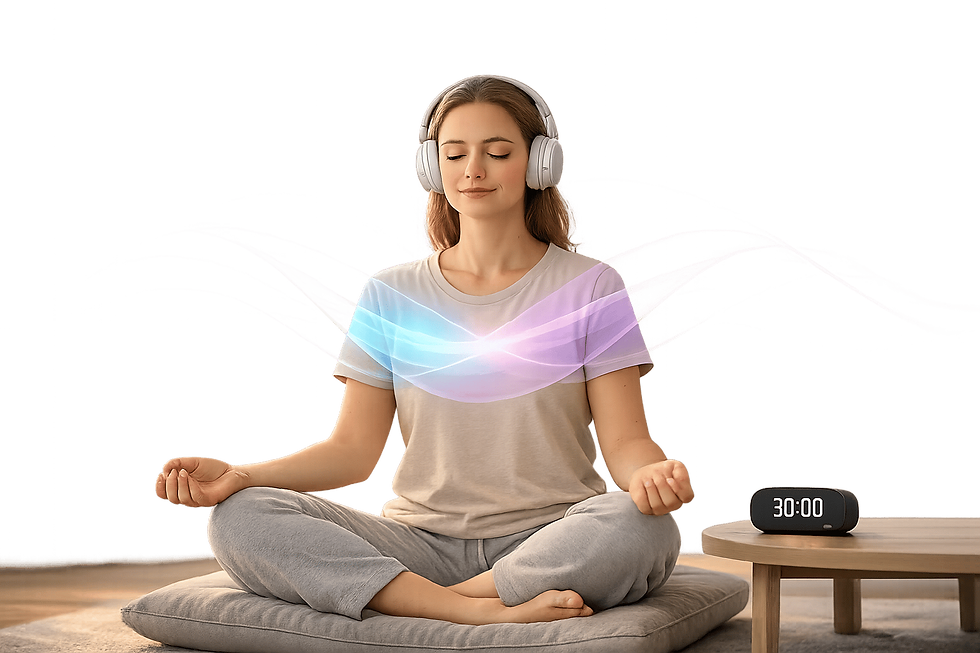
Headphones versus speakers produce meaningfully different experiences for ADHD listeners. Binaural beats require headphones to work — the two-frequency differential that creates the perceived beat depends on each ear receiving a separate signal. For other types of adhd music for focus, the choice depends on individual preference. Many ADHD listeners find that over-ear headphones create a sense of enclosure and insulation that amplifies the focusing effect, essentially building a portable private soundscape that travels with them regardless of the physical environment. Others find headphones physically distracting or uncomfortable during long sessions, in which case quality speakers positioned to create an even sound field work well.
Consistency accelerates the benefits. The ADHD brain, like all brains, is capable of conditioned response — when you use the same music consistently for focused work, over time the auditory cue of that music begins to prime the focus state before the neurochemical effects have had time to develop fully. Many experienced ADHD focus music users report that after a few weeks of consistent use, pressing play on their focus playlist produces a near-immediate shift in mental state — the music has become a context signal that tells the brain it is time to work.
Volume: 50-65 dB optimal — loud enough to mask distractors, quiet enough not to dominate processing
Binaural beats require stereo headphones; other focus music can be used through speakers effectively
Over-ear headphones create an insulating soundscape that many ADHD brains find deeply grounding
Consistent use of the same playlist builds conditioned focus priming over time — the music becomes a context cue
Use a dedicated focus playlist rather than shuffle or radio to prevent novelty-seeking disruption when tracks change
Pair music with a consistent physical setup — same desk, same lighting — to layer environmental context cues
ADHD Focus Music for Different Scenarios: Deep Work, Studying, Creative Work & Reading
Different cognitive tasks make different demands on the ADHD brain, and the best adhd music for focus shifts accordingly. Using the same music for writing a report, reading a textbook, doing creative brainstorming, and processing administrative tasks is like using the same tool for every job — it works some of the time but not reliably enough. Matching the music type to the task type is a straightforward optimization that produces significant improvements in focus quality.
Deep work — extended, high-concentration sessions on cognitively demanding tasks like writing, coding, complex analysis, or strategic thinking — is best supported by music that provides maximum neurological support with minimum auditory interest. Brown noise layered with 40 Hz gamma binaural beats is the gold standard for this use case. The brown noise provides broadband masking and grounding stimulation, while the 40 Hz gamma entrainment drives the prefrontal cortex toward the high-level cognitive binding that deep work requires. Sessions of 90-120 minutes with this combination consistently produce the deep flow states that many ADHD brains can access but struggle to sustain.
Studying — reading, memorizing, reviewing, and processing academic or professional material — has different requirements. Working memory is under heavy load, and the music needs to support retention rather than just attention. For studying, alpha-range binaural beats (8-12 Hz) often outperform beta-range, because alpha states support the relaxed, receptive mode of attention that is optimal for encoding new information. 432Hz tuned ambient music or lo-fi hip hop at moderate volume are also strong choices for studying — familiar enough to be non-distracting, engaging enough to prevent the drift into distraction that comes with silence.
Creative work — brainstorming, design, writing first drafts, problem-solving, and ideation — benefits from a different neurological state than analytical deep work. Creativity requires the ability to make unexpected connections, which involves a more fluid, less constrained mode of attention. For creative ADHD work, alpha-range entrainment (10-12 Hz) paired with more melodically varied ambient music — atmospheric electronic, nature soundscapes, or 528Hz tuned compositions — tends to open the creative flow state better than the tight structure of gamma-range entrainment.
Reading, particularly of dense or challenging material, is often the ADHD task most vulnerable to derailment. The eyes are moving across the page while the language centers are processing meaning while the working memory is holding context — and the default mode network is hovering, ready to insert a tangential thought the moment the material becomes slightly abstract or unfamiliar. For reading, the most effective adhd music for focus is often the simplest: consistent brown or pink noise without melody, or very sparse ambient music with minimal harmonic variation, playing quietly enough to be nearly subconscious. The goal is pure masking without any musical elements that could compete with linguistic processing.
Deep work: brown noise + 40 Hz gamma binaural beats for maximum prefrontal support and flow state access
Studying: alpha binaural beats (8-12 Hz) or 432Hz ambient music to support relaxed receptive attention and memory encoding
Creative work: alpha-range entrainment (10-12 Hz) + melodically varied ambient or 528Hz music for flexible, associative thinking
Reading: minimal, sparse noise or very simple ambient music at low volume to mask distractors without creating linguistic competition
Administrative tasks: lo-fi hip hop or upbeat instrumental at moderate volume to provide stimulation without cognitive competition
Task-switching sessions: a brief 2-3 minute transition with theta-range binaural beats (4-7 Hz) can help reset the brain between different task types
The single biggest upgrade most ADHD focus music users can make is to stop using one playlist for everything and start matching the music type to the cognitive demands of the specific task. The difference in sustained focus quality is immediate and significant.
Timing and Duration: How Long and When to Listen for Maximum ADHD Focus
The ADHD brain has a characteristic relationship with time — specifically, a compressed experience of time that makes hour-long focus sessions feel simultaneously eternal and invisible. Getting the timing and duration of adhd focus music right is not a minor detail; it is a core part of making the approach work consistently.
For most people with ADHD, the optimal focused work block is 45-90 minutes. Below 45 minutes, the brain has barely had time to settle into the focus state that the music is working to produce — particularly with binaural beats, which require 10-15 minutes of listening before significant brainwave entrainment occurs. Above 90 minutes, cognitive fatigue accumulates and focus quality degrades regardless of the music. The Pomodoro Technique (25-minute focused blocks with 5-minute breaks) is popular in general productivity culture, but for ADHD, the short blocks often interrupt the focus state just as it is beginning to develop. Longer blocks of 60-90 minutes followed by proper breaks tend to produce better sustained output for most ADHD adults.
The time of day matters significantly for ADHD focus music effectiveness. Most people with ADHD have a 2-4 hour window of peak executive function — typically in the mid-morning or early afternoon — when dopamine availability is naturally highest and the focus music is most effective at amplifying an already-present capacity. Scheduling the most demanding cognitive work during this window, with full focus music support, maximizes both the natural neurochemistry and the music's augmentation of it. Evening work with ADHD is harder regardless of music, because executive function resources are depleted, stimulant medication (if used) has worn off, and the brain is beginning to wind down.
Allow at least 10-15 minutes of music before beginning demanding work. This pre-loading period allows brainwave entrainment to develop and gives the brain time to acclimate to the sonic environment. Many experienced ADHD focus music users begin their playlist while doing low-demand warm-up tasks — answering emails, organizing their workspace, reviewing their task list — and then transition to deep work once the focus state has had time to develop.
Optimal focus block length: 60-90 minutes, longer than typical Pomodoro blocks to allow full entrainment development
Binaural beats require 10-15 minutes of listening before significant brainwave entrainment takes effect
Schedule the most demanding work during your personal peak executive function window (typically mid-morning to early afternoon for most ADHD adults)
Pre-load 10-15 minutes of music before beginning demanding tasks to allow focus state development
Take genuine breaks between blocks — 10-20 minutes of non-screen, low-demand activity — rather than switching to a different cognitively demanding task
Total daily use of 3-4 focused hours with music is sustainable; beyond this, cognitive fatigue undermines focus regardless of audio support
What to Avoid: Music That Worsens ADHD Focus
Understanding what to avoid is as important as knowing what works. The ADHD brain's sensitivity to novelty and reward means that certain types of music that are enjoyable, even deeply meaningful, will consistently undermine focus rather than support it — regardless of personal preference or intention.
Lyrics in your native language are the single most reliable focus disruptor for ADHD. When you read or write text, the brain's language processing regions are actively engaged. When you simultaneously hear spoken or sung words in a language you understand, those same regions are recruited to process the lyrics — creating direct competition for the same neural resources your task requires. This is not subtle. Studies consistently show significant degradation in reading comprehension, writing quality, and working memory performance when people perform language tasks while listening to music with intelligible lyrics. For ADHD brains with already-reduced executive resources, the impact is amplified. Save lyrics for commuting, exercise, and tasks that do not involve language processing.
Highly variable or emotionally intense music — whether it is a favorite album, a dramatic film score, or music with strong personal associations — is problematic for ADHD focus because it captures attention rather than supporting it. The ADHD brain is wired to orient toward emotionally salient stimuli, and music that triggers strong emotional responses will reliably pull attention toward itself and away from the task. This includes music you love. The paradox of ADHD focus music is that the best focus music is often music you find pleasant but not exciting — it needs to be in the engagement range of interest without entering the range of emotional pull.
Silence, counterintuitively, is often one of the worst environments for ADHD focus. The absence of sound does not create a blank canvas — for the ADHD brain, silence is often louder than noise, because every ambient sound becomes highly salient against a quiet background, and internal mind-wandering accelerates without external stimulation to anchor attention. Many people with ADHD discover that they have been working in silence as a default for years, assuming it was correct, without realizing that background music would dramatically improve their capacity to sustain effort. If you find yourself constantly distracted in quiet environments, that is not a discipline problem — it is your brain signaling that it needs more stimulation to stay on task.
Lyrics in your native language: direct competition with language processing regions during reading and writing tasks
Emotionally intense or personally significant music: captures ADHD attention too effectively, redirecting it from the task
Highly variable tempo, volume, or dynamics: each change triggers an orienting response that interrupts focus
Shuffle or radio: unpredictability triggers ADHD novelty-seeking as the brain anticipates what comes next
Complete silence: often counterproductive for ADHD, increasing the salience of distractors and accelerating mind-wandering
Music from new albums or artists you haven't heard before: novelty competes with task for attention resources
The ADHD brain is not poorly designed — it is optimized for a different environment than the modern knowledge-work setting. ADHD focus music is not about forcing attention. It is about creating the right neurological conditions for the attention you already have to land on the right target.
Frequently Asked Questions About ADHD Music for Focus
Does music actually help ADHD focus, or is it just a distraction?
The research is clear: the right music significantly improves focus for most people with ADHD. A 2020 Frontiers in Psychology study found that beta-frequency binaural beats improved sustained attention, working memory, and inhibitory control in ADHD populations. The key distinction is music type — ambient instrumental music, binaural beats, brown noise, and isochronic tones support focus because they provide dopaminergic stimulation and sensory gating without competing for the brain's language or executive processing resources. Music with lyrics, highly variable dynamics, or emotionally engaging content can become a distraction rather than a support. Used correctly, ADHD music for focus is one of the most accessible and effective non-pharmacological tools available for attention regulation.
What is the best music for ADHD studying?
For studying — reading, memorizing, and processing academic material — the most effective music for ADHD is alpha-range binaural beats (8-12 Hz), brown or pink noise, or 432Hz tuned ambient music. Alpha brainwave states support the relaxed, receptive attention mode that is optimal for encoding new information. Lo-fi hip hop at moderate volume is also widely used and effective, particularly for students who find pure noise environments sterile. The key rule for studying is no lyrics in your native language — linguistic processing during reading directly competes with the language centers needed to comprehend the text, degrading both focus and retention.
Do binaural beats really work for ADHD focus?
Yes, with important caveats. Binaural beats work through brainwave entrainment — when the brain perceives the frequency difference between two tones played in each ear separately, it synchronizes its electrical activity toward that frequency. For ADHD focus, beta-range binaural beats (15-30 Hz) drive the brain toward active-concentration brainwave states, while 40 Hz gamma beats support high-level cognitive binding and executive function. Multiple peer-reviewed studies, including research published in Frontiers in Psychology and Applied Psychophysiology and Biofeedback, have documented measurable improvements in ADHD-relevant cognitive metrics with binaural beat exposure. They require stereo headphones, they take 10-15 minutes to produce significant entrainment, and consistent use amplifies the effect over time.
How long should I listen to ADHD focus music during a work session?
The optimal session length for ADHD focus music is 60-90 minutes. This is longer than the 25-minute Pomodoro blocks that are popular in general productivity culture, because ADHD brains — particularly with binaural beats — need at least 10-15 minutes of listening before significant neurological entrainment develops. Cutting a session off at 25 minutes is often stopping right when the focus state is beginning to build. Allow 10-15 minutes of music before starting demanding work to pre-load the focus state, then work for 60-90 minutes before taking a genuine break. Total sustainable daily focused work with music support is typically 3-4 hours for most ADHD adults.
Should I use music with lyrics or without for ADHD focus?
Without, for almost all cognitively demanding tasks. Music with intelligible lyrics in your native language directly competes with the brain's language processing regions during reading, writing, and analytical tasks. This competition degrades performance measurably in most people and significantly in ADHD brains where executive resources are already running closer to their limit. The exception is music with lyrics in a language you do not understand — this can provide the social warmth and rhythmic engagement of vocal music without the linguistic processing competition. For tasks that do not involve language — drawing, physical work, data entry of non-verbal content — lyrics are generally less disruptive and may be motivating.
What is the best frequency for ADHD focus?
40Hz gamma frequency is the most research-supported specific frequency for ADHD focus. Studies from MIT and other leading neuroscience institutions have shown that 40Hz stimulation drives the prefrontal cortex toward the gamma brainwave state associated with high-level cognitive binding, sustained attention, and executive function. For a gentler approach that supports relaxed concentration and memory encoding, alpha-range frequencies (8-12 Hz) are excellent. 432Hz as a base tuning for ambient music is widely reported to produce a more grounded, settled quality of focus than standard 440Hz tuning. 528Hz adds a layer of internal coherence that helps resolve the scattered, fragmented mental state that often underlies ADHD focus failure.
Can ADHD focus music replace medication?
No, and it is important to be clear about this. ADHD music for focus is a genuine neurological support tool with meaningful research behind it, but it addresses a different layer of ADHD than medication does. Stimulant medications work by directly increasing dopamine and norepinephrine availability across the prefrontal cortex for an extended period. Focus music provides a stimulus-driven, task-dependent neurochemical boost that is real but more modest and context-specific. For many people with ADHD, music works best as a complementary tool — used alongside medication, therapy, coaching, and structural strategies rather than in place of them. For people with mild ADHD who choose not to medicate, or during periods when medication is not available, music can provide meaningful support. Always consult your healthcare provider about ADHD treatment decisions.
Start Using ADHD Focus Music Today
The ADHD brain is not a deficient brain. It is a brain optimized for a world that no longer exists — a world of high novelty, immediate rewards, and environmental stimulation that kept our ancestors both alive and engaged. The modern knowledge-work environment — its long hours of low-stimulation desk work, its demand for sustained voluntary attention, its absence of movement and immediate feedback — is genuinely one of the worst possible environments for the ADHD nervous system. ADHD music for focus does not fix this mismatch by forcing the ADHD brain to be something it is not. It resolves it by changing the environment. By introducing the right kind of stimulation — dopaminergic, rhythmically grounding, neurologically structured — it creates conditions in which the ADHD brain's natural strengths — intensity, pattern recognition, creative connection-making, hyperfocus — can come online rather than being drowned out by the struggle to sustain basic attention. Start with either playlist above. Choose the environment that matches your task. Give it 10-15 minutes before demanding deep focus. And then notice what your brain is actually capable of when it has the neurological conditions it needs.
Explore the full library of healing frequency playlists, sound science guides, and focus music at Miracle Frequencies — everything you need to build a daily sound practice that works with your ADHD brain.
Follow Miracle Frequencies on Spotify, Apple Music, and YouTube for new ADHD focus music, healing frequency playlists, and sound science content every week. Your brain is not the problem — the environment is. We make the environment.



Comments