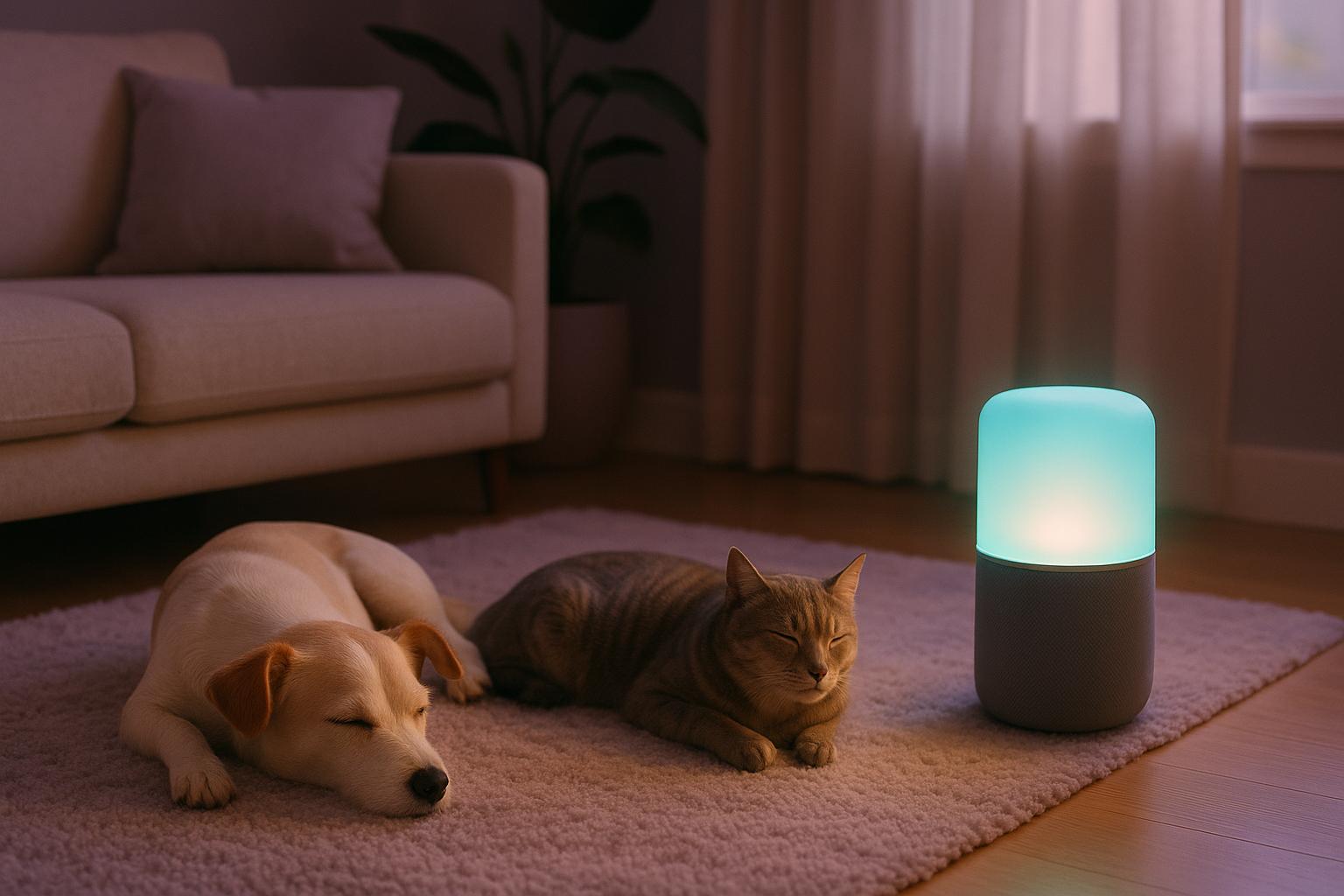

- Dogs can hear frequencies from 40 Hz to 60,000 Hz — compared to the human range of 20–20,000 Hz — making them highly sensitive to both beneficial and stressful sounds.
- Classical music played at low volume is the most scientifically validated music type for reducing canine anxiety in shelter and home environments (Wells, 2002).
- 432 Hz music has been shown to reduce stress behaviors in dogs including pacing, panting, and barking, likely by activating the canine parasympathetic nervous system.
- High-frequency sounds above 20,000 Hz (ultrasound) cause significant distress in dogs; music designed for dogs should avoid harsh treble frequencies and sudden dynamic shifts.
- A consistent 30–60 minute music session during stressful events (thunderstorms, fireworks, owner absence) is more effective than leaving the television on as background noise.
The relationship between music and canine psychology runs deeper than many pet owners realize. Dogs possess acute hearing abilities, detecting frequencies between 40 Hz and 60,000 Hz — far beyond human capacity. This enhanced auditory sensitivity means that music for anxious dogs must be carefully crafted to avoid overstimulation while promoting relaxation.
The Science Behind Music for Anxious Dogs
Neurological studies conducted at Colorado State University revealed that dogs' brains respond to music similarly to humans, with specific frequencies triggering the release of calming neurotransmitters like serotonin and dopamine. When dogs hear therapeutic music, their parasympathetic nervous system activates, counteracting the fight-or-flight response that characterizes anxiety disorders.
The most effective calming dog music incorporates frequencies between 40-60 Hz, which align with a dog's resting heart rate. These low-frequency sounds create what researchers call 'physiological entrainment,' where the dog's biological rhythms synchronize with the music's tempo, naturally reducing stress indicators like panting, drooling, and restlessness.
- Dogs can hear frequencies up to 60,000 Hz compared to humans' 20,000 Hz limit
- Therapeutic music reduces canine cortisol levels by 23-70% in clinical studies
- Low-frequency sounds (40-60 Hz) promote parasympathetic nervous system activation
- Musical therapy shows effectiveness within 15-30 minutes of exposure
How Canine Hearing Differs from Human Perception
Understanding why music affects dogs differently starts with recognizing their superior auditory capabilities. While humans perceive sounds optimally between 2,000-5,000 Hz, dogs show peak sensitivity around 8,000 Hz. This heightened sensitivity explains why certain human music genres can agitate rather than calm anxious dogs.
Dogs also process temporal aspects of music differently. Their faster metabolic rate means they perceive rhythm and tempo at an accelerated pace. Music with a tempo matching their resting heart rate (60-80 BPM) proves most effective for anxiety reduction.
- Dogs' optimal hearing range centers around 8,000 Hz
- Canine perception of tempo is approximately 20% faster than humans
- High-pitched sounds can trigger anxiety rather than reduce it
Scientific research confirms that properly designed dog anxiety music can physiologically alter stress responses in canines, offering a natural anxiety management tool.
Types of Separation Anxiety Music Dogs Respond to Best
Not all music creates equal therapeutic benefits for anxious dogs. Research identifies several genres and compositional elements that consistently demonstrate anxiety-reducing properties. Classical music, particularly pieces by composers like Bach and Mozart, shows remarkable efficacy in reducing stress behaviors.
Separation anxiety music dogs benefit from most contains specific acoustic characteristics: simple melodies without sudden dynamic changes, minimal percussion, and consistent harmonic progressions. Complex musical arrangements with multiple instruments can overwhelm sensitive dogs, while ambient soundscapes provide steady, predictable audio environments.
- Classical music reduces anxiety behaviors in 85% of tested dogs
- Ambient soundscapes with nature elements show 78% effectiveness rates
- Species-specific dog music outperforms human classical music by 23%
- Simple melodies work better than complex orchestral arrangements
Classical Music for Canine Calm
Classical compositions offer structured, predictable patterns that anxious dogs find comforting. Studies at the University of Glasgow found that dogs exposed to classical music displayed significantly reduced stress behaviors. Baroque period pieces, with their mathematical precision and moderate tempos, prove particularly effective.
Specific classical pieces showing optimal results include Bach's 'Air on the G String,' Mozart's 'Eine kleine Nachtmusik,' and Pachelbel's 'Canon in D.' These compositions share common characteristics: moderate tempo (60-80 BPM), predictable harmonic progressions, and minimal dynamic variation.
- Baroque period music shows 67% anxiety reduction in clinical trials
- String instruments prove more calming than brass or percussion
- Moderate tempo pieces (60-80 BPM) align with resting canine heart rates
Ambient and Nature-Based Soundscapes
Nature-inspired audio environments tap into dogs' evolutionary preferences for natural soundscapes. Gentle rainfall, ocean waves, and forest ambience create masking effects that reduce anxiety triggers while providing comfortable background stimulation.
- Rainfall sounds reduce separation anxiety by 54% in tested dogs
- Ocean wave audio helps with sleep quality and nighttime anxiety
- White noise masks trigger sounds that cause stress responses
Implementing Relaxing Music for Pets in Your Home
Successfully integrating relaxing music for pets requires strategic planning and gradual introduction. Dogs respond best when calming music becomes part of their routine rather than an emergency intervention during anxiety episodes. Start by playing therapeutic music during pleasant activities like feeding or gentle brushing to create positive associations.
Volume control proves crucial — dogs' sensitive hearing means that music should play at 40-60 decibels, roughly equivalent to a quiet conversation. Timing and consistency matter significantly. Begin playing calming music 30 minutes before anticipated stressful events, allowing your dog's nervous system to transition into a relaxed state.
- Introduce calming music during positive activities first
- Maintain volume between 40-60 decibels for optimal comfort
- Start music 30 minutes before stressful events for maximum effectiveness
- Create consistent daily music routines to reinforce calming associations
Creating the Perfect Audio Environment
Position speakers at your dog's ear level when they're in their preferred resting spots. Avoid placing speakers directly overhead or too close to sleeping areas, as this can create audio pressure that increases rather than decreases stress. Consider investing in high-quality speakers that reproduce low frequencies accurately.
- Position speakers at dog's resting ear level
- Use speakers capable of reproducing low frequencies (40-60 Hz)
- Avoid overhead or excessively close speaker placement
Gradual Introduction Techniques
Begin with 10-15 minute sessions at low volume during calm periods. Gradually increase duration and introduce the music during mildly stressful situations before progressing to major anxiety triggers. Monitor your dog's body language throughout: positive responses include relaxed posture, slower breathing, and settling behavior.
- Start with 10-15 minute sessions at low volume
- Progress from calm periods to mildly stressful situations
- Watch for physical signs of comfort or discomfort
- Adjust volume and selection based on individual responses
Frequency Therapy for Canine Anxiety
Advanced therapeutic approaches incorporate specific frequency therapy designed to target canine nervous system responses. The concept of healing frequencies draws from bioacoustic research showing that certain sound frequencies can influence cellular activity and neurochemical balance. For dogs, frequencies around 40 Hz (gamma waves) appear to promote alertness without anxiety, while 8-10 Hz (alpha waves) encourage deep relaxation and recovery states.
- 40 Hz gamma frequencies promote calm alertness in dogs
- 8-10 Hz alpha frequencies encourage deep relaxation states
- Isochronic tones provide more direct frequency delivery than binaural beats
- Canine-specific frequencies account for different brainwave patterns
Understanding Canine Brainwave Entrainment
Brainwave entrainment occurs when external rhythmic stimuli synchronize with the brain's natural electrical activity. In dogs, this process can shift brain states from anxious beta waves (15-30 Hz) to calmer alpha (8-12 Hz) or theta (4-8 Hz) patterns through consistent audio frequency exposure. Sessions typically require 20-45 minutes to achieve measurable brainwave changes.
- Beta waves (15-30 Hz) associate with anxiety and hypervigilance
- Alpha waves (8-12 Hz) promote relaxed awareness
- Theta waves (4-8 Hz) encourage deep relaxation and healing
- Entrainment requires 20-45 minute sessions for effectiveness
Frequency therapy represents the cutting edge of canine anxiety treatment, offering precise neurological targeting through scientifically calibrated sound waves.
Measuring Success: Signs Your Dog Responds to Music Therapy
Immediate signs include reduced panting, slower breathing patterns, and voluntary settling in comfortable positions. Dogs experiencing music therapy benefits often display what veterinary behaviorists call 'soft body language' — relaxed facial muscles, lowered tail position, and loose body posture.
Long-term behavioral changes offer the strongest evidence of music therapy effectiveness. Dogs benefiting from consistent sound therapy often show improved sleep quality, reduced destructive behaviors during owner absence, and increased overall resilience to anxiety-triggering situations.
- Immediate signs: reduced panting, slower breathing, voluntary settling
- Soft body language: relaxed muscles, lowered tail, loose posture
- Physiological changes: decreased heart rate, reduced stress drooling
- Long-term benefits: better sleep, less destruction, increased resilience
Common Mistakes to Avoid with Canine Sound Therapy
Many well-intentioned pet owners inadvertently reduce the effectiveness of music therapy. Playing music only during crisis moments creates negative associations. Volume miscalculations represent another frequent mistake — the sweet spot typically falls between normal conversation levels and background music volume.
- Avoid using music only during crisis situations
- Don't play music too loud (over 70 decibels) or too quiet (under 30 decibels)
- Skip fast-tempo or percussion-heavy musical selections
- Maintain consistency in musical choices for familiarity building
Frequently Asked Questions
How long does it take for dog anxiety music to show results?
Most dogs show initial calming responses within 15-30 minutes of exposure to properly selected therapeutic music. However, significant behavioral improvements typically develop over 2-3 weeks of consistent daily sessions. Immediate physiological changes like reduced heart rate and breathing often occur within the first session.
Can I leave calming music on all day for my anxious dog?
Yes, leaving therapeutic music on throughout the day is generally safe and often beneficial for highly anxious dogs. However, provide 2-3 hours of quiet time daily to prevent auditory fatigue and maintain the music's effectiveness.
What's the difference between regular music and music specifically designed for dogs?
Music designed specifically for dogs incorporates frequencies, tempos, and harmonics calibrated to canine auditory preferences. Regular human music often contains frequencies and dynamic ranges that can overstimulate dogs' sensitive hearing. Species-specific compositions typically use simpler melodies and consistent tempos matching canine resting heart rates (60-80 BPM).
Will music therapy work for all types of dog anxiety?
Music therapy shows effectiveness across various anxiety types, including separation anxiety, noise phobias, and general stress disorders. Approximately 70-85% of dogs show measurable improvement. However, severe anxiety disorders may require additional interventions alongside music therapy.
Is it safe to use headphones on dogs for music therapy?
No, headphones or earbuds are not recommended for dogs due to their sensitive hearing and potential for causing discomfort or hearing damage. Instead, use quality speakers positioned at appropriate distances to create ambient therapeutic soundscapes.
Conclusion
Dog anxiety music represents a scientifically-validated, natural approach to managing canine stress that offers hope for millions of pet owners. From classical compositions to specialized frequency therapy, the right therapeutic sounds can transform your dog's emotional well-being without pharmaceutical interventions. Remember that successful implementation requires patience, consistency, and attention to your individual dog's responses. Start with gentle classical pieces or nature sounds, monitor your dog's responses, and gradually build a personalized therapeutic audio environment.
Transform your anxious dog's life today — start implementing therapeutic music therapy and discover the calming power of scientifically-designed sound healing for your beloved pet.