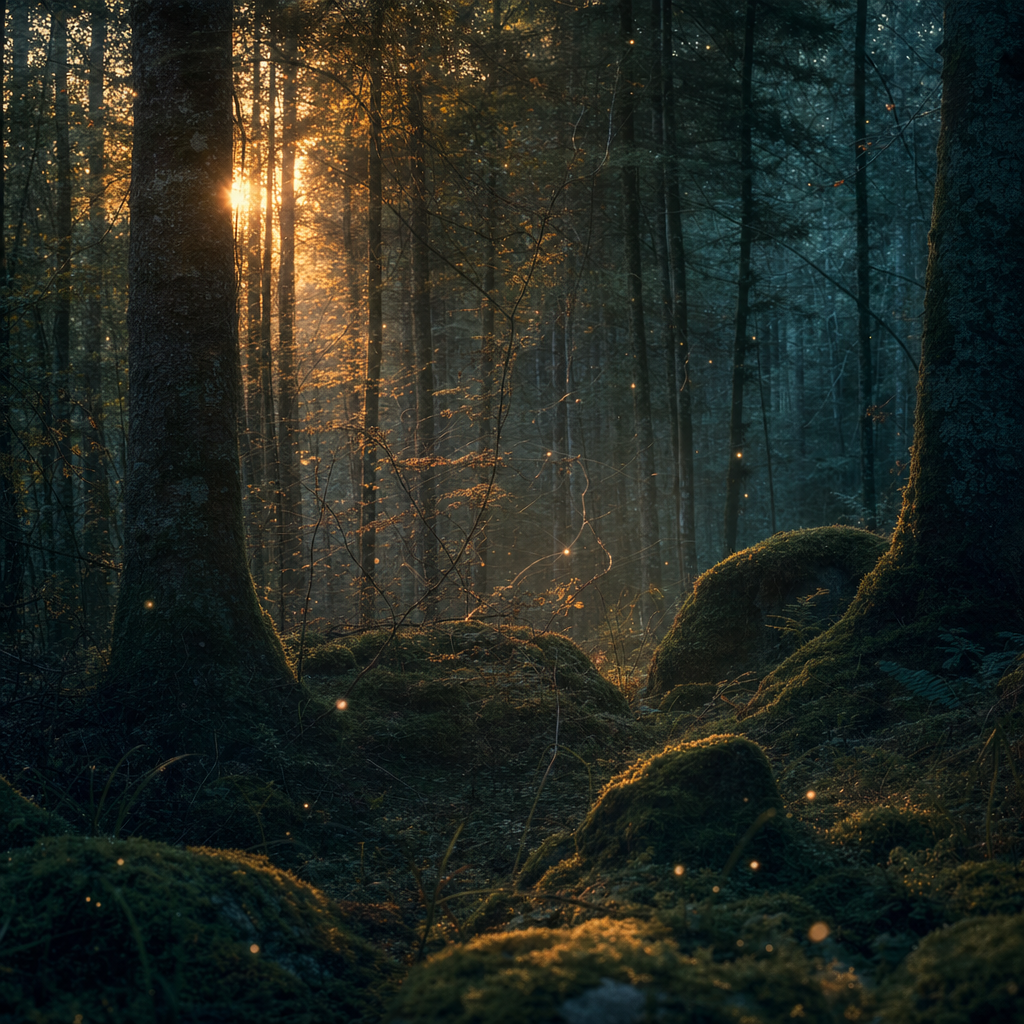
Forest ambience works on sleep for the same acoustic reason rain does — it fills the silence that makes a sudden noise startling — but it does it with a different texture. Where rain is a continuous wash, woodland sound is sparser and slower: air through leaves, distant birds, the sense of a large open space. People who find rain loops too busy or too obviously looped usually sleep better with this. These six tracks pair that ambience with music tuned to 417 Hz and 432 Hz, and stream free with nothing inserted between them.
How Forest Sounds for Sleep helps
Sparser than rain, and less loop-like
Rain is dense and constant, which some sleepers find intrusive rather than soothing. Forest ambience has more space in it, so the ear stops tracking a repeating pattern — the usual complaint that makes people give up on sleep sounds.
It still masks
The masking principle is unchanged: a steady, gentle sound floor stops a door or a passing car from standing out sharply enough to wake you. Research on gentle acoustic stimulation during sleep found enhanced slow-wave oscillations and better overnight memory consolidation.
Nature sound and recovery
Natural soundscapes are among the most consistently preferred restorative sounds, and music listening independently lowers cortisol, heart rate and blood pressure — the physiological direction you want in the last hour before bed.
Tuned underneath the ambience
The music beneath the forest sits at 417 Hz or 432 Hz rather than standard 440 Hz. A randomized clinical trial found 432 Hz tuning produced lower heart rate, anxiety and salivary cortisol than the same music at 440 Hz.
The science
The mechanism is masking plus arousal reduction. A controlled crossover study found gentle acoustic stimulation during sleep enhanced slow-wave oscillations — the marker of deep sleep — and improved memory consolidation the next morning; a steady natural soundscape supplies that continuous, non-startling sound floor. On the music side, a meta-analysis of randomized controlled trials found music-assisted relaxation improves sleep quality with a standardised mean difference of −0.74, and a 2026 systematic review across 14 RCTs and 1,730 participants confirmed music-based interventions significantly improve adult sleep. A randomized clinical trial also recorded lower heart rate, anxiety and cortisol for 432 Hz tuning against standard pitch.
- Acoustic stimulation enhanced slow-wave sleep oscillations and memory (crossover trial) — Papalambros et al., Frontiers in Human Neuroscience, 2017
- Music-assisted relaxation improves sleep quality (meta-analysis of RCTs, SMD −0.74) — Journal of Advanced Nursing
- Music-based interventions significantly improve sleep in adults (systematic review, 14 RCTs, 1,730 people) — Frontiers in Psychiatry, 2026
- 432 Hz music lowered anxiety, heart rate and salivary cortisol (randomized clinical trial) — PMC7213780
How to use Forest Sounds for Sleep
- Start the set 30 minutes before you plan to sleep, while you are still winding down.
- Keep the volume at quiet-fan level — audible but never distinct.
- Let it run all night rather than using a timer, so the masking holds through lighter sleep.
- A room speaker is more comfortable than earbuds across a full night.
Frequently asked questions
Are forest sounds good for sleep?
Yes, for the same reason rain is: they raise the background sound floor so sudden noises stop standing out enough to wake you. Forest ambience is sparser than rain, which suits people who find rain loops too dense or too obviously repeating.
Forest sounds or rain sounds — which is better?
Rain masks more completely because it is denser, so it wins in a genuinely noisy environment. Forest is gentler and less repetitive, which tends to suit a quiet room or anyone who finds rain distracting. Try both — the difference is preference, not effectiveness.
Should forest sounds play all night?
If noise is what wakes you, yes. A timer that cuts out mid-night removes the masking precisely when lighter sleep stages are most easily disturbed.
What volume is right?
Around 30–40 dB — quiet-fan level. You should be able to notice it if you listen for it, and forget it entirely if you do not.
Do the birds not wake you up?
The ambience here is kept low and distant rather than foreground dawn chorus. Anything with sharp, close, irregular calls would defeat the purpose, so those are not in the set.
Is this free?
Yes, free to stream with no app and no sign-up, and no advertising is inserted between tracks.