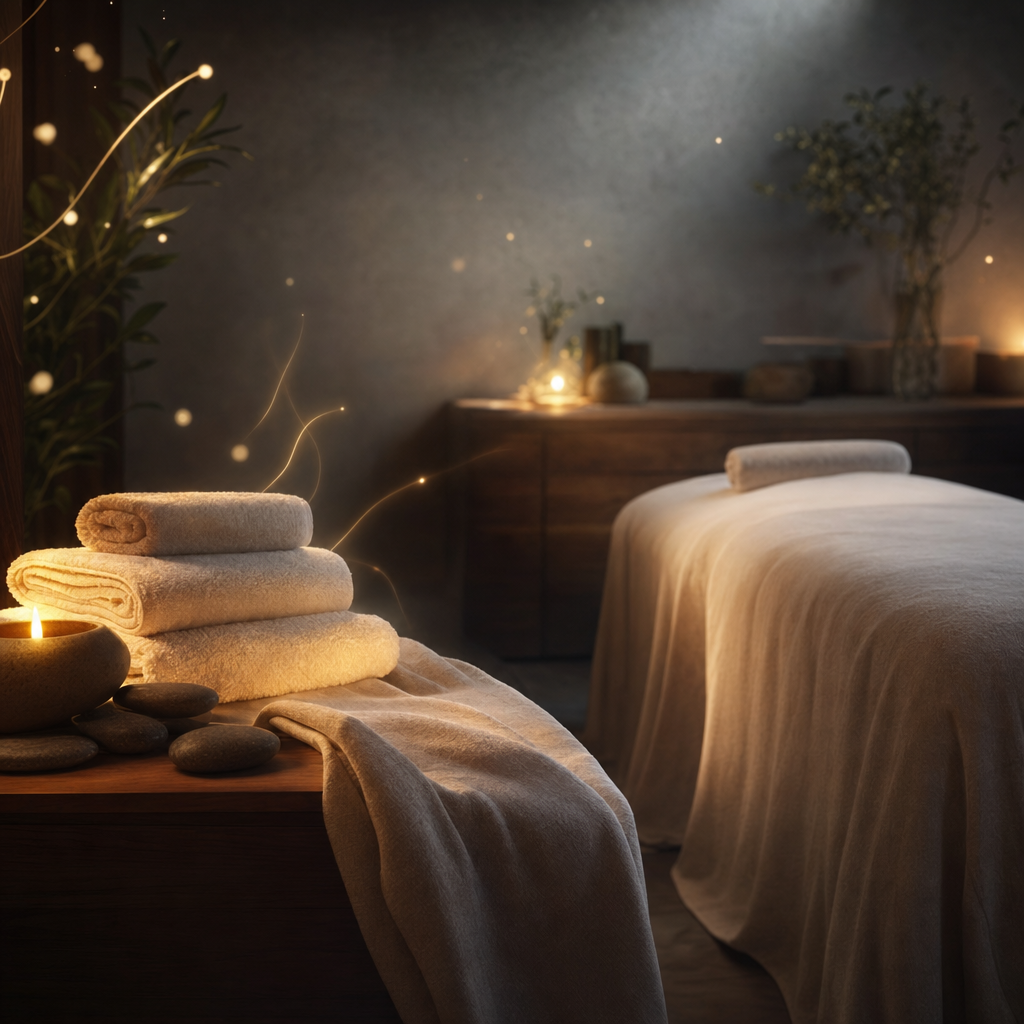
Massage music has to do two contradictory things: be present enough that the room is never silent, and unremarkable enough that a client never opens their eyes to it. These tracks are selected for that narrow brief — slow, wide, no vocals, no percussion, no dynamic jumps that would make a body tense against the table. Most sit at 417 Hz or 432 Hz. There is also a practical reason therapists use this page rather than a streaming app: nothing is inserted between tracks, so a session cannot be broken by an advertisement.
How Music for Massage — Treatment-Table Sound helps
It reduces what the client feels
This is the finding that matters most on a table. A systematic review and meta-analysis of music therapy in pain management found significant reductions in both reported pain and opioid requirements — sound genuinely changes how much discomfort registers during treatment.
Lower arousal means less guarding
A tense client resists the work. Music listening reliably lowers cortisol, heart rate and blood pressure, and music therapy significantly reduces anxiety — all of which shows up as a body that stops bracing.
417 Hz and the nervous system
Several tracks here are tuned to 417 Hz and written around nervous-system settling. In the tuning research more broadly, 432 Hz produced lower heart rate, anxiety and salivary cortisol than standard 440 Hz in a randomized clinical trial.
Nothing breaks the session
An advertisement partway through a massage undoes the previous forty minutes. These tracks stream free and continuous, which is the whole reason to use them over a free streaming tier.
The science
The strongest evidence for music on a massage table concerns pain. A systematic review and meta-analysis found music therapy significantly reduces both pain scores and opioid requirements, and a further systematic review found music therapy reduces musculoskeletal and chronic pain specifically. Alongside that, a systematic review and meta-analysis in Health Psychology Review found music listening lowers cortisol, heart rate and blood pressure, and a companion meta-analysis found music therapy significantly reduces anxiety — the physiological picture of a body that has stopped guarding. A randomized clinical trial comparing 432 Hz with 440 Hz tuning recorded lower heart rate, anxiety and cortisol on the 432 Hz condition.
- Music therapy significantly reduces pain and opioid use (systematic review & meta-analysis) — PMC8555445
- Music listening lowers cortisol, heart rate and blood pressure (systematic review & meta-analysis) — Health Psychology Review
- Music therapy significantly reduces anxiety (systematic review & meta-analysis) — Health Psychology Review, 2020
- 432 Hz music lowered anxiety, heart rate and salivary cortisol (randomized clinical trial) — PMC7213780
How to use Music for Massage — Treatment-Table Sound
- Start the set before the client is on the table.
- Keep it just below conversation level so instructions never have to compete with it.
- Let the whole collection run — do not change tracks mid-session.
- Use room speakers rather than a phone, on airplane mode.
Playing this in your business?
Commercial spaces need a license — and because we own both the recordings and the compositions, one simple annual license from us covers everything for our catalog. From $149/year.
License for your business →Frequently asked questions
What music do massage therapists use?
Slow, quiet, non-melodic ambient music with no vocals and no sudden dynamics. Healing-frequency music is one of the most common categories, alongside solo piano and nature sound.
Does music actually help during a massage?
Yes, measurably. A systematic review and meta-analysis of music therapy in pain management found significant reductions in reported pain and opioid use, and music listening independently lowers cortisol, heart rate and blood pressure.
How loud should massage music be?
Just below conversational level. If the client would have to raise their voice to speak over it, it is too loud — and if it is noticeable enough to have an opinion about, it is also too loud.
How long are the tracks?
Long-form, and the collection runs continuously, so a standard 60- or 90-minute treatment is covered without you touching the player.
Can I use this in my massage business?
The page is free for personal listening. Commercial playback in a business is governed by public-performance licensing that varies by country — check your local rules, or contact us and we will point you to the right licence.
Is it really free with no ads?
Yes. No sign-up, no app, and nothing inserted between tracks.