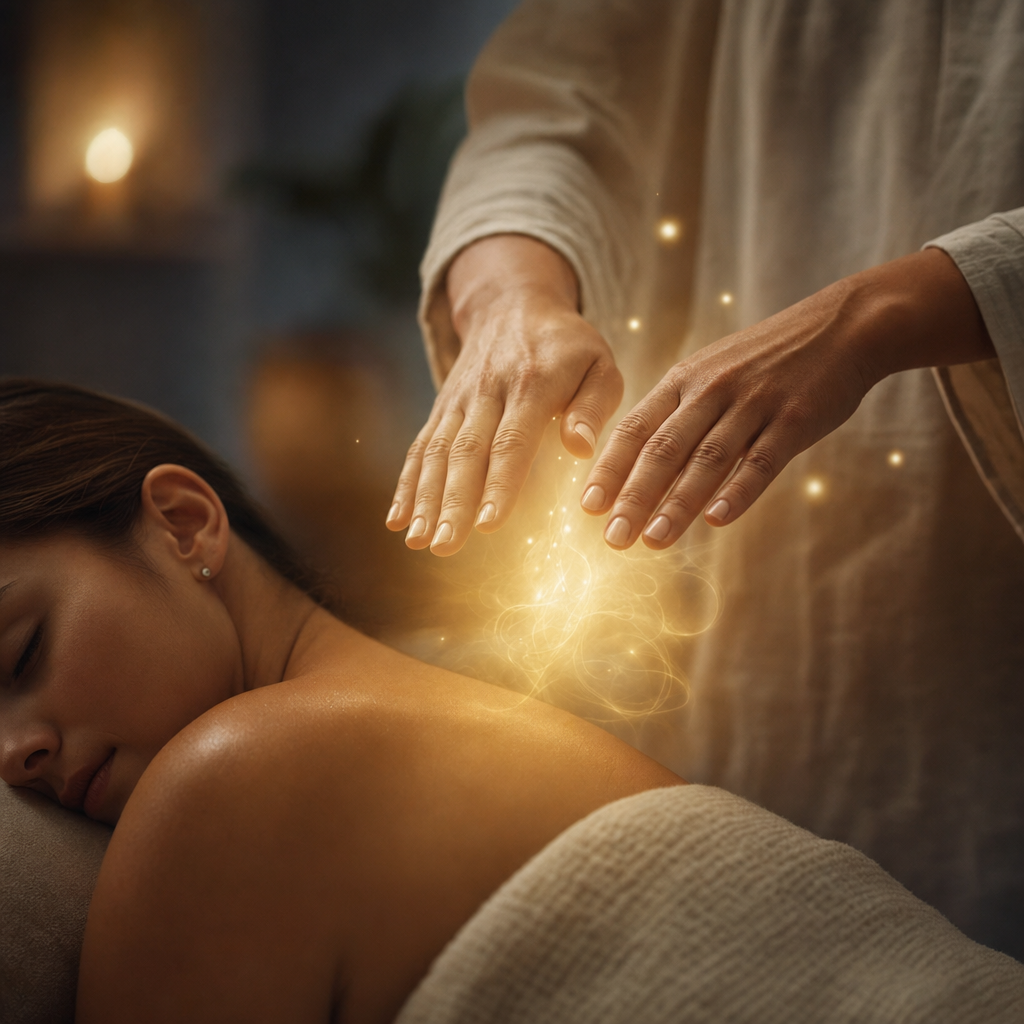
Reiki music has an unusual requirement: it has to be present for a full treatment without ever becoming the thing anyone is paying attention to. These tracks are drawn from the Healing Miracle Frequencies catalogue and chosen on that basis — slow, sustained, no vocals, no percussion, no dynamic surprises, and long enough to cover a session without a gap. Most sit at 396 Hz, 417 Hz or 528 Hz, the Solfeggio tones most commonly used in energy work. Everything streams free with no advertising, which matters when a break in the sound is a break in the session.
How Reiki Healing Music — Sound for Energy Work helps
Continuous, not sequenced
A reiki treatment does not have movements, so the music should not either. These pieces sustain rather than develop — no builds, no resolutions, nothing that suggests a session should be ending when it is not.
The Solfeggio tones used in energy work
396 Hz, 417 Hz and 528 Hz are the tones most commonly associated with releasing, change and transformation respectively. The tradition is older than the research, but 528 Hz does have a controlled study behind its effect on cortisol and oxytocin.
It lowers arousal on its own
Independently of the energy work, music listening reliably lowers cortisol, heart rate and blood pressure across studies, and music therapy significantly reduces anxiety. A client who arrives tense settles faster with sound than without it.
Nothing interrupts
No advertisement, no shuffle jumping to an unrelated track, no sign-up wall. The set runs to the end of the treatment and stops being your problem.
The science
Reiki itself is an energy practice rather than a clinical intervention, and the evidence base for the music is separate from any claim about the modality. What is documented is the sound: a systematic review and meta-analysis found music listening significantly lowers cortisol, heart rate and blood pressure, and a companion meta-analysis found music therapy significantly reduces anxiety. Where a session involves physical discomfort, a systematic review and meta-analysis of music therapy in pain management found significant reductions in both reported pain and opioid use. For the specific tones, a controlled comparison found 528 Hz music reduced cortisol and increased oxytocin relative to standard 440 Hz tuning.
- Music listening lowers cortisol, heart rate and blood pressure (systematic review & meta-analysis) — Health Psychology Review
- Music therapy significantly reduces anxiety (systematic review & meta-analysis) — Health Psychology Review, 2020
- Music therapy significantly reduces pain and opioid use (systematic review & meta-analysis) — PMC8555445
- 528 Hz music significantly reduced cortisol and increased oxytocin vs 440 Hz — Akimoto et al., Health, 2018
How to use Reiki Healing Music — Sound for Energy Work
- Start the set before the client is on the table, so the room is already settled.
- Keep the volume low enough for normal-voice conversation without either person raising their voice.
- Let it run unattended — do not touch the player mid-treatment.
- Keep the playback device on airplane mode so nothing can interrupt.
Playing this in your business?
Commercial spaces need a license — and because we own both the recordings and the compositions, one simple annual license from us covers everything for our catalog. From $149/year.
License for your business →Frequently asked questions
What music is best for a reiki session?
Continuous, slow, non-melodic sound with no vocals and no dynamic changes — the client should never notice a track start or end. Solfeggio healing frequencies are among the most widely used, alongside ambient drones and simple piano.
How long should reiki music play?
Long enough to cover the whole treatment with no gap, typically 45–60 minutes or more. These tracks are long-form and the collection runs continuously, so a session is covered without touching the player.
Which frequency is used for reiki?
There is no single prescribed tone. In practice 396 Hz, 417 Hz and 528 Hz are the most commonly used — associated with releasing, change and transformation respectively.
Can I use this music for self-reiki?
Yes. Start the set, work through your hand positions and let the sound mark the time so you are not checking a clock.
Can I play this in my practice or clinic?
This page is free for personal listening. Commercial playback in a business has its own public-performance licensing rules that vary by country — check your local requirements, or contact us and we can point you to the right licence.
Is there any research behind healing music?
On the music, yes: meta-analyses show music listening lowers cortisol, heart rate and blood pressure, and reduces anxiety and pain. On reiki as an energy modality, that is a separate question and not one the music research answers.