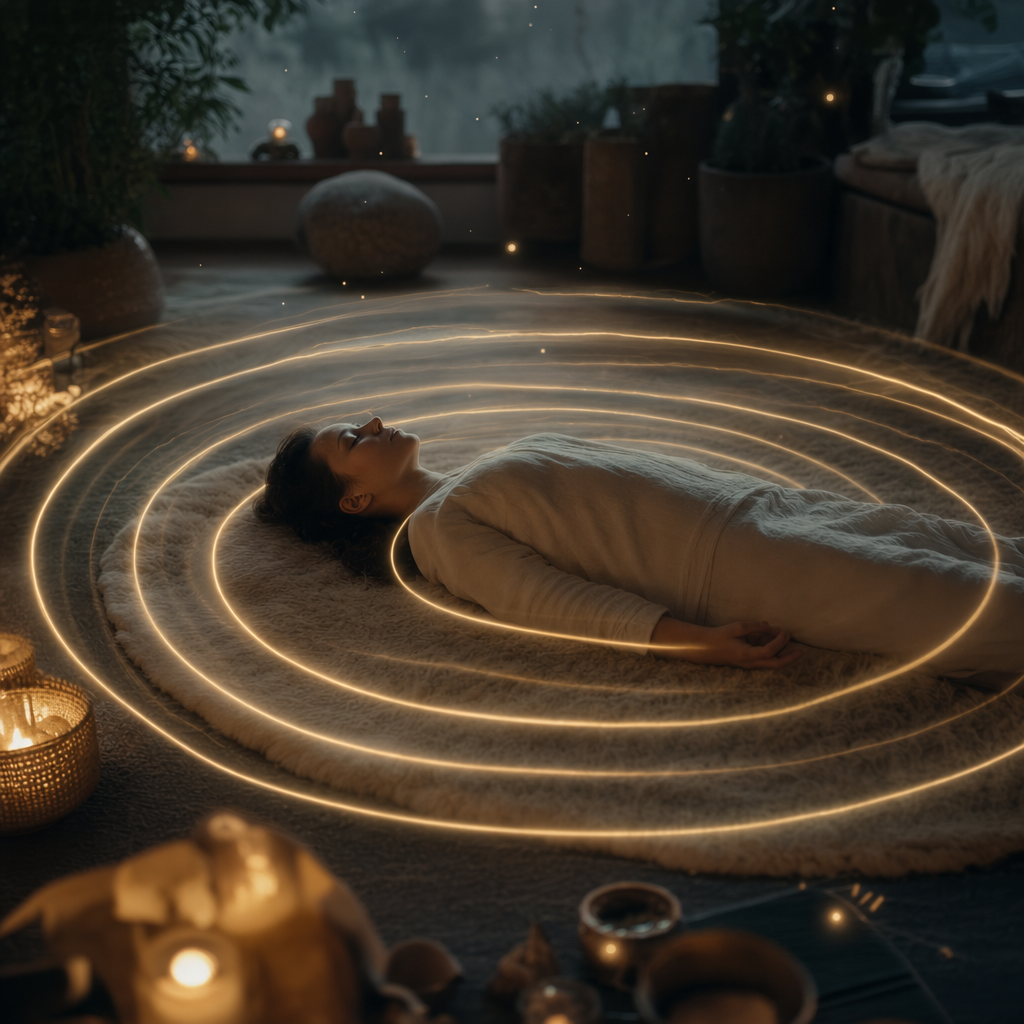
A sound bath is a listening posture more than a genre: you lie down, you do nothing else, and you let sustained sound wash over you for an extended stretch. This collection is built for that — long, slow, enveloping frequency music at 432 Hz, 528 Hz and 963 Hz, with no beat, no vocals and no structure to follow. One point of honesty about what this is: these are frequency-based sessions, not recordings of Tibetan bowls or gongs. If bowls are specifically what you are after, this is not that. If what you want is to lie down and be immersed, it is exactly that, and it streams free with nothing interrupting it.
How Sound Bath Music — Immersive Healing Frequencies helps
Built to be lain down to
A sound bath is not background listening. These pieces are long, slow and enveloping, with nothing that resolves or restarts — the structure is deliberately absent so there is nothing to anticipate and nothing to mark time by.
It measurably changes state
A systematic review and meta-analysis found music listening significantly lowers cortisol, heart rate and blood pressure, and a companion meta-analysis found music therapy significantly reduces anxiety. The heavy, settled feeling at the end of a session is a real physiological shift, not just atmosphere.
Frequency-based, not bowls
Being straightforward: this is sustained frequency music, not percussion instruments. 528 Hz lowered cortisol and raised oxytocin against standard tuning in a controlled comparison, and 963 Hz is the Solfeggio crown tone — that is the material these sessions are made from.
Nothing interrupts a session
The point of a sound bath is uninterrupted immersion for 30–60 minutes. An advertisement halfway through ends it. Nothing is inserted here, which is the practical reason to use this rather than a free streaming tier.
The science
The evidence concerns what sustained listening does to the body rather than any claim about the format. A systematic review and meta-analysis in Health Psychology Review found music listening significantly lowers cortisol, heart rate and blood pressure; a companion meta-analysis found music therapy significantly reduces anxiety; and a systematic review and meta-analysis of music therapy in pain management found significant reductions in reported pain and opioid use. For the specific tones used here, a controlled comparison by Akimoto and colleagues found 528 Hz music reduced salivary cortisol and increased oxytocin relative to 440 Hz, and a randomized clinical trial found 432 Hz tuning lowered heart rate, anxiety and cortisol against standard pitch. What no study shows is a frequency curing a condition, and this page makes no such claim.
- Music listening lowers cortisol, heart rate and blood pressure (systematic review & meta-analysis) — Health Psychology Review
- Music therapy significantly reduces anxiety (systematic review & meta-analysis) — Health Psychology Review, 2020
- Music therapy significantly reduces pain and opioid use (systematic review & meta-analysis) — PMC8555445
- 528 Hz music significantly reduced cortisol and increased oxytocin vs 440 Hz — Akimoto et al., Health, 2018
How to use Sound Bath Music — Immersive Healing Frequencies
- Lie down properly — on your back, warm, with a blanket and something under your knees.
- Give it 30–60 minutes with no phone and nothing else running.
- Keep the volume low; immersion comes from duration and stillness, not loudness.
- Get up slowly afterwards, and give yourself a few minutes before doing anything demanding.
Frequently asked questions
What is a sound bath?
A session in which you lie down and are immersed in sustained sound for an extended period, typically 30–60 minutes, doing nothing else. Traditionally it is led live with bowls and gongs; recorded frequency sessions like these are the at-home equivalent.
Does this use singing bowls?
No — and it is worth being clear rather than letting the name imply it. These are sustained healing-frequency compositions at 432 Hz, 528 Hz and 963 Hz. If you specifically want bowls and gongs, this collection is not that.
How long should a sound bath be?
Thirty to sixty minutes is typical. The effect comes from duration and stillness, so a short session is a different experience rather than a condensed one.
What does a sound bath actually do?
It reliably changes physiological state: music listening lowers cortisol, heart rate and blood pressure across studies, and reduces anxiety and reported pain. That is what the deeply settled feeling afterwards consists of. It is not a treatment for any medical condition.
Should I use headphones or speakers?
Speakers if you have them — the sense of being surrounded is most of the experience, and headphones make the sound feel located inside your head instead of around you.
Can I fall asleep during it?
Yes, and many people do. If you would rather stay awake, sit propped up slightly rather than lying completely flat.