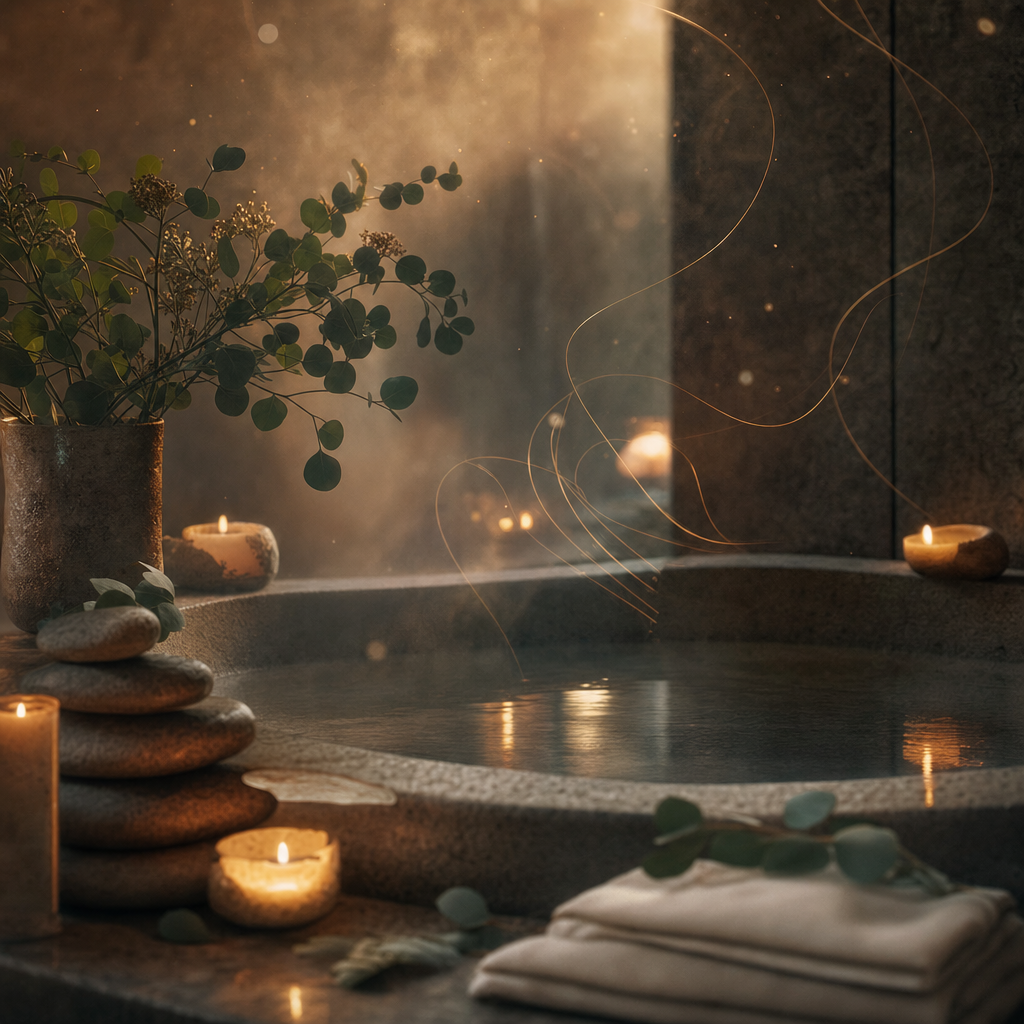
Spa music has one job: to hold a room steady while something else happens in it. This collection is drawn from the Healing Miracle Frequencies catalogue — slow, wide, low-contrast pieces with no sudden dynamics, no vocals and no melodic hooks that pull attention. Every piece is tuned to 432 Hz or 417 Hz, the pitches associated in clinical work with lower heart rate and cortisol. Every track streams free in your browser with no sign-up and, critically for a treatment room, no advertising breaks.
How Spa Music — Calm Treatment-Room Sound helps
Built to be ignored
Good spa music is not memorable. These pieces stay in a narrow dynamic range with slow harmonic movement and no percussive transients — nothing that makes a client open their eyes. Attention slides off the music and settles on the body instead.
It measurably lowers arousal
A systematic review and meta-analysis found that listening to music reliably lowers cortisol, heart rate and blood pressure. That physiological drop is the actual product a spa is selling; the soundtrack is doing part of the work, not just decorating it.
Calmer tuning
Most tracks here sit at 432 Hz or 417 Hz rather than standard 440 Hz concert pitch. In a randomized clinical trial, 432 Hz music produced lower heart rate, anxiety and salivary cortisol than the same music at 440 Hz — a small, free edge for a room built around relaxation.
No ads, ever
An advertisement in the middle of a massage undoes the session. This page streams the full-length masters directly, free, with nothing inserted — which is why therapists use it instead of a free streaming tier.
The science
The relaxation response spa treatments aim for is measurable, and music contributes to it independently of touch. A systematic review and meta-analysis in Health Psychology Review found music listening significantly reduces cortisol, heart rate and blood pressure across studies, and a companion meta-analysis found music therapy significantly reduces anxiety. Where treatment involves discomfort, music also has an analgesic effect: a systematic review and meta-analysis of music therapy in pain management found significant reductions in both reported pain and opioid requirements. Tuning appears to add a further margin — a randomized clinical trial comparing 432 Hz with standard 440 Hz tuning recorded lower heart rate, anxiety and salivary cortisol on the 432 Hz condition.
- Music listening lowers cortisol, heart rate and blood pressure (systematic review & meta-analysis) — Health Psychology Review
- Music therapy significantly reduces anxiety (systematic review & meta-analysis) — Health Psychology Review, 2020
- Music therapy significantly reduces pain and opioid use (systematic review & meta-analysis) — PMC8555445
- 432 Hz music lowered anxiety, heart rate and salivary cortisol (randomized clinical trial) — PMC7213780
How to use Spa Music — Calm Treatment-Room Sound
- Start the collection before the client enters — the room should already be settled.
- Set the volume just under conversation level, so speech never has to compete with it.
- Let it run in order and unattended; the tracks are long and sequenced to avoid jolts.
- Use room speakers rather than a phone, and keep the source on airplane mode so nothing interrupts.
Playing this in your business?
Commercial spaces need a license — and because we own both the recordings and the compositions, one simple annual license from us covers everything for our catalog. From $149/year.
License for your business →Frequently asked questions
What music do spas actually play?
Slow, quiet, non-melodic ambient music with no vocals and no sudden dynamic changes — the point is that a client never notices it. Healing-frequency music of the kind on this page is one of the most widely used categories in treatment rooms, alongside solo piano and nature sound.
Is this spa music free to stream?
Yes. Every track streams free in your browser with no app and no sign-up, and there are no advertisements inserted between tracks — which is the usual reason a free streaming tier is unusable during a session.
Can I play this in my salon, spa or clinic?
This page is free for personal listening. For commercial playback in a business, public-performance licensing rules vary by country and by how the music is delivered, so check your local requirements — contact us and we can point you to the right licence for your setup.
How long is each track?
The tracks are long-form and loop cleanly, so a single collection covers a full treatment without you having to touch the player. Press play and let the whole set run.
What volume should spa music be?
Just below conversational level — quiet enough that a client and therapist can speak normally without either raising their voice. If the music is noticeable enough to have an opinion about, it is too loud.
Why 432 Hz rather than normal tuning?
A randomized clinical trial found the same music tuned to 432 Hz produced lower heart rate, anxiety and salivary cortisol than at standard 440 Hz. The difference is subtle, but in a room whose entire purpose is lowering arousal, it is a free margin worth taking.