

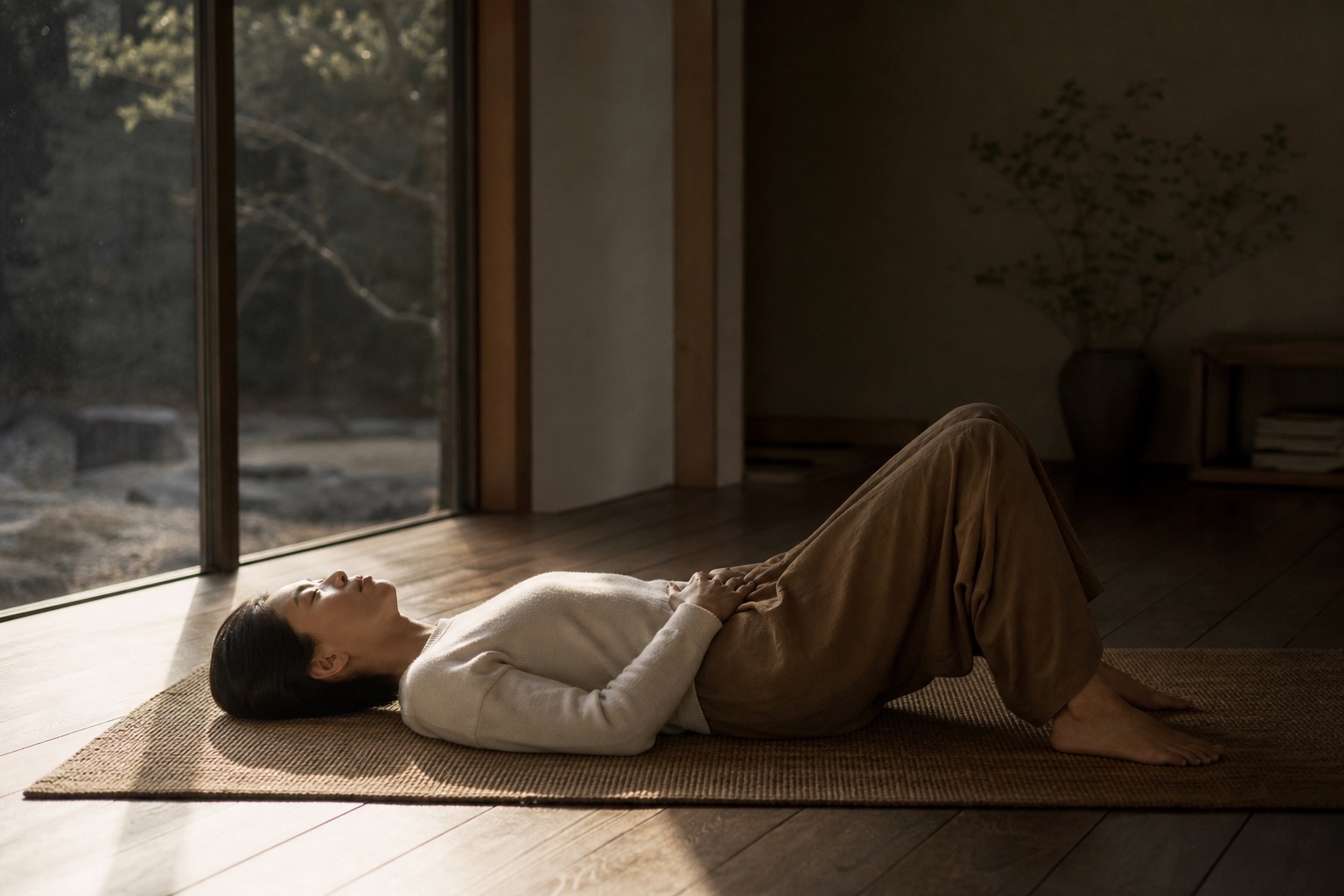
- Lying down is a legitimate meditation posture — several classical practices (yoga nidra, body scan, savasana) are designed for it
- The trade-off is arousal: horizontal posture tells the nervous system 'sleep', which is why sitting traditions exist — not because lying down is cheating
- Stay awake by lifting one forearm, bending the knees, keeping eyes slightly open, or practising earlier in the day
- For chronic pain, fatigue, pregnancy or anxiety that spikes when sitting still, lying down is often the MORE sustainable posture
- If the goal is falling asleep, stop fighting it: a lying-down body-scan with slow music is one of the best natural sleep inductions there is
The Short Answer
Yes. You can meditate lying down, it counts, and entire traditions are built on it — yoga nidra is practised flat on the back, the body scan at the heart of clinical mindfulness programmes is usually taught lying down, and savasana has closed every yoga class for a century. The idea that meditation only counts on a cushion with a straight spine is posture folklore, not doctrine.
What the folklore gets half-right is this: posture sets arousal. Sitting upright holds the nervous system in a lightly alert state; lying flat tells it the day is over. So the honest framing isn't "is lying down allowed?" — it's "lying down makes meditation easier on the body and harder on wakefulness." Everything below is about managing that one trade.
When Lying Down Is the Better Choice
Pain and injury. If sitting means twenty minutes of negotiating with your lower back, the posture is consuming the attention the practice needs. Flat on the floor with knees bent, or with calves resting on a chair, removes the negotiation entirely.
Fatigue, illness and chronic conditions. A practice you can hold on a bad day is worth more than a perfect one you skip. Lying down keeps the practice alive through flares, exhaustion and recovery.
Pregnancy. Side-lying with pillow support is a completely valid meditation posture — left side is generally the comfortable choice in later months.
Anxiety that spikes with stillness. Some nervous systems read upright stillness as exposure. The ground is pressure and contact along the whole back of the body — for many anxious meditators it feels safer, and safety is where practice becomes possible. (More on that route in our nervous-system regulation guide.)
Bedtime — on purpose. If your actual goal is sleep, lying down and "failing" into unconsciousness is not failure. It's the technique. More below.
How to Meditate Lying Down Without Falling Asleep
The classical tricks all work by adding a small amount of muscular engagement or sensory brightness — just enough alertness to balance the horizontal signal:
1. The forearm prop. The traditional yoga nidra hack: bend one elbow so the forearm points at the ceiling. If you drift toward sleep, the arm falls and wakes you. Crude, ancient, effective.
2. Bend the knees. Feet flat on the floor, knees up. The slight balance demand keeps a thread of muscle tone active, and it flattens the lower back comfortably at the same time.
3. Eyes soft, not shut. Lids lowered but a sliver of light in. Full darkness plus horizontal is the strongest sleep instruction your body knows; a little light interrupts it.
4. Surface matters. Mat or carpet on the floor, not the bed. Your bed is a conditioned sleep trigger — the association is doing more work than you think, in both directions.
5. Time of day. Lying-down practice at 7am survives; at 10pm it becomes a nap. If evening is your only slot, accept the drift or sit instead.
6. Give the mind a moving object. Wakefulness follows engagement. A travelling body scan, counted breaths, or quiet instrumental sound gives attention a path to walk. Steady music tuned low and slow — like the 432 Hz pieces in the playlist below — occupies the auditory channel without demanding anything, which keeps the session anchored the way a guide's voice would (our inner-peace frequency guide covers which tones people use for this).
A 10-Minute Lying-Down Practice
Lie on the floor, knees bent or calves on a chair. One hand on the belly. Three slow breaths, exhale longer than inhale. Then scan: toes → feet → calves → knees → thighs — pausing two breaths at each station, noticing whatever is there without editing it. Continue through hips, belly, chest, hands, arms, shoulders, jaw, eyes, scalp. When the mind wanders (it will, that's the rep), return to the last body part you remember. Finish with three breaths feeling the whole body at once, then roll to one side before getting up.
Ten minutes, no app, no posture pain. Do it daily for two weeks before judging it.
If You Fall Asleep Anyway
Two cases. Daytime practice: falling asleep repeatedly is information, not failure — you're under-slept, and the body is taking what it needs. Fix the nights first (our sleep-schedule guide is the protocol). Night-time practice: congratulations, that's the feature. A body scan with slow low music is among the most reliable natural sleep inductions there is — the playlist below runs long enough to carry you all the way through.
Frequently Asked Questions
Is meditating lying down as effective as sitting?
For attention-training, sitting has a mild edge because the posture holds arousal up. For relaxation, body awareness, pain management and sleep preparation, lying down is equally effective and sometimes better — and a lying-down practice you actually do beats a sitting practice you avoid.
What position should I lie in to meditate?
On your back on a firm surface, arms a little away from the body, palms up, with knees bent or supported if the lower back complains. Side-lying with a pillow between the knees is the standard alternative for pregnancy or back pain.
Why do I only fall asleep when I meditate lying down?
Horizontal posture plus stillness plus closed eyes is, to your nervous system, the complete instruction set for sleep. Add any one alertness signal — bent knees, a propped forearm, slightly open eyes, morning scheduling — and the balance shifts back toward awake.
From our studio · Vibrate
Guided Meditation Library — Voice-guided sessions over therapeutic sound — free to begin.