

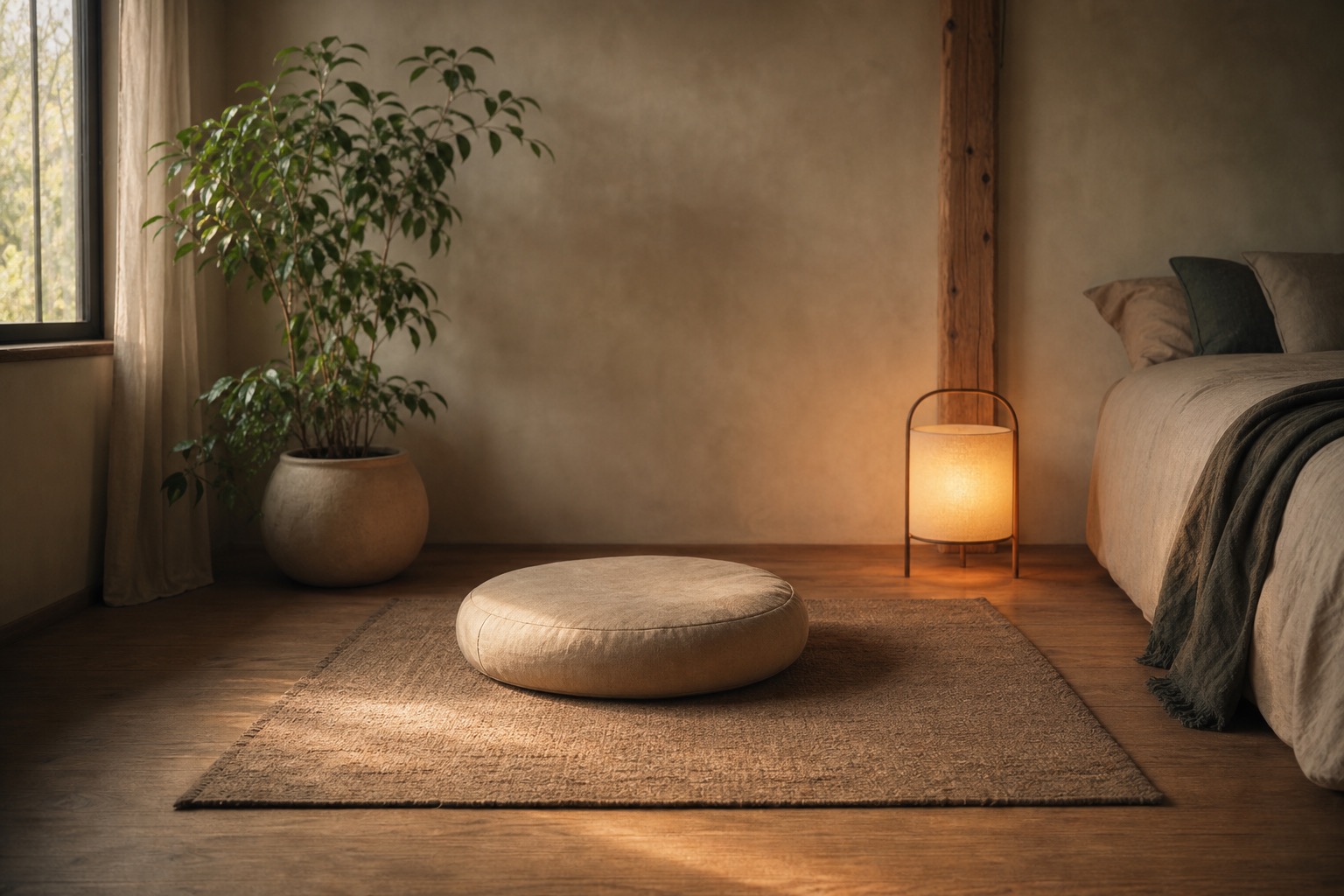
- A meditation bedroom is one dedicated corner, not a renovation — the dedication is what builds the habit
- Zone it: a cushion or chair that is only for practice creates a conditioned cue, exactly like the bed-sleep association
- Light low and warm, never overhead; morning practice by a window doubles as circadian light
- One sensory anchor per sense is enough: a candle or plant (sight), a consistent scent, one steady sound
- Sound is the fastest room-changer: the same quiet track at every session turns pressing play into the start of practice
Why a Corner Beats a Room
The Pinterest fantasy is a spare room with floor-to-ceiling windows and a Buddha statue. The functional reality is better news: what builds a meditation habit isn't square footage — it's a spot your brain has learned to associate with practice. One corner of a bedroom does this perfectly, because conditioning doesn't care about size; it cares about consistency. The same principle that makes your bed a sleep trigger makes a dedicated cushion a practice trigger. Sit in the same place, at roughly the same time, with the same light and sound, and within two or three weeks arriving at the spot starts the settling by itself.
The Five Decisions
1. The zone
Pick the corner you can see from the door — visible spaces get used; hidden ones get forgotten. Claim roughly a metre square. If floor space is genuinely tight, the zone can be a chair — the only rule is that this seat, arranged this way, means practice and isn't buried under laundry by Thursday. A small mat or folded blanket defines the edge; the edge is psychological, not decorative.
2. The seat
Comfort outranks aesthetics, because discomfort is the number-one silent habit-killer. Options in order of back-friendliness: a firm cushion (zafu) that lifts the hips above the knees; a folded blanket stack doing the same job for free; a meditation bench if your knees complain; an ordinary chair — feet flat, spine self-supported — which is a completely legitimate meditation seat despite what Instagram implies. Keep a spare blanket for the knees or shoulders; cold is another silent killer.
3. The light
Overhead light is the enemy of every calm room. You want low, warm and directional: a small lamp at floor or table height, a candle (real or battery), or — the best free resource — a window. If you practise in the morning, face the window with eyes soft: ten minutes of natural morning light is also the strongest circadian anchor there is, so the same session that trains attention also sets your sleep clock (why that matters is in our sleep-schedule guide). Evening practice: lamp or candle only, and dim the rest of the room so the zone glows and everything else recedes.
4. The senses — one anchor each
Minimalism wins because every extra object is a place for attention to snag. One visual anchor: a plant, a stone, a candle, a single image — not all four. One scent, used only here: a particular incense, a essential-oil roller, a dried-lavender sachet; scent is the most conditioned of the senses, and a practice-only scent becomes a remarkably strong cue. Declutter the sight-line: whatever the open-eyed gaze rests on should be still and simple — a wall beats a bookshelf; anything with screens, cables or unfinished tasks in view is quietly spending your attention.

5. The sound layer
This is the decision most room-design guides skip, and it's the fastest way to change what a room feels like — because sound reaches the nervous system faster than any cushion. The move: one consistent, quiet, wordless track or soundscape used at every session. Same track, every time. Within weeks, pressing play becomes the starting gun — the auditory equivalent of the cushion. Slow instrumental music tuned to 432 Hz works beautifully for this (it's what the playlist below is composed for), as do rain and soft noise beds; the qualities that matter are steadiness, no lyrics, and no surprises. Play it from a small speaker in the zone, not from your phone in your hand — the phone stays outside the metre square, always. Our meditation frequencies collection streams free in the browser precisely so the phone can stay out of it.
Three Layouts That Work
The window corner (best all-round): cushion facing the window at 45°, small plant on the sill, speaker on the floor. Morning light does the light design for you.
The bed-foot zone (small rooms): a rolled mat stored under the bed, unrolled at the foot each session on a rug that lives there. The unrolling itself becomes part of the ritual — thirty seconds of transition the mind learns to use.
The chair sanctuary (knees, pain, pregnancy, age): a comfortable upright chair angled away from the desk and toward the calmest wall, lamp beside it, blanket over the arm. Nothing about the floor is sacred.
What Not to Put in It
No phone (outside the zone, on silent, running nothing except — if it must — the audio, screen down). No mirror in the sight-line; self-observation is the opposite of the practice. No task objects: laundry, laptops, paperwork are attention debts, and the zone works because it contains none. And no perfection: a corner that's 80% right and used daily beats a shrine that took three weekends and gets visited twice.
Frequently Asked Questions
How do I make a meditation corner in a small bedroom?
One metre square, visible from the door: a cushion or chair, one lamp or candle, one plant or stone, a small speaker. Store a rollable mat under the bed if the floor doubles for other uses. Dedication and consistency do the work, not space.
What colors are best for a meditation space?
Low-contrast, warm and muted — soft whites, warm greys, earth tones, muted greens. The principle beats any specific palette: nothing saturated or high-contrast in the sight-line, because visual loudness is attentional loudness.
Should I play music while meditating in my bedroom?
If it helps you settle, yes — the practice-relevant rules are wordless, steady, quiet, and consistent (the same audio each session, so it becomes a cue). Slow 432 Hz instrumental pieces and gentle rain are the two most-used options; both are in our free player.