
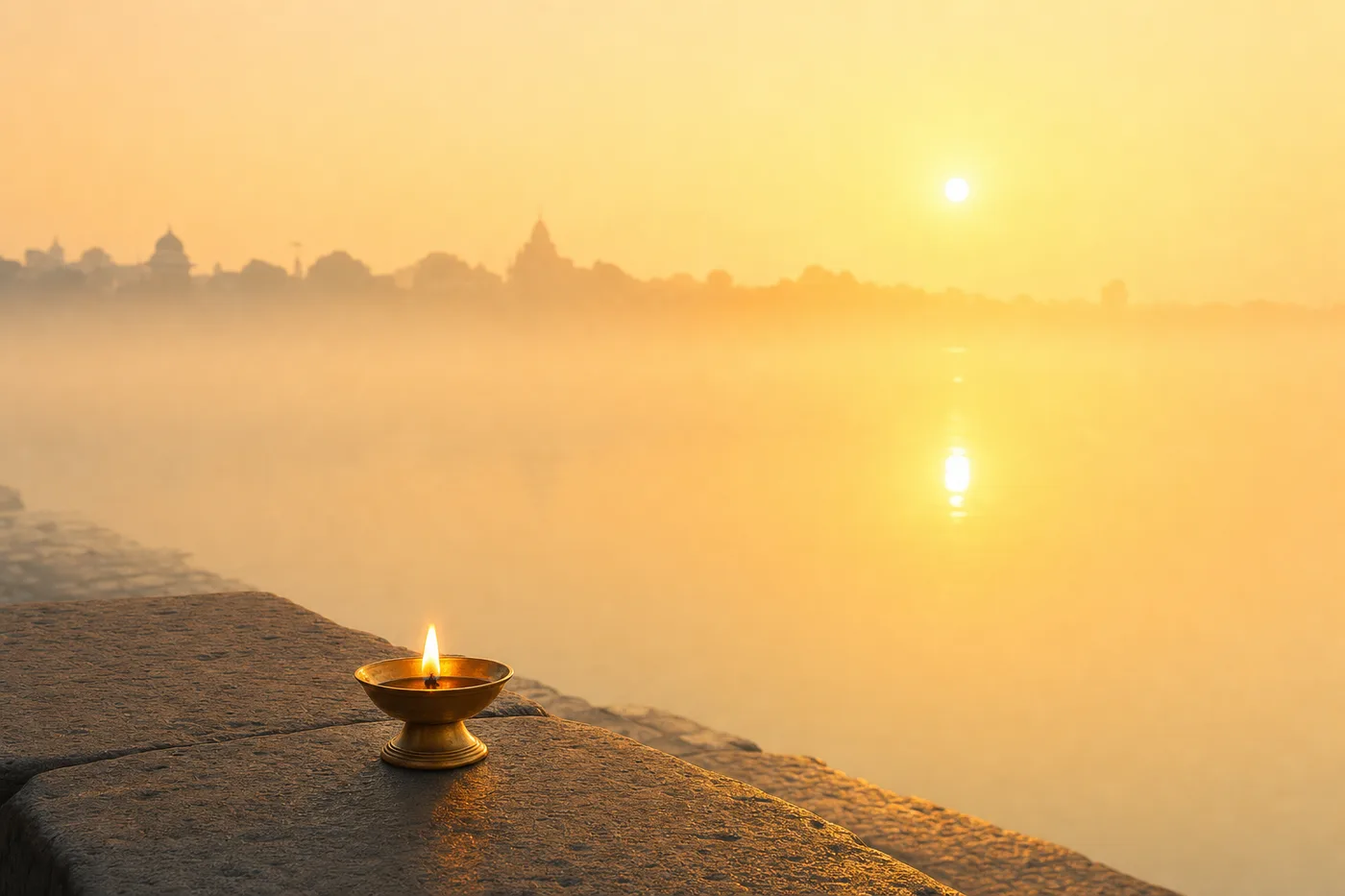
Gayatri Mantra
The Gayatri is the most revered verse of the Rigveda — called the “mother of the Vedas,” chanted at dawn for some three thousand years without interruption.
It is not a request for things. It is a single, precise prayer: that the same light which illuminates the world would illuminate the mind — that our thinking itself be lit from the source.
Listen & chant along
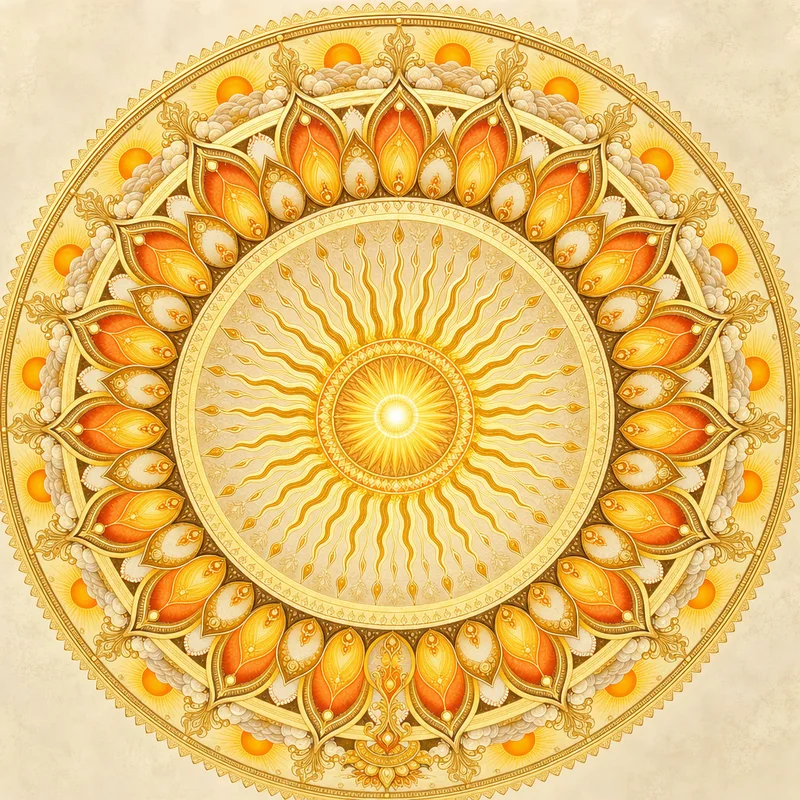
Word by word
The deeper meaning
Every phrase of the Gayatri narrows the aperture: from the three worlds, to the source of light, to its radiance, to meditation on it — and finally to the one thing asked for: that our thoughts be guided by it. In an age of scattered attention, it is difficult to imagine a more relevant prayer.
Its meter — the gāyatrī chandas of twenty-four syllables — gives the mantra its name and its rhythm: three lines of eight, a natural triple breath. Traditionally it is chanted at the three junctions of the day (dawn, noon, dusk), with dawn considered the most potent.
Benefits of chanting
- The classic mantra for mental clarity — its single request is an illuminated mind
- A grounding morning ritual: chanted at sunrise it marks the day’s beginning like a bell
- The 24-syllable, three-line structure naturally paces long, even breaths
- Traditionally associated with study, insight and discernment — the student’s mantra
- Chanting at dawn, noon and dusk (sandhya) builds a steady daily rhythm of pause
How to chant it
- Best at dawn, facing the morning light — but any quiet moment works.
- Play the recording once through, following the three lines of eight syllables.
- Chant along, one line per breath: OM BHUR BHUVAH SVAHA — TAT SAVITUR VARENYAM — BHARGO DEVASYA DHIMAHI — DHIYO YO NAH PRACHODAYAT.
- Traditional practice is 10, 28 or 108 repetitions; even three unhurried rounds clears the morning mind.
- Sit for a moment after — the request has been made; let it settle.
Frequently asked questions
What does the Gayatri Mantra mean?
In essence: “We meditate on the radiant light of the divine source — may it illuminate our thoughts.” It invokes Savitr, the animating sun, across the three worlds, and asks for one thing only: an enlightened mind.
When should the Gayatri Mantra be chanted?
Traditionally at the three sandhyas — dawn, noon and dusk — with sunrise held as the most auspicious. Practically, it makes a beautiful morning practice before the day’s noise begins.
Why is it called the Gayatri?
After its Vedic meter, the gāyatrī chandas: twenty-four syllables in three lines of eight. The meter’s name became the mantra’s — and the goddess Gayatri is its personification.
Can anyone chant the Gayatri Mantra?
Historically its formal initiation was restricted, but today it is chanted worldwide and most teachers hold that anyone may practice it with sincerity and respect. Our recording is offered in that open spirit.
Chant with our healing music
Mantra and frequency belong together — a soft 432 Hz or 528 Hz bed underneath gives your chanting something to rest on, and carries the stillness on long after the last repetition. Our meditation music is free on every platform.
Many practitioners chant over a soft carrier tone. Try our free tone generator at 136.1 Hz (the “OM frequency”), or explore all sound tools.