Benefits of AI in Sound Healing Therapy
- 7 hours ago
- 8 min read
AI is transforming sound healing therapy by addressing its key challenges: lack of personalization, limited accessibility, and difficulty in measuring results. By analyzing real-time physiological data like EEG and heart rate variability (HRV), AI creates tailored soundscapes that adapt to individual needs. This approach improves relaxation, sleep, and stress management while making therapy accessible through mobile apps and wearable devices.
Key Takeaways:
Personalized Therapy: AI uses biofeedback to adjust sound in real-time, ensuring sessions match your unique state.
Improved Accessibility: Mobile and wearable tools bring sound healing to more people without requiring expensive equipment or professionals.
Measurable Results: AI tracks outcomes with data, replacing subjective feedback with clear metrics like HRV and brainwave activity.
AI-powered sound therapy tools are reshaping wellness routines, offering practical benefits for stress relief, better sleep, and even pain management - all through personalized, data-driven soundscapes.
Beating Insomnia, Anxiety, and Depression with AI Sound Frequency Therapy
sbb-itb-894b1e4
Key Problems with Standard Sound Healing
One-Size-Fits-All Approach
Traditional sound healing often sticks to a generic formula, using the same solfeggio frequencies and tracks for everyone. This ignores the fact that each person has a unique biological and psychological profile. According to Frontiers in Digital Health, "effectiveness is inconsistent among individuals due to inherent biological and psychological variances". For example, while the 40 Hz gamma frequency is known to support memory and attention, it only works well when it matches a person’s natural brain rhythms. Unfortunately, most standard sessions don’t account for this level of individualization.
Limited Access for Many Users
Even when sound healing proves effective, accessibility remains a hurdle for many people in the U.S. Successful sessions often require trained professionals, specialized tools, and controlled environments. As noted by Frontiers in Digital Health, "delivering these therapies often requires skilled practitioners, advanced equipment, and controlled environments, which limits their reach to underserved or remote populations". Beyond the costs and logistics, factors like scheduling and travel make it tough for users to stick to the daily routines that research recommends. Studies show that 15 to 30 minutes of daily listening are needed to improve sleep quality or reduce stress symptoms meaningfully. On top of these challenges, traditional methods lack a way to objectively verify treatment effectiveness.
No Clear Way to Measure Results
Standard sound healing relies heavily on subjective feedback, which makes it difficult to track real progress. Frontiers in Digital Health highlights that "many studies have relied on small samples or pilot designs that lack control groups and robust biomarkers". Without tools like EEG or heart rate variability (HRV) monitoring, practitioners can’t confirm whether a session has genuinely altered a listener’s neurological state. The same journal also notes, "while EEG measures can confirm genuine shifts in alpha, theta, or gamma power, such data are rarely incorporated, leaving causal links between brainwave entrainment and cognitive-emotional benefits largely speculative".
The table below compares how traditional sound healing measures up against AI-enhanced methods when it comes to tracking outcomes:
Measurement Type | Standard Sound Healing | AI-Enhanced Sound Healing |
Primary Data Source | Subjective self-reports | Real-time biofeedback (EEG, HRV, heart rate) |
Protocol Consistency | Low; lacks universal frameworks | High; driven by standardized algorithms |
Adaptability | Static; fixed loops | Dynamic; adjusts to mood and environment |
Efficacy Tracking | Anecdotal and speculative | Data-driven and quantifiable |
Without reliable data, practitioners are left guessing about what works, unable to refine techniques or build on past results. This lack of measurable outcomes makes it hard to establish sound healing as a dependable, evidence-based therapy.
How AI Changes Sound Healing Therapy
Personalized Soundscapes Through Data Analysis
Traditional sound healing often relies on pre-recorded tracks, offering the same experience to everyone. AI flips this approach by creating soundscapes tailored to each person. It uses data from wearable sensors, EEG readings, heart rate variability (HRV) monitors, and self-report apps to fine-tune therapy in real time. By analyzing patterns like stress levels, mood changes, or attention lapses, AI adjusts elements like musical rhythm, complexity, and frequencies to match what you need in the moment. It even considers details like the time of day, light exposure, and physical activity to craft what researchers call "functional music" - sound designed to support specific goals like better focus or deeper sleep.
This approach ties directly to brainwave frequencies:
Brainwave State | Frequency Range | Associated Mental State |
Delta | 0.5–3 Hz | Deep rest and healing |
Theta | 4–7 Hz | Emotional processing and meditation |
Alpha | 8–12 Hz | Relaxation and stress reduction |
Gamma | 30–100 Hz | Attention and cognitive clarity |
The combination of these frequencies and real-time data ensures a soundscape that evolves with your needs, fine-tuned through biofeedback.
Real-Time Sound Adjustment with Biofeedback
AI doesn’t stop at creating personalized soundscapes; it also adapts them on the fly using biofeedback. By monitoring HRV markers like RMSSD and high-frequency power (HF), the system evaluates whether your nervous system is shifting into a calm, restorative state. If not, it adjusts the music’s rhythm or frequency in real time. Some systems even use facial recognition to pick up on visible signs of stress or anxiety. For instance, the Resonance Rx system, developed in Canada, uses facial cues to help dementia patients. Clinical trials show that even short sessions can noticeably reduce stress.
Greater Access and Convenience
AI-driven sound healing makes therapy more accessible, delivering personalized sessions straight to your smartphone or wearable device. This means you can easily fit sound healing into your routine - whether you're at home, on a break, or winding down before bed - without needing special equipment or a clinical setting.
What AI Brings to Sound Healing in Daily Life
Stress Relief and Emotional Balance
AI-powered sound therapy is changing the way we manage stress. By analyzing vocal biomarkers from just a short recording, these tools can assess your stress levels and create a personalized sound session to help you shift from the high-alert "fight-or-flight" mode to the calmer "rest-and-recover" state. In a recent placebo-controlled clinical study, participants experienced a complete reduction in high-stress autonomic readings during their sessions. Even more impressive, they spent 262% more time in a relaxed state.
Better Sleep Quality
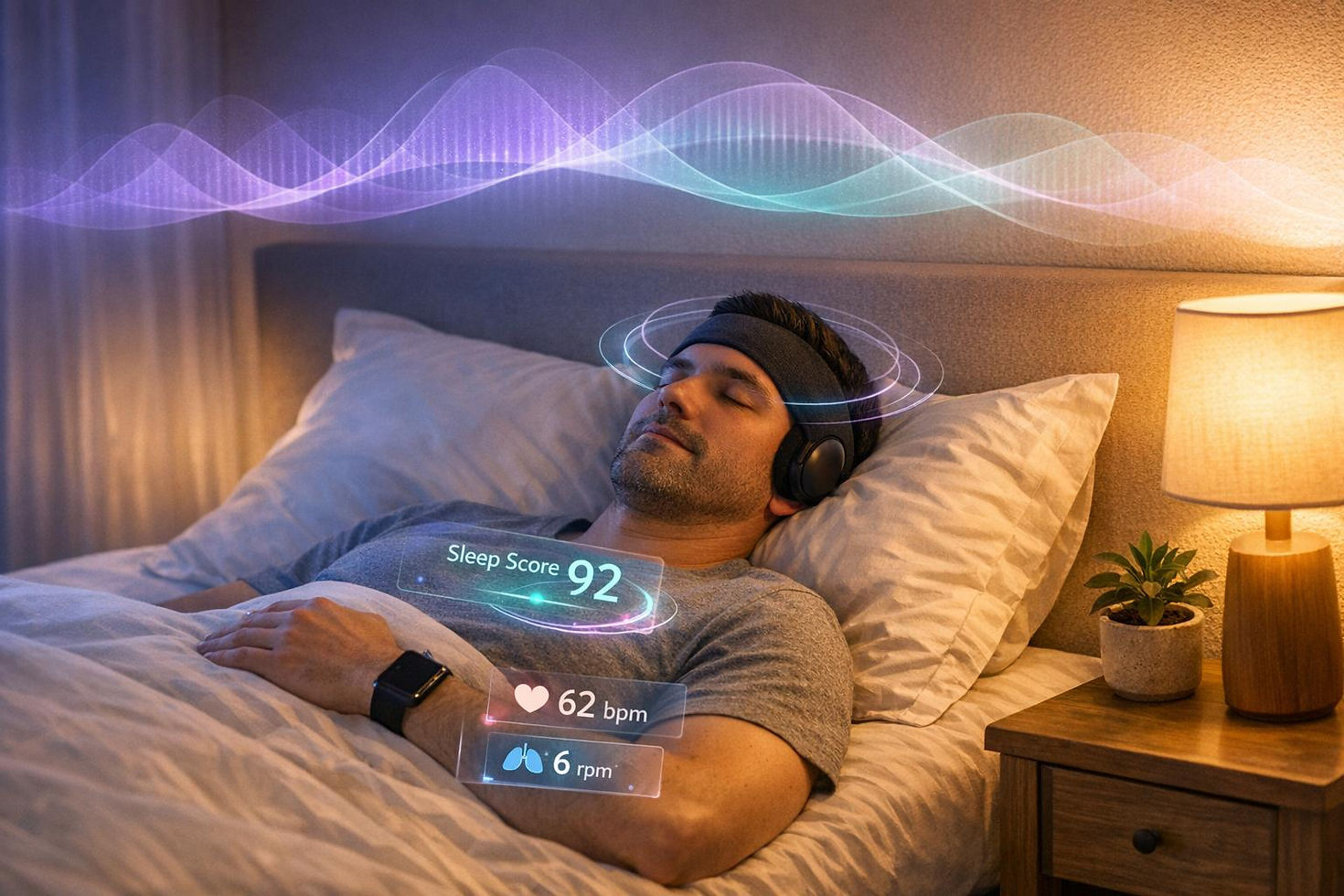
Struggling with sleep? AI sound tools are designed to help. When your nervous system is overactive, falling into deep, restorative sleep can feel impossible. These tools use advanced wearable headbands and smartphone facial scans to develop low-frequency sound profiles tailored specifically to your needs. Clinical trials, including collaborations with experts from Stanford University and Harvard Medical School, revealed that 90% of users saw major improvements in their sleep, with an average 50% drop in Insomnia Severity Index scores.
Voice-based AI sessions have also shown an average 34% boost in sleep quality over four weeks. Research highlights how specific frequencies, like binaural beats (such as 0.25 Hz), can even help you enter slow-wave sleep - the most restorative sleep phase - faster.
"The approach is unique in that it offers a customized solution for each individual, making the therapy more targeted and potentially more effective." - Dr. Robson Capasso, Professor of Sleep Medicine, Stanford University
Support for Pain Management
AI sound therapy is also making waves in pain relief. By using targeted frequencies such as 40 Hz gamma stimulation and engaging the vagus nerve, these sessions promote the release of natural endorphins. Studies on music therapy have shown a notable reduction in pain severity, with a standard mean difference (SMD) of –2.18 across various conditions. For chronic pain, the SMD was –0.51, while burn patients experienced an even greater reduction at –3.66.
One study focusing on digitally customized sound for tinnitus found that 92.5% of participants reported relief or complete elimination of symptoms after three months. Even short sessions, as brief as 20 minutes, have proven effective in managing chronic pain.
These examples show how AI is reshaping sound healing, making it a practical and impactful addition to daily wellness routines.
AI Sound Healing Tools in Practice
AI is reshaping the way sound healing integrates into daily wellness routines. By using real-time data, these tools go beyond traditional methods to create personalized audio experiences tailored to your unique needs.
Core Features of AI Sound Healing Tools
Today's AI sound healing tools offer much more than static playlists. They incorporate biometric sensing, such as analyzing vocal biomarkers like pitch, tempo, and tone from a quick 10-second voice sample. This real-time feedback allows the system to assess your current state and adjust the session dynamically. The adaptive engine fine-tunes elements like layers, rhythm, and frequency as your body responds, ensuring a session that evolves with you.
These tools also help you set specific goals. Whether you're looking to reduce stress, improve focus, or enhance sleep quality, they use targeted frequencies to match your objectives. For instance, 40 Hz gamma stimulation can enhance mental clarity, while 528 Hz Solfeggio is known for promoting emotional balance. Each session is uniquely generated, ensuring no two experiences are the same.
How People Use These Tools Day to Day
Incorporating AI sound healing into your daily routine is simple. You might start your day with a 5-minute 40 Hz gamma track to boost focus, recalibrate at midday with a quick 10-second voice analysis, and wind down in the evening with a continuous 528 Hz Solfeggio track for better sleep. All you need is a smartphone and headphones.
Research supports this approach: starting with just 5 minutes a day and working up to 60–90 minutes per week has been linked to lasting cognitive improvements. For example, an eight-week routine has shown to improve cognitive scores by 26%. This gradual, consistent use highlights how accessible and effective AI sound healing can be.
How Healing Miracle Frequencies Fits In
The quality of audio plays a crucial role in the effectiveness of AI sound healing. Healing Miracle Frequencies takes this a step further by providing expertly crafted, multi-layered soundscapes designed to complement personalized therapy sessions. Their tracks include Solfeggio frequencies like 396 Hz for releasing fear and 963 Hz for fostering deep spiritual connection, offering a range of therapeutic options.
With over 50 million streams worldwide, Healing Miracle Frequencies has become a trusted name in therapeutic audio. Their music is available on platforms like Spotify and Apple Music, and their Miracle app - recognized as a "Best 2026 Healing App" - offers a 7-day free trial. For just $33.99 per year (less than $3 a month), users gain unlimited access to the full Solfeggio collection. For those seeking extended sessions, their YouTube channel features longer tracks ideal for overnight healing or focused work sessions.
Conclusion: Where AI and Sound Healing Are Headed
AI is reshaping sound healing, turning it into a form of "digital medicine" that offers measurable benefits for conditions like chronic stress, tinnitus, and even Alzheimer's - all without relying on traditional medication.
With AI's ability to provide real-time personalization and biofeedback, the focus now shifts to seamlessly integrating these tools into everyday life. Imagine environments that adapt sound dynamically, using biofeedback to fine-tune frequencies and rhythms in real time. As Yunicrafts observed in 2026:
"The future of sound healing is likely to be a combination of technology, neuroscience, and nature, rather than one simply replacing the other."
This harmony between cutting-edge technology and natural sound design is what makes the field so exciting.
For practical use, establishing a daily routine is key. Regular sessions can lead to noticeable improvements in areas like sleep and mood. With advancements making sound healing more accessible than ever, incorporating high-quality, personalized audio - such as Healing Miracle Frequencies, available on Spotify and Apple Music - is now easier to achieve.
Whether you're tapping into AI-powered biofeedback tools or simply enjoying a nightly sound ritual, consistent practice can deliver meaningful results. The tools are here, the science is advancing, and the benefits are within reach.
FAQs
Do I need an EEG headband or wearable for AI sound healing to work?
You don’t always need an EEG headband or wearable device to experience AI sound healing. Plenty of approaches rely solely on audio features or basic web applications, like those designed for binaural beats. That said, incorporating real-time physiological monitoring, such as EEG, can take personalization to another level, potentially making the experience more effective.
How soon can I expect measurable changes in stress or sleep from AI sessions?
Measurable changes in stress levels and sleep quality often appear within 4 to 8 weeks of consistent AI session use. Research indicates noticeable decreases in stress and better sleep patterns during this time, emphasizing the positive effects of regular engagement.
Is it safe to use AI sound healing every day, and who should be cautious?
Using AI sound healing daily is considered safe for most individuals since sound frequencies are gentle and promote relaxation and stress reduction. That said, people with sensitive hearing, specific medical conditions, or those who experience discomfort during use should exercise caution. If you're uncertain, it's wise to consult a healthcare professional before making it a regular part of your routine.


Comments