
Science of Binaural Beats and Relaxation
- 11 hours ago
- 10 min read
Binaural beats are sound illusions that can help you relax, sleep better, and reduce stress. By playing slightly different frequencies in each ear, your brain creates a "phantom" beat, which can influence brainwave activity. Research shows binaural beats can:
Induce relaxation in under 10 minutes.
Improve sleep quality with delta (0.5–4 Hz) and theta (4–8 Hz) frequencies.
Reduce anxiety and stress, especially with consistent use over three weeks.
How it works: Your brain synchronizes with the beat's frequency, affecting areas tied to mood and stress. For best results, use stereo headphones and listen for 15–30 minutes daily. Pairing beats with meditation or breathing exercises can amplify their calming effects. While generally safe, consult a doctor if you have epilepsy or a psychiatric condition.
Binaural beats are an easy, non-drug option to improve mental well-being. Platforms like Healing Miracle Frequencies offer tailored soundscapes to get started.
Do Binaural Beats Work?? NEUROLOGIST explains binaural beats
How Binaural Beats Work in the Brain
How the Brain Perceives Binaural Beats
The experience of binaural beats begins as sound enters each ear. From there, signals travel through the auditory system, starting with the cochlea and moving up to the superior olivary complex (SOC) - the first brain region that processes input from both ears. This is where the magic of binaural beats starts to take shape. The signals then pass through the inferior colliculus and medial geniculate nucleus, finally reaching the primary auditory cortex.
"The superior olivary complex (SOC), the first locus of the auditory pathway to receive input from both ears and an important structure for sound integration, has been identified as the main neuroanatomical structure involved in binaural beat perception." - Ingendoh RM, et al., PLOS One
Within the SOC, the medial superior olive plays a key role by detecting the subtle differences in frequency between the two tones. This detection is what allows the brain to create the auditory illusion of a binaural beat. However, for this process to work, the carrier tones need to stay below 1,000 Hz, with a frequency difference of no more than 30 Hz. Proper headphone use is also critical to ensure the brain can accurately process these differences. This precise neural activity sets the foundation for brainwave entrainment, which is believed to contribute to the relaxation effects associated with binaural beats.
Brainwave Entrainment and Relaxation
Once the brain identifies the subtle frequency differences, it can synchronize its activity to match the rhythm of the binaural beat. For example, listening to a 6 Hz binaural beat may cause the brain to oscillate at or near 6 Hz through a process called neural synchronization (or neural phase-locking). This synchronization typically begins in the auditory cortex.
"The brainwave entrainment hypothesis... assumes that external stimulation at a certain frequency leads to the brain's electrocortical activity oscillating at the same frequency." - PLOS One
But the effects of entrainment don't stop there. This process can also influence other brain regions, including the prefrontal cortex and parts of the limbic system, through thalamocortical loops. These connections may affect mood, stress levels, and overall mental clarity. Different binaural beat frequencies are associated with specific mental states:
Frequency Band | Range | Associated State |
Delta | 0.5–4 Hz | Deep sleep, physical restoration |
Theta | 4–8 Hz | Meditation, deep relaxation, creativity |
Alpha | 8–12 Hz | Relaxed alertness, light focus |
Beta | 13–30 Hz | Active thinking, high alertness |
In October 2025, researchers led by Chanaka N. Kahathuduwa at the Texas Tech University Health Sciences Center conducted a groundbreaking study with 25 healthy adults. Using a closed-loop, EEG-guided system that adjusted audio in real time based on prefrontal brain activity, the results were striking: 96% of participants reached a delta state (below 4 Hz) within a median of 9.0 minutes, while none in the control group achieved this state. The study also found a notable improvement in reaction times for novelty encoding tasks (p = 0.039), showing that the deeply relaxed state did not interfere with cognitive performance.
What Research Says About Binaural Beats and Stress Relief
Short-Term Effects on Relaxation and Anxiety
Research shows that binaural beats can provide immediate stress relief. For example, a June 2025 study conducted at a university in southern Taiwan involved 65 college students who participated in 20-minute sessions with theta (6 Hz), alpha (10 Hz), and beta (25 Hz) binaural beats. All three frequencies helped reduce anxiety, but beta-frequency (25 Hz) sessions stood out by lowering heart rate and systolic blood pressure while enhancing parasympathetic nervous system activity.
"BBT, in which participants were subjected to theta‐frequency, alpha‐frequency, and beta‐frequency binaural beats for 20 min, contributed to reducing anxiety." - BMC Complementary Medicine and Therapies
Pairing binaural beats with music proved even more effective than using either method alone. A March 2022 randomized clinical trial at Ryerson University, led by Adiel Mallik and Frank A. Russo, examined 163 participants on anxiolytic medications. The study divided them into four groups, testing different sound-based treatments. The combination of music and theta auditory beat stimulation (ABS) resulted in the greatest reduction in cognitive anxiety, with a score of 6.38. This was significantly better than ABS alone (3.13) or music alone (3.35). The combined approach was especially effective for participants with moderate trait anxiety.
"For participants with moderate trait anxiety, combined conditions [music and ABS] were most efficacious." - Adiel Mallik, Department of Psychology, Ryerson University
These short-term benefits provide a foundation for the broader stress and mood improvements that can occur with regular use.
Long-Term Effects on Stress and Mood
Beyond immediate relaxation, long-term use of binaural beats can lead to lasting improvements in stress management and mood. In one study, healthy adults listened to theta-frequency binaural beats for 15 minutes during the day and 30 minutes before bed over three weeks. Participants reported significant reductions in stress, anxiety, and insomnia. Another study focused on older adults, where daily 30-minute sessions of familiar songs embedded with alpha binaural beats over five days led to increased high-frequency heart rate variability (HRV). This indicated a shift toward a calmer and more balanced autonomic nervous system.
A meta-analysis of 22 studies highlighted that binaural beats had a moderate but consistent effect on anxiety, cognition, and pain perception, with an effect size of g = 0.45. While not dramatic, these results underscore the value of binaural beats as a low-cost, non-pharmaceutical option for stress relief. The evidence suggests that daily use for at least three weeks is key to achieving the most enduring benefits.
sbb-itb-894b1e4
Binaural Beats and Sleep Quality
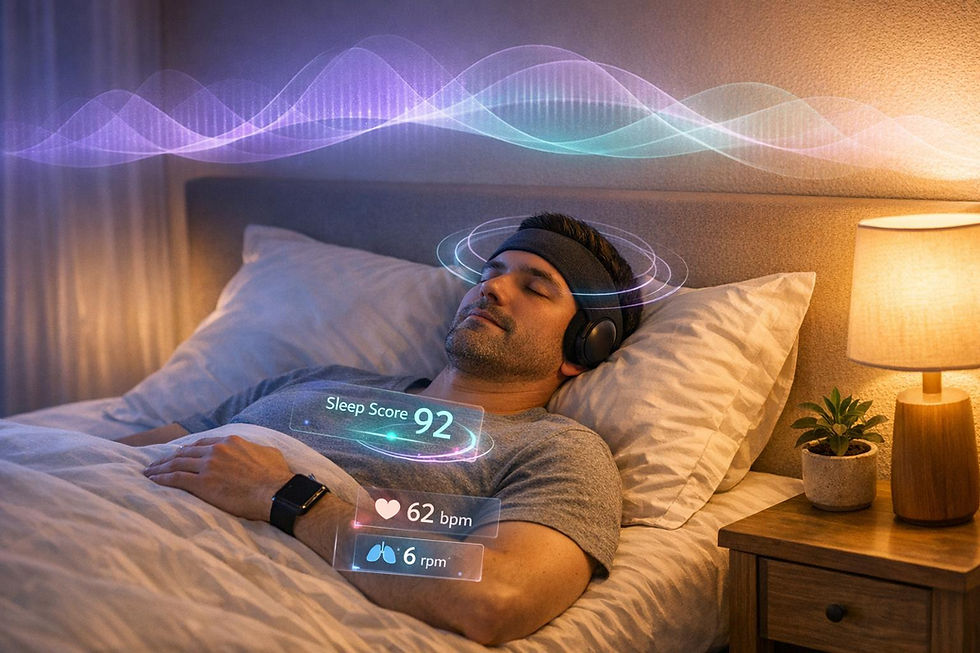
Binaural beats aren't just about stress relief - they can also play a role in improving sleep. By helping to synchronize brain activity, they create the conditions for better rest. Research highlights two key frequency ranges for this purpose: delta frequencies for deep sleep and theta frequencies for easing into sleep.
Delta-Frequency Binaural Beats and Deep Sleep
Delta frequencies, ranging from 0.5 to 4 Hz, are particularly effective for enhancing deep sleep. A study conducted in October 2024 at the University of Tsukuba Hospital explored the effects of infra-slow binaural beats on 12 healthy adults (average age 25.4) during 90-minute afternoon naps. Using a 250 Hz carrier tone, the researchers discovered that 0.25 Hz binaural beats significantly reduced the time it took participants to enter N2 and N3 (slow-wave) sleep stages, compared to a placebo condition.
"This study demonstrated the potential of binaural beats at slow frequencies, specifically 0.25 Hz, for inducing slow-wave sleep in generally healthy populations." - Scientific Reports
In another example, 3 Hz binaural beats applied after participants reached N2 sleep were found to shorten the time needed to enter N3 sleep and increase the total duration of deep sleep. This is significant because N3, or slow-wave sleep, is crucial for physical recovery, memory processing, and a strong immune system. While delta beats are tied to deepening sleep, theta beats are more about easing the transition into it.
Theta-Frequency Binaural Beats and Sleep Onset
Theta frequencies (4–8 Hz) help prepare the body for sleep by lowering heart rate and blood pressure, creating a relaxed state that makes it easier to drift off. While these beats don't directly deepen sleep, they set the stage by calming the mind. Recent EEG-based studies confirm that theta beats can quickly induce a relaxed brain state, readying the mind for rest.
"Real-time EEG-guided binaural beats may rapidly induce low-frequency brain states while potentially preserving or enhancing aspects of executive function." - Chanaka N. Kahathuduwa, Department of Neurology, Texas Tech University Health Sciences Center
For practical use, listening to theta-frequency binaural beats for 15–30 minutes before bedtime can help establish a pre-sleep routine. Platforms like Healing Miracle Frequencies offer soundscapes designed to support this process, making it easier to transition from wakefulness to sleep.
How to Use Binaural Beats for Relaxation
Listening Tips for Best Results
The key to making binaural beats work? Always use stereo headphones. This is non-negotiable. Binaural beats rely on delivering slightly different tones to each ear, which headphones achieve. Using speakers won't cut it because the sounds blend before reaching your ears, canceling out the effect entirely.
Choosing the right frequency is just as important. Your goal determines which frequency range to use:
Theta frequencies (around 6 Hz): Perfect for relaxation and easing stress.
Sub-delta frequencies (0.25 Hz): Best for winding down and falling asleep.
Alpha frequencies (9–12 Hz): Great for a light, calming effect during a hectic day.
How long you listen also matters. A quick 5-minute session can help shift your mood, but for deeper relaxation or entrainment, aim for 20–30 minutes. Research shows that neural activation peaks between 10–15 minutes, with most people entering a relaxed state (below 8 Hz) in just over 7 minutes.
For a more enjoyable experience, consider listening to binaural beats embedded in pink noise - think of the soothing sound of a waterfall. This type of audio is often more pleasant than pure tones but still delivers the same relaxation benefits. Platforms like Healing Miracle Frequencies offer layered soundscapes combining therapeutic beats with immersive audio, available on Spotify and Apple Music.
While these tips can help you get started, understanding safety precautions is just as important before making binaural beats a regular part of your routine.
Safety and Who Should Be Cautious
Binaural beats are generally safe for most healthy adults, but like any tool, they’re not without potential side effects. Some people report mild issues, such as dizziness, headaches, or a strange "head-wringing" sensation, especially after 6–8 minutes of continuous listening. If you experience any of these, stop immediately.
Certain groups should avoid binaural beats or consult a healthcare provider first:
Individuals with epilepsy or a history of seizures: Auditory stimulation might trigger episodes.
People with hearing impairments: The effect depends on precise sound delivery to each ear, making it less effective for those with hearing loss.
Those with unstable psychiatric conditions: Professional guidance is recommended before use.
For everyone else, starting with shorter sessions at a comfortable volume - enough to hear clearly without being overwhelming - is the safest way to begin.
Combining Binaural Beats with Other Relaxation Methods
While binaural beats are effective on their own, pairing them with other relaxation techniques can enhance their benefits.
Mindfulness meditation is an excellent companion. The beats provide a focal point, helping quiet mental distractions and making it easier to stay present.
Adding slow, controlled breathing takes things a step further. Techniques like box breathing (inhale for 4 seconds, hold for 4, exhale for 4, hold for 4) can lower your heart rate and blood pressure, amplifying the calming effects of the beats. For example, listening to 6 Hz theta beats while practicing deep breathing before a stressful situation can create a state of relaxed alertness - calm yet focused.
If you’re looking to improve your sleep, try combining theta-frequency audio with progressive muscle relaxation or a body scan meditation 15–30 minutes before bed. This combination helps signal your nervous system to wind down, making it easier to transition into restful sleep.
"Brief, self-administered theta BB protocols are effective, accessible, and scalable for enhancing meditative mood states in diverse populations." - Micah Amd, University of the South Pacific
Conclusion: Binaural Beats as a Tool for Relaxation
The research we've explored highlights how binaural beats can be an effective way to achieve relaxation quickly. Studies show that these sound frequencies can influence brain activity in measurable ways. For example, in one clinical trial, all participants reached a relaxed brain state in just 7.4 minutes on average - a remarkable result for a non-invasive, self-guided method.
To get the most out of binaural beats, it’s important to choose the right frequency for your goal. For calm focus, 6 Hz Theta is ideal. If you’re looking to improve sleep, try 0.25–5 Hz Delta, while 8 Hz Alpha can help with managing ongoing stress. Using binaural beats consistently matters too. Research shows that daily use over three weeks can significantly improve clinical scores for depression and insomnia in adults dealing with stress.
Another reason binaural beats stand out is their flexibility. They can easily be incorporated into your routine - whether paired with breathing exercises, meditation, or even progressive muscle relaxation. All you need is a good set of stereo headphones.
If you’re curious to try them, Healing Miracle Frequencies offers soundscapes tailored to these frequencies. Their music is free to stream on Spotify and Apple Music, with extended versions available on YouTube. It’s a simple, no-commitment way to explore the benefits of binaural beats for yourself.
FAQs
Do binaural beats work if I only hear from one ear?
Binaural beats work by leveraging the brain's ability to process sounds delivered to both ears. If hearing is limited to one ear, the intended effect might not take place, as this process relies on recognizing phase differences between the sounds reaching each ear. That said, other types of therapeutic music - such as those provided by Healing Miracle Frequencies - can still encourage relaxation and support overall well-being, even without the use of binaural beats.
What volume is safest for binaural beats?
The safest way to listen to binaural beats is at a volume that's comfortably audible without being too loud. Keeping the sound at a moderate level helps avoid discomfort or potential harm to your hearing. Although research doesn't provide exact volume recommendations, it's best to choose a level that feels natural and doesn't interfere with relaxation.
Can binaural beats interfere with my medications or therapy?
Binaural beats are typically regarded as safe for most people. However, their effects on individuals who are taking medications or receiving therapy remain unclear. Since they could potentially influence certain treatments, it’s wise to consult with a healthcare professional before incorporating them into your routine.




Comments