
- A binaural beat is created when each ear hears a slightly different tone — for example 200 Hz in the left ear and 204 Hz in the right — and the brain perceives the 4 Hz difference as a slow pulse; because the beat is built from the difference between the ears, headphones are required.
- Theta beats sit between 4 and 8 Hz and match the drowsy, drifting stage of falling asleep; delta beats sit between 0.5 and 4 Hz and match the slow, heavy rhythm of deep sleep.
- Sleep moves in cycles of roughly ninety minutes, with deep sleep concentrated in the first half of the night and lighter, dream-rich sleep in the morning hours — which is why a theta-then-delta order fits the night's natural shape.
- The simplest whole-night sequence is a 4–6 Hz theta track for the first twenty to thirty minutes, then a 1–3 Hz delta track for the first half of the night, and either soft theta, pink noise or silence for the morning hours.
- Keep binaural tracks well below conversation level and choose a low carrier tone, roughly 100 to 250 Hz, for sleep — the carrier is the note you actually hear, and a high one keeps attention up.
- A binaural beat is a different thing from 432 Hz tuning or a solfeggio pure tone: a track's beat frequency (delta or theta) is always stated separately from its carrier and its tuning, so read the label before queuing it.
What Binaural Beats Are (and How They Differ From 432 Hz Tuning)
A binaural beat is not a sound on the recording. It is something your brain builds. Play one tone in the left ear — say 200 Hz — and a slightly different tone in the right — say 204 Hz — and instead of hearing two separate notes you hear a single tone with a slow, gentle pulse inside it. That pulse runs at the difference between the two, 4 Hz in this example, and it is the beat. Change the gap and the pulse changes speed: a 2 Hz gap gives a slower, heavier throb; a 6 Hz gap gives a lighter, faster ripple.
Two things follow from this. First, headphones are the whole mechanism. The beat only exists when each ear receives its own tone, so a binaural track played through a speaker becomes an ordinary drone — pleasant, but not binaural. Second, a binaural beat is a different thing from the 432 Hz music and solfeggio pure tones this site is best known for. Music tuned to 432 Hz is a tuning: every note of the piece is pitched relative to that reference. A pure tone such as 528 Hz is a single sustained frequency. A binaural track is built around a carrier tone (the note you actually hear) with a beat frequency (the slow pulse) layered inside it, and the two numbers are always stated separately. When a track is labelled "delta" or "theta", it is the beat frequency being named, not the tuning.
If you already use binaural beats and want to sharpen the practicalities — headphone fit, session length, what to do if the pulse feels too strong — our guide on how to listen to binaural beats correctly goes into that detail. This article is about the one question that guide leaves open: which beat, at which point in the night.

Delta and Theta: The Two Beat Ranges That Belong to Sleep
Brainwave activity is described in bands, and two of them belong to the night. Theta covers roughly 4 to 8 Hz and is the rhythm of drowsiness — the loose, image-filled state of the first minutes after the lights go out, and of light sleep. Delta covers roughly 0.5 to 4 Hz and is the rhythm of deep sleep — the slowest, heaviest stretch, when breathing is slowest and the body is most still. Binaural beats for sleep are built to sit inside these two bands, and choosing between them is mostly a matter of matching the beat to the stage of the night you are in.
Theta beats (4–8 Hz): the drift-off range
A theta beat pulses somewhere between four and eight times a second. At the top of the range, around 7 to 8 Hz, it feels like a soft, steady flicker — alert enough to follow with attention, which is why the same range is favoured for meditation. At the bottom, around 4 to 5 Hz, it slows into something closer to a slow rocking. For sleep, the lower theta range is the one to reach for. It is the rhythm of the moment when thoughts loosen, the eyes get heavy and the day starts to blur, and a theta track at the beginning of the night gives a busy mind a slow, predictable thing to rest on while sleep arrives.
Delta beats (0.5–4 Hz): the deep-rest range
A delta beat pulses fewer than four times a second — at 2 Hz, once every half second; at 1 Hz, a single slow swell per second. It is less a flicker than a tide. This is the rhythm of deep sleep, and delta binaural tracks are built for that stretch: long, unchanging, with nothing to catch the ear. A delta track is not the one to start with while you are still turning over and thinking; it is the one to have running once you are under, carrying the first hours of the night. Our earlier piece on delta waves sleeping music describes the character of this range in more depth.
A Night in Three Parts: Which Beat Goes Where
Sleep is not one flat state. It moves in cycles of roughly ninety minutes, and the cycles change shape as the night goes on. The first two or three are heavy with deep sleep. The later ones lighten, with more of the dream-rich stage (REM) and more brief surfacing between cycles. That shape is the reason a single beat for the whole night is a compromise: what settles you at eleven is not what the body is doing at three in the morning. Think of the night in three parts and give each its own sound.
Part one: falling asleep — theta
The first twenty to thirty minutes are the window that decides how the night begins. Choose a theta track with a beat between 4 and 6 Hz, start it before you lie down so the sound is already in the room, and let the pulse carry the count of your breath. If you use a slow breathing pattern, the 4-4-4-4 square in our guide to box breathing for calm sits comfortably on a theta beat. The point of this part is not depth; it is the transition. If falling asleep is where your nights come undone, our guide on how to sleep fast covers the other levers around the sound — light, temperature, timing — that make the theta window shorter.
Part two: the first half of the night — delta
Once you are asleep, the beat that matches the body is delta. This is where the deep-sleep cycles cluster, and a delta track between 1 and 3 Hz gives them a slow, unbroken bed. There are two ways to do this: queue a delta track after your theta track so the change happens while you sleep, or play a longer delta track from the start and add a theta track in front of it only on nights when you need the transition. The Sleep Music playlist is arranged so either approach works — more on that below. For what the body is doing in this front-loaded stretch and how much of it a night needs, our guide to what core sleep is lays it out in plain language.
Part three: the morning hours — lighter, or silent
From roughly the fourth cycle on, sleep lightens and dreaming takes over. A heavy delta pulse is not what the morning hours are doing, and this is the part of the night where listeners split: some keep a very soft theta track running, some switch to a steady noise bed with no pulse at all, and some let the last cycles run in silence. The mechanics of this stretch are the subject of our companion article on binaural beats for REM sleep, which explains why the later cycles behave differently and which sounds suit them. If you want to lengthen those morning cycles, how to get more REM sleep lists the levers that live outside the headphones.
Choosing Tracks From the Sleep Music Playlist
The Sleep Music playlist gathers the site's delta and theta binaural tracks alongside its slower 432 Hz pieces, and the simplest way to use it for a whole night is to build a two-part order: a theta track first, then a delta track. Read the label of each track before you queue it. A binaural track names its beat — "4 Hz theta", "2 Hz delta" — separately from its carrier, and it is the beat number you are matching to the part of the night. Where a track states only a musical tuning, treat it as music rather than a beat; it still belongs at bedtime, just not as the binaural layer.
If you would rather hear a beat before you commit a night to it, The Frequency Studio generates both ranges free in the browser: open the theta preset to hear the drift-off range and the delta preset to hear the deep-rest range, with the carrier tone and beat frequency under your fingers. Ten minutes with each, headphones on, tells you more about which pulse your body settles into than any description can. Once you know, go back to the playlist and pick the tracks that match.
How to Listen: Headphones, Volume, Carrier and Timers
Headphones are non-negotiable — and comfort decides the night
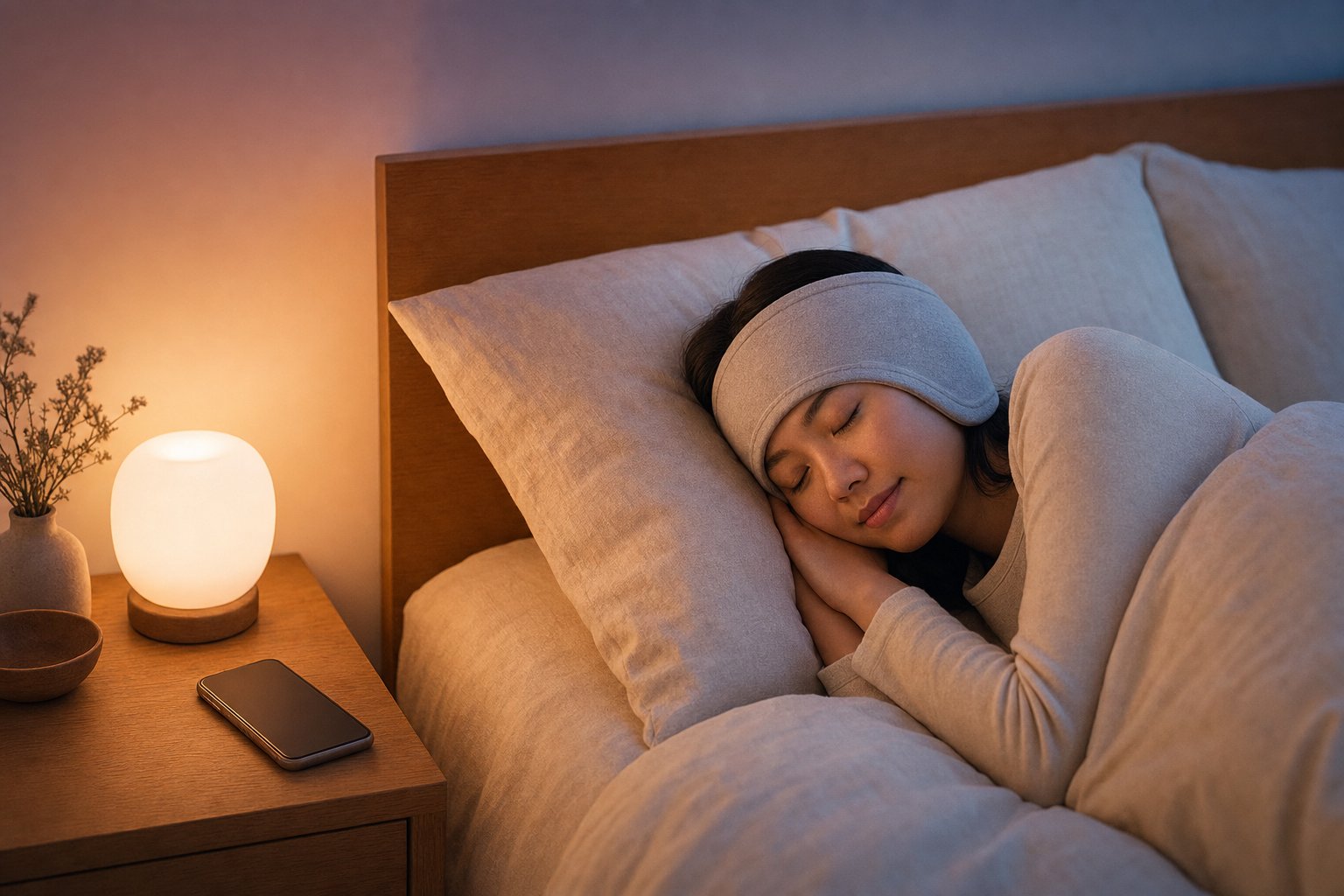
Because the beat is made by the difference between the ears, both ears need their own channel. Over-ear headphones are lovely for the drift-off window but hard to sleep in; for all-night play, a flat fabric sleep headband or small, soft in-ear buds are the practical choice. Side sleepers in particular should try a headband before committing to an all-night session. If headphones at night are simply not for you, use the theta track for the falling-asleep window only, then switch to a speaker with a noise bed or slow music for the rest of the night.
Keep the volume low and the carrier low
A binaural track should sit well below conversation level — present if you listen for it, easy to forget if you do not. The carrier tone is what you actually hear, so its pitch matters more than most people expect: a low carrier, somewhere around 100 to 250 Hz, feels warm and grounded at night, while a high carrier feels bright and keeps attention up. Many sleep tracks pair a low carrier with a soft pad or a pink-noise layer so the tone never feels exposed. If a beat ever feels too strong or too fast, drop the volume first, then choose a slower beat.
Timer or all night?
For the theta window, a thirty- to forty-five-minute timer is enough — you will be asleep before it ends. For the delta part, use either a long track (many run sixty to a hundred and eighty minutes, which covers the deep-sleep cycles) or a queue that simply continues. Decide in advance what you want the morning hours to sound like; if the answer is nothing, set the playlist to stop after the delta track and let the last cycles run in quiet.
A Seven-Night Plan
Nights one and two: theta only. Choose one 4–6 Hz theta track from the playlist, headphones on, low volume, timer at thirty minutes. Your only job is to notice how the pulse feels as you drift. Nights three and four: add the delta track after it, and let the change happen while you sleep. Notice in the morning whether you woke during the switch; if you did, lower the delta volume a touch or pick a track with a longer fade-in. Nights five and six: decide what the morning hours get — soft theta, pink noise or silence — and try one option each night. Night seven: run the full sequence you have settled on, start to finish, and write down in one line how the night felt. By the end of the week you have a night that is yours: a beat for falling asleep, a beat for the deep hours, and a deliberate choice for the morning.
Pairing Binaural Beats With Breath and Noise
Binaural beats work best as one layer in a small bedtime stack rather than the whole of it. Two pairings suit sleep particularly well. The first is breath: a slow breathing pattern over the theta window gives the mind two anchors — the pulse and the count — and the two reinforce each other. The second is a noise bed. Pink noise, the steady-rain hush described in our guide to pink noise for sleep, layers under a delta beat beautifully, filling in the gaps a bare tone leaves and masking the household sounds that surface you between cycles. If you are choosing between noise colours for the bed, colors of noise explained compares them side by side. Keep the stack small — a beat, a bed, a breath — and keep everything quiet. The night does the rest.
Frequently Asked Questions
Which binaural beat frequency is best for sleep?
There is no single number, because the night has more than one stage. For falling asleep, a theta beat between 4 and 6 Hz matches the drowsy transition. Once you are asleep, a delta beat between 1 and 3 Hz matches deep sleep, which is concentrated in the first half of the night. The most useful arrangement is theta first, then delta, with a lighter or silent morning.
Should I use delta or theta binaural beats to fall asleep?
Theta. Delta is the heavier rhythm of deep sleep, and starting there while thoughts are still moving feels like too big a jump — the pulse is slower than the mind is ready for. Use a theta track for the first twenty to thirty minutes, then let a delta track take over once you are under.
Do binaural beats work without headphones?
No. The beat is created by the difference between what the left and right ears hear. Through a speaker both ears receive both tones, the difference disappears, and you are left with a pleasant drone rather than a binaural beat. If headphones are not an option at night, isochronic pulses — where the pulse is built into the recording itself — are the speaker-friendly alternative, and a plain noise bed or slow music works well for the later hours.
Can I play binaural beats all night?
Yes, provided the headphones are comfortable enough to sleep in — a flat sleep headband is the usual answer. Keep the volume low, choose a long delta track or a queue that continues, and decide in advance whether the morning hours get soft theta, a noise bed or silence. Plenty of listeners stop the sound after the delta track and let the last cycles run quiet.
Are binaural beats the same as 432 Hz sleep music?
No. 432 Hz describes a tuning — the reference pitch a piece of music is built on. A binaural beat is a slow pulse created by two slightly different tones, one in each ear, and it is described by its beat frequency (for example 2 Hz delta) and its carrier. A single track can be both — a binaural beat whose carrier is tuned to a 432-scale note — but the label will state each number separately, and it is the beat that decides which part of the night the track belongs to.
What carrier frequency should a sleep binaural track use?
A low one. The carrier is the note you actually hear, and somewhere around 100 to 250 Hz feels warm and grounded at night, while a higher carrier feels bright and keeps attention up. Many sleep tracks soften the carrier further with a pad or a pink-noise layer so the tone never feels exposed. If a track feels too sharp, lower the volume first and then look for a track with a lower carrier.