
Binaural Beats for Stress Management
- 13 minutes ago
- 11 min read
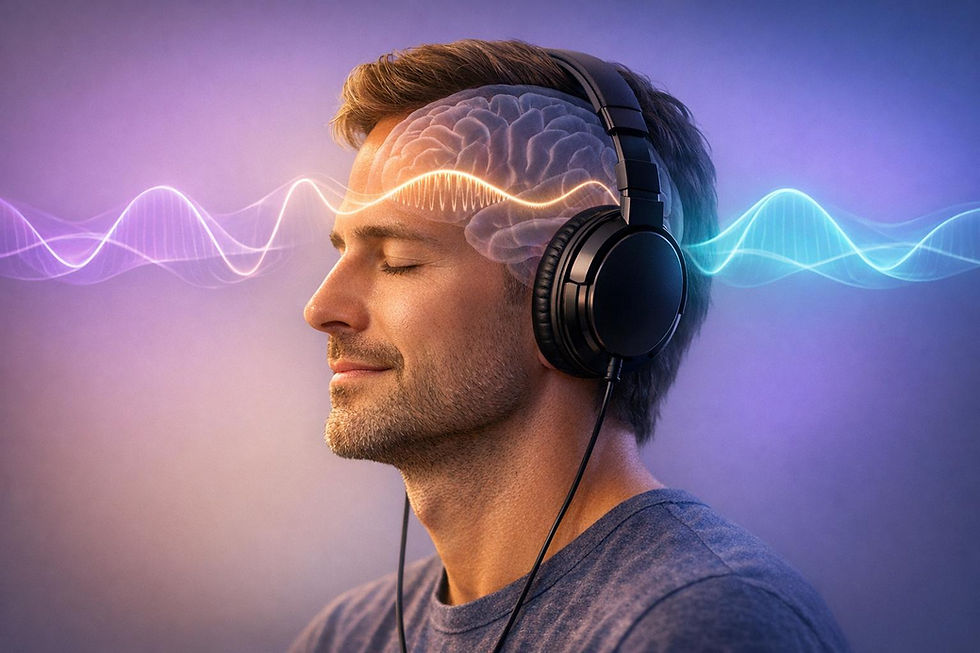
Binaural beats are a simple, headphone-based method to help reduce stress by syncing your brain's activity with specific sound frequencies. This technique uses two slightly different tones in each ear, creating an auditory illusion that promotes relaxation and calmness. Research shows that listening to frequencies in the theta (4–8 Hz) or alpha (8–13 Hz) range can guide your brain into relaxed states, easing anxiety and tension.
Key Benefits:
Quick stress relief: Effects can start within 5–7 minutes of listening.
Non-invasive and accessible: Requires only headphones and a sound source.
Improved sleep and focus: Specific frequencies like delta (1–4 Hz) enhance sleep, while alpha (8–13 Hz) supports calm focus.
How to Use:
Use stereo headphones for proper sound delivery.
Listen for 15–30 minutes in a quiet setting.
Choose the right frequency for your goal:
Theta (4–8 Hz): Deep relaxation and reduced anxiety.
Alpha (8–13 Hz): Calm alertness for daytime stress.
Delta (1–4 Hz): Deep sleep and recovery.
While binaural beats are safe for most, consult a professional if you have a medical condition like epilepsy. For best results, make it part of your daily routine. Platforms like Healing Miracle Frequencies offer curated playlists to help you get started.
The Science Behind Binaural Beats and Relaxation
Brainwave Entrainment and the Frequency-Following Response
At the heart of binaural beats lies brainwave entrainment - a phenomenon where the brain aligns its electrical activity with an external rhythmic stimulus. This process, known as the Frequency-Following Response (FFR), explains how the brain reacts to binaural beats. When listening to these beats, the brain's EEG signals begin to synchronize with the frequency of the beats.
"The brainwave entrainment hypothesis... suggests that auditory or visual stimulation at a specific frequency will lead the brain's electrocortical activity to oscillate at the external signal's frequency or at its multiples." - PLOS One
Specific frequencies, such as theta (4–8 Hz) and alpha (8–12 Hz), have been linked to relaxation. These frequencies encourage the body to transition from a "fight-or-flight" mode, governed by the sympathetic nervous system, to a "rest-and-digest" state, controlled by the parasympathetic system. This shift is what drives the calming effects often associated with binaural beats.
What Research Says About Stress Reduction
Research continues to highlight the potential of binaural beats for reducing stress. For instance, a randomized, double-blind crossover trial conducted in October 2025 by Chanaka N. Kahathuduwa at Texas Tech University Health Sciences Center demonstrated impressive results. In the study, 25 healthy adults used an EEG-guided binaural beat system, with 100% of participants achieving a relaxed brain state (below 8 Hz) within a median of 7.4 minutes. Additionally, 96% reached a deep delta state (below 4 Hz) within 9.0 minutes.
"Real-time EEG-guided binaural beats may rapidly induce low-frequency brain states while potentially preserving or enhancing aspects of executive function." - Chanaka N. Kahathuduwa, Department of Neurology, Texas Tech University Health Sciences Center
Another study, published in June 2025 in BMC Complementary Medicine and Therapies, tested the effects of binaural beats on 65 college students. Participants listened to 20 minutes of natural sounds embedded with theta, alpha, or beta frequencies. All three frequency types led to a significant reduction in heart rate and systolic blood pressure, demonstrating a measurable impact on physical stress markers. Furthermore, a meta-analysis of 22 studies revealed a moderate effect size (0.45) for binaural beats in alleviating anxiety, improving cognition, and managing pain. These findings suggest that binaural beats can serve as a quick and effective tool for stress reduction when paired with other relaxation techniques.
Limitations and Considerations
Despite the promising evidence, there are still gaps in research. A systematic review of 14 studies found that only 36% of the results aligned with the brainwave entrainment hypothesis, while 57% showed mixed or inconsistent outcomes.
"The results corroborate the impression of an overall inconsistency of empirical outcomes, with five studies reporting results in line with the brainwave entrainment hypothesis, eight studies reporting contradictory, and one mixed results." - PLOS One Systematic Review
These inconsistencies often stem from differences in study design, such as variations in carrier frequencies, session durations, or control conditions, making direct comparisons challenging. Additionally, individual sensitivity plays a role - some people respond more strongly to binaural beats than others. There are also occasional reports of mild side effects, like headaches or dizziness, particularly when listening to pure sine-wave tones without any masking sounds.
While binaural beats show potential, they are best used as a complementary tool within a broader stress management plan. They should not replace professional care when needed but can serve as a helpful addition to relaxation routines.
sbb-itb-894b1e4
[ Stress - Anxiety ] HEALING RELAXATION Theta Waves l Sleep Meditation Music - Binaural Beats
Choosing the Right Frequencies for Stress Management
Frequency Bands and Their Effects
Binaural beats work across various frequency bands, each targeting a specific mental state, similar to how solfeggio frequencies impact well-being. Here's a breakdown:
Frequency Band | Range | Mental State | Stress-Relevant Benefit |
Delta | 1–4 Hz | Deep Sleep | Supports physical recovery and enhances sleep quality |
Theta | 4–8 Hz | Deep Relaxation | Helps release emotional tension and reduces mental anxiety |
Alpha | 8–13 Hz | Calm Alertness | Eases racing thoughts and promotes a sense of calm |
Low Beta (SMR) | 12–15 Hz | Focused Relaxation | Improves mental clarity while maintaining a relaxed state |
High Beta | >15 Hz | Alert/Stress Mode | Often linked to anxious or overactive thinking |
Among these, Theta (4–8 Hz) stands out for reducing worry and overthinking. A study led by Adiel Mallik at Ryerson University explored this frequency's impact by testing 163 participants using anxiolytics. Over a 24-minute session, they combined music with theta-frequency auditory beat stimulation (4–7 Hz). The results showed this combined approach significantly reduced cognitive anxiety compared to using music or beats alone.
"Sound-based treatments are effective in reducing somatic and cognitive state anxiety. For participants with moderate trait anxiety, combined conditions [music & ABS] were most efficacious." - Adiel Mallik, Department of Psychology, Ryerson University
On the other hand, Alpha (8–13 Hz) is ideal for managing the kind of mild stress that accumulates during a hectic day. It keeps you calm and focused without making you feel sluggish.
By understanding how these frequency bands work, you can better tailor your approach to stress management.
Gradual Frequency Modulation
Jumping straight from a high-stress state to deep relaxation can feel abrupt and unsettling. This is where gradual frequency modulation comes in. By starting at a higher frequency and slowly transitioning to a lower one, the brain can adjust more smoothly. This method draws inspiration from the Iso Principle, a technique that aligns the stimulus with your current mental state before gradually shifting toward the desired one.
"Stress isn't just an emotional experience. It alters your brain rhythms, making it harder to switch into calm, restorative states." - Mind Alive
For example, you might begin a session with low beta or alpha frequencies and then move into theta over 15–20 minutes. This gradual adjustment helps prevent the discomfort of sudden changes and reinforces the brain's ability to transition into a relaxed state. It’s a practical way to make binaural beats a reliable tool for stress relief.
Practical Frequency Recommendations
Incorporating binaural beats into your daily routine doesn’t have to be complicated. A study from Seoul National University Bundang Hospital showed that listening to 8 Hz Alpha for 15 minutes during the day and 5 Hz Theta for 30 minutes at night significantly improved stress levels. Participants reported better scores on the Perceived Stress Scale, Beck Depression Inventory-II, and Insomnia Severity Index, with many experiencing normalized depression and insomnia symptoms. Impressively, 90% of participants stuck with the protocol throughout the study.
Here’s a simple starting guide:
Work break (15 min): Use 8 Hz Alpha to stay calm and focused without feeling drowsy.
Evening wind-down (30 min): Switch to 5 Hz Theta to ease into a relaxed, pre-sleep state.
Deep sleep support: Incorporate 1–4 Hz Delta to promote physical recovery while you sleep.
For noticeable anxiety reduction, aim for sessions lasting 20 to 30 minutes. While shorter sessions can still provide some relief, long-term consistency is key to achieving lasting benefits.
How to Use Binaural Beats Effectively
Equipment and Setup
To get started with binaural beats, you'll need a pair of stereo headphones or earbuds. This is because binaural beats rely on dichotic delivery, where each ear receives a slightly different frequency at the same time. Regular speakers won't work for this purpose. You'll also need a device capable of playing stereo audio. Before starting, test your setup to ensure both ears are receiving sound at balanced volumes. Keep the volume low and comfortable - turning it up won't improve the effects and could lead to discomfort.
Step-by-Step Listening Guide
Once you've selected the frequency that aligns with your goals, follow these steps to make the most of your binaural beats session:
Pick the Right Frequency: Choose a frequency based on your desired outcome. For example, 8 Hz Alpha waves can help with a midday break, 5 Hz Theta waves are great for winding down in the evening, and 1–4 Hz Delta waves are ideal for deep sleep.
Create a Relaxing Environment: Find a quiet space with minimal distractions. A dimly lit or calm setting can enhance your brain's response to the beats.
Listen for 15–30 Minutes: Studies show that synchronization begins within about 7.4 minutes. Sessions lasting 15–30 minutes typically produce more stable and lasting effects. If you're just starting, begin with shorter, 15-minute sessions and increase the duration gradually.
Add Rhythmic Breathing: Try slow breathing - inhale for 4 seconds and exhale for 6 seconds. This can amplify the relaxation effects.
For the best outcomes, aim for consistency. Daily sessions over a period of at least four weeks often lead to noticeable improvements in emotional balance and stress reduction.
Safety Tips and Precautions
While binaural beats are safe for most people, there are a few important precautions to keep in mind.
Avoid Using Them While Driving or Operating Heavy Machinery: These tracks are designed to relax you, which could make you drowsy.
Consult a Professional if Necessary: If you have a history of seizures, epilepsy, or are taking antidepressants, talk to your doctor before trying binaural beats. The rhythmic audio stimulation may not be suitable for everyone.
"The intervention rapidly reduced dominant EEG frequency in all participants, with 100% achieving <8 Hz... within median 7.4 [minutes]." - Chathurika S. Dhanasekara, Department of Pharmacology and Neuroscience, Texas Tech University Health Sciences Center
If you experience dizziness or headaches during a session, stop immediately. You might benefit from shortening the session length next time.
Relaxation with Healing Miracle Frequencies
If you're searching for therapeutic audio grounded in sound therapy principles, Healing Miracle Frequencies might be just what you need. This platform combines therapy, research, and music into a single resource designed to help with stress relief, meditation, and sleep. Let’s break down how Healing Miracle Frequencies turns these concepts into practical tools for relaxation.
What Healing Miracle Frequencies Offers
Healing Miracle Frequencies creates soundscapes that sync with your body’s natural rhythms. Similar to the calming effects of binaural beats, their tracks are designed to guide you toward relaxation. They incorporate brainwave entrainment frequencies, such as Alpha waves for daytime relaxation and Delta waves for deep, restorative sleep. Additionally, they feature the full Solfeggio frequency scale, from 174 Hz to 963 Hz, which is often associated with healing and balance.
What makes their soundscapes stand out is the inclusion of soft nature sounds layered beneath the frequencies. These subtle elements help deepen relaxation and create a more immersive experience. Their library includes playlists tailored for specific needs like easing anxiety, promoting deep healing, or improving sleep. This means you can select tracks that fit your mood or goal for the day.
With over 50 million streams worldwide, Healing Miracle Frequencies has gained recognition from professionals in the field. Alexander Hall, a therapist and meditation guide, shared his thoughts:
"Always helps the therapy sessions.. I also use the music in my guided meditations, it's such an amazing addition as a background layer."
How to Build a Routine with Healing Miracle Frequencies
Incorporating these frequencies into your daily routine is simple and effective. Much like binaural beats, consistency is key. Aim for 20 to 30 minutes of listening at the same time each day. You might prefer mornings to start your day calmly, midday for a mental reset, or evenings to wind down before bed.
For better sleep, try a Delta-wave track about 30 minutes before going to bed. If you’re looking to ease daytime stress, an Alpha-wave session during a lunch break can work wonders. For those wanting an even deeper experience, their YouTube channel offers extended tracks lasting anywhere from 1 hour to 10 hours. These are perfect for overnight listening or long meditation sessions.
Once you’ve established a routine, you’ll find it easier to integrate these sessions into your daily life.
Where to Access Healing Miracle Frequencies
Healing Miracle Frequencies is easy to access and fits seamlessly into your schedule. You can stream their tracks for free on Spotify and Apple Music, or explore extended versions on their YouTube channel. For a more personalized experience, check out the Miracle app, which offers customizable sessions and includes a 7-day free trial.
Platform | Format | Best For |
Spotify / Apple Music | Standard tracks | Daily listening sessions |
YouTube | 1–10 hour extended versions | Sleep or deep meditation |
Miracle App | Customizable sessions | Structured routines with tracking |
Conclusion: Key Takeaways for Stress Management with Binaural Beats
Recap of Benefits
Binaural beats provide a simple, non-intrusive way to help manage stress, accessible right from your phone or laptop. Studies suggest that just five minutes of a theta session can boost calmness and focus, with measurable effects showing an impact size of over 0.84. In clinical trials, every participant achieved a relaxed brain state in just 7.4 minutes when using guided binaural beat audio.
These frequencies are also linked to better mood, reduced anxiety, and improved sleep. Their versatility means you can use them during a quick midday break or as part of a bedtime routine. The trick is to match the frequency to your goal: theta (6 Hz) for calm focus, alpha (9–12 Hz) for relaxation, and delta (<4 Hz) for deep, restorative rest.
"BWE demonstrates promising therapeutic potential and may support the management of various health conditions, enhancing individuals' quality of life." - Applied Psychophysiology and Biofeedback
How to Start Your Routine
Getting started is straightforward. Use stereo headphones and listen to binaural beats correctly to activate the binaural effect. Begin with short sessions - just five minutes is enough to feel the calming effects. Over time, you can gradually extend your sessions to 20–30 minutes daily for more lasting results.
Platforms like Healing Miracle Frequencies make it easy to dive in, offering curated playlists on Spotify, Apple Music, and extended sessions on YouTube. Whether you’re looking for Alpha-wave tracks to enhance focus during the day or Delta-wave tracks to support restful sleep, there’s no complicated setup required.
Pick a frequency that fits your needs and make it part of your daily routine for consistent stress relief. Why not start today? A calmer mind is just a few minutes away.
FAQs
Do binaural beats work without headphones?
Binaural beats won't work effectively without headphones. Why? Because they depend on delivering slightly different sound frequencies to each ear. With speakers, even if you position them carefully, the separation of these frequencies won't be precise enough to create the intended auditory effect. Headphones are essential for the full experience.
How do I know which Hz to use for my stress level?
Research indicates that binaural beats in the theta range (4-8 Hz) are excellent for managing stress, with 6 Hz standing out as especially helpful. These frequencies are associated with relaxation and meditative states, making them effective for fostering calmness and improving focus. Listening to a binaural beat at approximately 6 Hz can significantly aid in stress reduction and relaxation.
Can binaural beats cause headaches or dizziness?
Binaural beats can sometimes lead to headaches or dizziness in certain individuals, especially if they're listened to improperly or for long durations. That said, research on these effects shows mixed results, and much of it comes down to personal sensitivity. If you find yourself feeling uncomfortable, try lowering the volume, limiting your listening time, or taking regular breaks to see if that alleviates the issue.


Comments