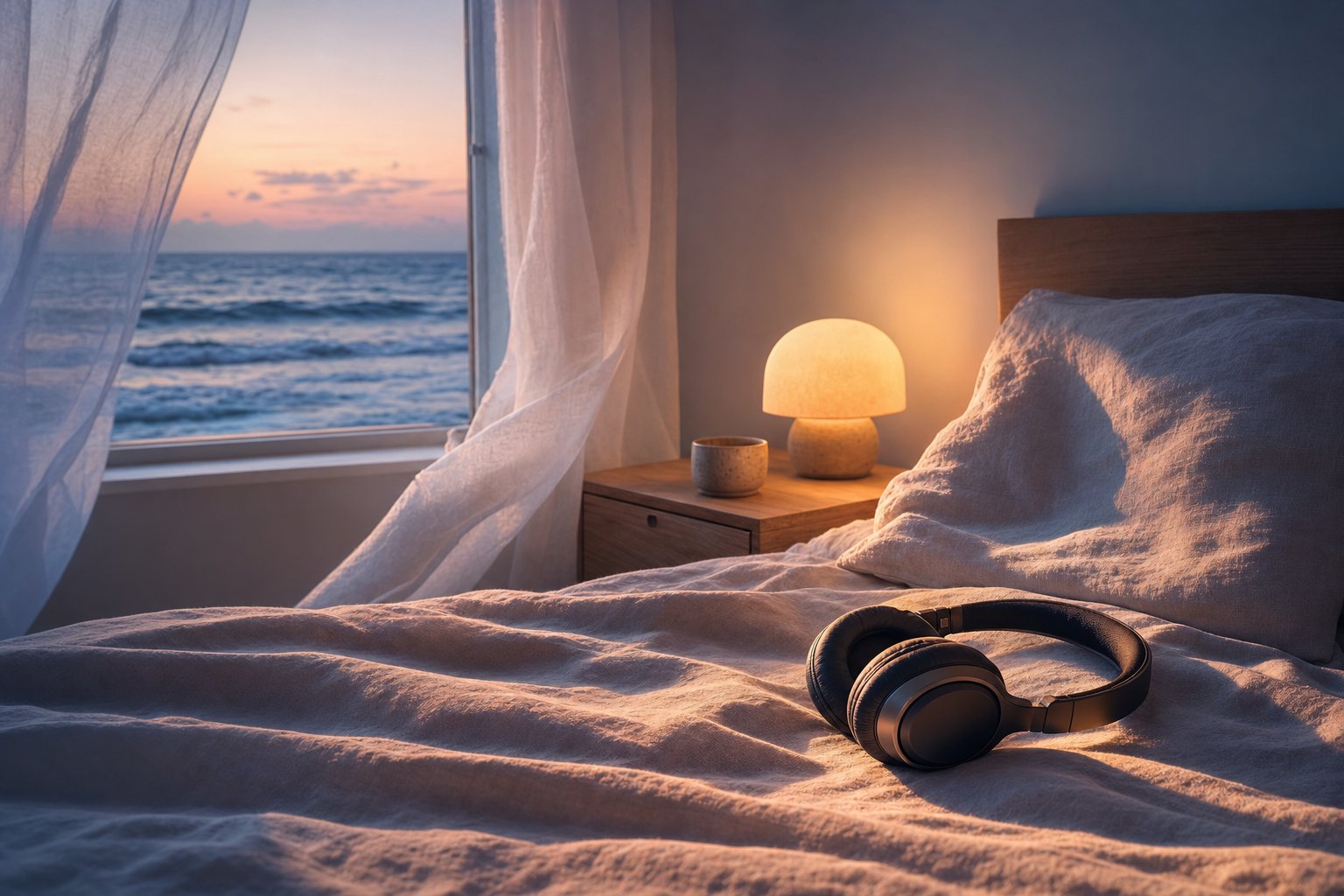


- Rain relaxes a busy mind because it is dense, continuous and unpredictable: there is no melody to anticipate, no tempo to count and no voice to decode, so your attention stops tracking it and the room's small noises — a fridge cycling, a door, a passing car — get covered by one steady floor.
- Steady rain on a roof or window is the default night recording; heavy rain with distant, rolling thunder suits a loud room; light drizzle on leaves suits an already quiet one; city rain and close thunderclaps belong to daytime listening because tyres, voices and sudden peaks are events your ear catches at 3 a.m.
- Set the volume in two passes — bring the rain up until the hallway, the street and the building go away and no further, then bring the music in underneath at a level where it reads as texture rather than melody.
- Layer one background only. Rain on top of ocean waves, or rain plus a second noise colour, does not cover the room twice; it raises the floor until nothing quiet is left, and the layered mix ends up louder than either sound needed to be.
- Pink noise and green noise are the generated versions of the same hush — pink falls off steadily as pitch rises, green concentrates energy in the mid band around 500 Hz where rainfall lives — and both hold one level all night with no loop seam to catch.
- After lights out, length is a question of interruptions rather than minutes: one long unbroken file beats a playlist, because a fade, a gap or a track change is an event, and a short loop with an audible seam becomes the one sound in the room your ear is waiting for.
Rain Works Because It Never Asks Anything of You
Search "rain sounds for sleep" and you get ten-hour uploads named after a window: no indication of what the recording actually is, how loud to set it, whether it loops cleanly, or what belongs underneath it. So you press play on somebody else's four decisions and then judge rain by the result. If the night went badly, it was rarely rain's fault — it was a thunderclap dropped into your 3 a.m., a seam in a two-minute loop, or a volume that left the hallway perfectly audible until morning.
The reason rain settles a mind that will not stop is worth holding onto, because it tells you what to choose. Rain is dense, continuous and unpredictable in a way attention cannot follow. There is no melody to anticipate, no tempo to count with, no voice to decode. Thousands of small impacts average out into one broad hush, and once your ear stops finding edges in a sound it stops tracking it. What gets covered on the way is everything that actually lifts you out of sleep: the fridge cycling on, a door two floors down, a car taking the corner, a partner turning over.
That is the entire job. Rain lays one steady floor across the room, and then slow music has somewhere quiet to sit on top of it. The pairing this guide uses throughout is rain over the Sleep Music playlist — 432 Hz tuned, wide, no vocals, no tempo arguing with anything — because rain handles the room and the music handles the hour.
What separates a rain recording you can actually sleep through
Four things, and you can check all of them in ninety seconds while you are still awake. Steadiness: the recording should sit at one intensity rather than swelling and fading, because every swell is a change your ear notices. No events: no close thunderclap, no gust, no gutter suddenly emptying. No stereo movement: rain that sweeps left to right was mixed to be interesting, which is the opposite of what you want at night. A clean loop: play the first two minutes and listen for the seam, the small click or dip where the file restarts. A seam you can hear once is a seam your ear will wait for all night.
Four Kinds of Rain, and What Each One Is For
"Rain" covers recordings that behave completely differently in a dark room. Treat it as four choices with a job attached to each, and you stop re-rolling uploads at midnight.
Steady rain on a roof or window: the default
This is the one to keep if you keep only one. Rain hitting a hard surface a few feet away produces a full, even hush with a lot of mid-range in it — the band where most household noise lives, which is exactly why it covers so well. It holds one level, it has no story, and it sounds the same at minute four and minute four hundred. If a recording is described as rain on a roof, a tin roof, a porch or a window and it was recorded from indoors, it is almost always the right shape for sleep.
Heavy rain with distant thunder: for a loud room
If you are on a main road, sharing a wall, or sleeping in a building that never fully goes quiet, a light recording will not reach. Heavy rain gives you more floor to work with, and distant thunder — the low rolling kind that arrives slowly and fades slowly — adds weight without adding an event. The test is simple: if any single rumble makes you notice it, the thunder is too close. Rolling is fine. Cracking is not.
Light drizzle on leaves: for an already quiet room
In a quiet bedroom, heavy rain is overkill and ends up being the loudest thing in the room. Drizzle on leaves, soft rain in a garden, rain in a forest — these sit lower and lighter, with more high-end detail and less pressure. They are also the better choice if you find full rain slightly oppressive, which some people do and almost nobody mentions. The trade-off is coverage: a drizzle recording will not hide a hallway conversation.
City rain and close storms: good listening, wrong time of night
Rain on a street is a genuinely lovely recording and a poor sleep background. Tyres on wet tarmac, distant voices, a siren, the slap of a passing car — all of those are events, all of them have edges, and your ear will find every one of them. The same goes for storm recordings built around close thunder, where the whole point is the peak. Keep both for reading, working and a rainy afternoon; there is a reason rain under meditation music works so well awake and needs a flatter cousin after lights out.
Set the Rain First, Then the Music
Volume: two passes, in this order
Start with the rain alone and bring it up until the room goes away — the hallway, the street, the building, the fridge — and then stop. That is the level. Most people overshoot here, because rain is pleasant and turning it up feels like turning up the effect; what you actually get is a room that is loud in a different way. The sign you have gone too far is that you can hear detail: individual drops, the texture of the surface, the character of the recording. Coverage, not detail, is the target.
Then bring the music in underneath at a level where it reads as texture rather than melody — present if you listen for it, gone if you do not. Set both before you lie down, not from the bed with one eye open, and leave the phone face down and out of reach once they are set. If you are using earbuds rather than a speaker, match both sides carefully; an imbalance turns an even hush into a lean.
What to put underneath: 432 Hz tuning, slow and wide
Rain covers the room; the music sets the hour. The Sleep Music playlist is built for exactly this slot — 432 Hz tuned, slow, no vocals, nothing with a tempo of its own to argue with the rain. Pace matters more than anything else in the choice: a piece that moves slowly gives your breathing something unhurried to settle against, and a piece with a beat gives your attention something to count. For how tuning, pure tones and beat rates fit around each other across the night, choosing a sleep music frequency takes it hour by hour, and 432 Hz music for sleep covers why that tuning sits so easily under a steady background.
What not to stack
Keep the stack to two things: one background, one bed of music. The commonest mistake is two backgrounds — rain over ocean waves, or rain alongside a noise colour — in the belief that more coverage is better coverage. It is not. Two masking layers do not cover the room twice; they raise the floor until there is no quiet left for the music to live in, and the whole mix ends up louder than either sound needed to be. If one background is not covering your room, change the recording rather than add another.
The second mistake is words. A vocal line pulls you forward every single time, and it is the fastest way to hand back a wind-down you had already won. The third is a rising-and-falling background under something you are trying to forget: surf swings between crest and trough, which makes any level you set correct only half the time. Rain's great advantage over waves is that it has no crest.
Generate the Same Hush Yourself: Pink and Green Noise
Rain that never loops, never thunders and never changes is not a recording at all — it is generated noise, and it is the most reliable version of this sound. Open the pink preset in The Frequency Studio and you get the steady-rain hush at one unbroken level for as long as you leave it running; open the green preset and you get energy concentrated in the mid band around 500 Hz, which is the part of the spectrum rainfall actually occupies and the reason green noise reads as rain more than any other colour. Both are free, both start in a tap, and neither has a seam.

The practical difference: pink noise falls off steadily as pitch rises, which makes it fuller and broader, closer to heavy rain on a roof. Green is narrower and more specifically rain-like, closer to steady rainfall heard from inside. Try them one after the other at the volume you already set and keep whichever one lets the room disappear at the lower setting. Pink noise for sleep goes deeper on the broad option, green noise benefits covers why that mid-band colour took over sleep listening, and the colours of noise explained puts white, pink, brown and green side by side so you can hear what you are choosing between.
The 20-Minute Rain Wind-Down
Minutes 0 to 5: rain only, lamp low
Start the rain by itself and set its level now, with the lamp still on and the phone still in your hand, so you never have to adjust anything later. Five minutes of rain alone does something a stacked mix cannot: it makes the room smaller. Use the time to do the unglamorous things that actually shorten the gap between lights out and under — water within reach, phone face down and across the room, one slow exhale longer than the one before it. How to sleep fast covers the rest of those levers.
Minutes 5 to 15: music underneath, attention on the breath
Lamp off, music in at texture level, and nothing to do for ten minutes except let each exhale stretch a little longer than the last. You are not listening to the music here; you are letting it take up the space your thoughts were using. Somewhere in this stretch the rain stops being a sound you can point at and becomes the shape of the room, and that is the moment the setup starts working. If you notice yourself attending to the recording — a particular drip, a passing swell — the rain is a notch too loud.
Minutes 15 to 20: stop listening on purpose
Leave the audio alone and run a slow body scan instead: soles to crown, one breath per region, no hurrying the legs. Five minutes covers the body once. If the file outlasts you, the routine did its job. If you are still wide awake at the end, the thing to change tomorrow is one setting, not everything — usually the volume down two notches, occasionally the recording from heavy to light. And if you want a pacing layer under the rain for the handover, the delta settings guide takes the slow end of the band number by number.
Loops, Fades and the File You Leave Running
Before midnight, length is planning. After lights out, it is purely a question of interruptions. A playlist of eight-minute rain tracks changes something every eight minutes — a fade, a gap, a different recording with a different character — and any one of those is an event at 3 a.m. One long unbroken file beats a well-curated playlist every time, and generated noise beats both, because there is nothing to end.
Three settings to check while you are still awake. Turn off any sleep timer you did not set deliberately, because silence arriving at 1 a.m. is itself a change and the room comes back with it. Turn off crossfade, which smears the seam rather than hiding it. And check the first two minutes for the loop point: if you can hear where the file restarts, nothing else about the recording matters, because that click is the one sound in the room your ear will be waiting for. Replace it with a longer file or a generated colour and the problem disappears for good.
Frequently Asked Questions
Are rain sounds good for sleep?
Rain is one of the most forgiving sleep backgrounds there is, because it is dense, continuous and has nothing in it for attention to follow — no melody to anticipate, no tempo, no voice. It lays a steady floor across the room that covers the small noises which actually lift you out of sleep, and it holds that floor without swelling or fading the way ocean recordings do. Choose a steady recording made from indoors, set it just loud enough that the hallway and the street disappear, and keep one long unbroken file rather than a playlist.
Rain sounds or white noise — which is better for sleep?
Rain and the softer noise colours do the same job, and most people find rain easier to leave on all night because it has no hiss. White noise spreads equal energy across every pitch, which puts a lot of weight in the high end and reads as sharp or airy in a quiet bedroom. Pink noise falls off steadily as pitch rises, which is why it sounds like steady rain, and green noise concentrates in the mid band around 500 Hz, which is where rainfall actually lives. If a rain recording loops audibly or carries thunder you do not want, a generated pink or green hush is the same sound with none of the events.
Should rain sounds play all night, or should I use a timer?
Leave it running. A timer makes silence arrive in the middle of the night, and that change brings the room back with it — the fridge, the hallway, the street — at exactly the hour when you are most easily lifted. If the audio has covered the room since lights out, it should keep covering it until morning. Use one continuous file or a generated noise rather than a playlist, turn crossfade off, and check that no sleep timer is quietly enabled in the app you are using.
How loud should rain sounds be?
Bring the rain up until the room goes away, then stop. The test is detail: if you can hear individual drops, the texture of the surface or the character of the recording, you are past the right level and the rain has become the loudest thing in the room. Coverage is the target, not presence. Set it before you lie down rather than from the bed, and if you are layering music underneath, set the rain first and bring the music in at a level where it reads as texture rather than melody.
Can I layer rain with 432 Hz music or a sleep beat?
Yes, and that pairing is the point: rain handles the room, the music handles the hour. Keep the stack to two things — one background and one bed of slow, wide, vocal-free music such as the Sleep Music playlist — and set the rain first. If you want a pacing layer as well, keep it quiet enough that you have to listen for it and reference its level against the rain rather than against silence. What does not work is two backgrounds at once: rain over surf, or rain plus a second noise colour, raises the floor until nothing quiet is left for the music to sit in.
Why does rain with thunder wake me up?
Because thunder is an event and rain is not. A close thunderclap has a sharp edge and a sudden peak, which is precisely the shape your ear is built to notice, so the one element you chose for atmosphere becomes the thing lifting you at 3 a.m. Distant thunder that arrives slowly and fades slowly is usually fine and adds useful weight in a loud room; anything that cracks is not. The same logic rules out city rain for the night, where tyres, voices and passing cars all have edges of their own.