

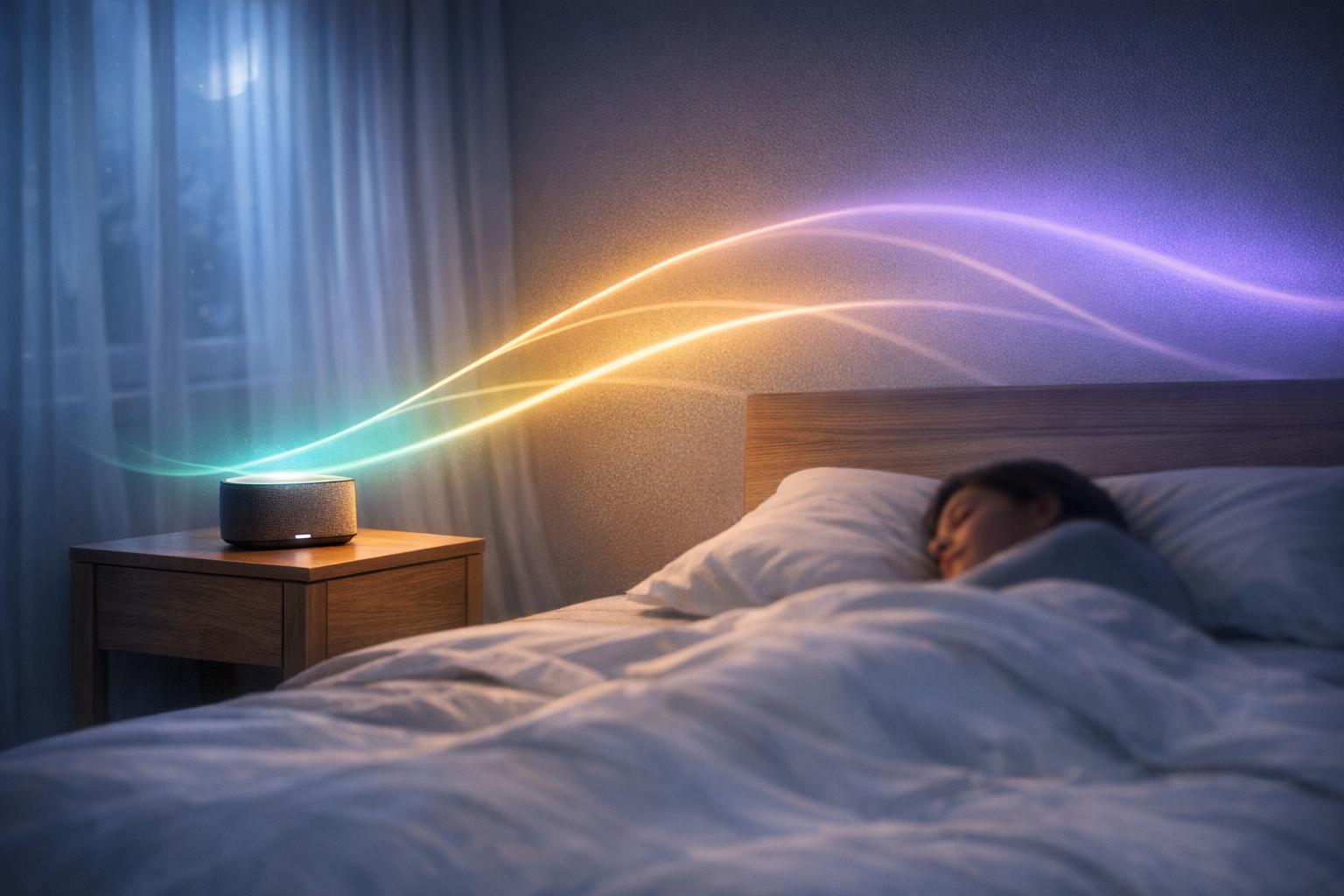
- Delta wave frequencies (0.5–4 Hz) dominate deep NREM Stage 3 sleep, and listening to them can extend deep sleep by up to 31%.
- A 2025 randomized trial at Pramukhswami Medical College found 15 minutes of daily 528 Hz OM chanting lowered PSQI scores from 6.48 to 5.04 (p = 0.021).
- A University of Tsukuba Hospital trial showed 0.25 Hz binaural beats helped participants reach N2 and N3 sleep stages significantly faster.
- Binaural beats can help people fall asleep about 37% faster and improve sleep quality by roughly 42% versus placebo.
- Vibroacoustic therapy delivers low-frequency vibrations through mats or chairs, activating the parasympathetic nervous system without headphones.
- Listening for 15–60 minutes before bed, ideally with stereo headphones, gives the brain time to entrain to sleep-ready states.
Struggling to fall asleep? Healing frequencies - specific sound waves measured in Hertz (Hz) - might help. These frequencies interact with your brain activity, guiding it from active states (Beta waves) to relaxed, sleep-ready patterns like Alpha, Theta, and Delta waves. Research shows they can improve sleep quality and reduce insomnia by 42%, reduce the time it takes to fall asleep by 37%, and enhance deep sleep by up to 31%.



Here’s a quick overview:
- Delta Waves (0.5–4 Hz): Linked to deep, restorative sleep.
- 528 Hz: Reduces stress and promotes relaxation.
- 963 Hz: Encourages mental calmness and spiritual connection.
- Binaural Beats & Isochronic Tones: Help synchronize brainwaves for better sleep.
- Vibroacoustic Therapy: Combines sound and physical vibrations for relaxation.
Studies back these methods, showing measurable improvements in sleep patterns, reduced stress markers, and increased melatonin production. Listening for 15–60 minutes before bed can help you transition into a restful state. While more research is needed, these techniques offer a drug-free way to improve sleep.
How Sound Frequencies Affect Brainwaves and Sleep
Your brain's activity isn't static - it shifts throughout the day. When you're awake and alert, Beta waves (13–30 Hz) take the lead. But as bedtime approaches, these waves slow down, transitioning to Alpha (8–13 Hz) and Theta (4–8 Hz) waves. Once you hit deep sleep, Delta waves (0.5–4 Hz) dominate. These shifts are essential for maintaining healthy sleep patterns and understanding them can shed light on how sound frequencies influence rest.
Brainwave Patterns and Sleep Stages
Each type of brainwave plays a specific role in sleep. During deep, dreamless sleep (NREM Stage 3), Delta waves are in charge. This stage is crucial for physical recovery, memory processing, and even immune system support. Meanwhile, Theta waves are more active during light sleep and REM, promoting dreaming, relaxation, and creativity. Before you drift off, Alpha waves help your mind unwind, reducing stress and preparing you for rest. On the flip side, Beta waves - great for daytime focus - can disrupt sleep if they linger too long at night.
Interestingly, research has shown that listening to Delta wave frequencies can extend the time spent in deep sleep by as much as 31%. A study from AIIMS Patna in December 2019 revealed that 432 Hz music for sleep significantly boosted Alpha wave activity during the onset of sleep (P < 0.01) in a small group of 15 volunteers. Additionally, sound frequencies ranging between 20–500 Hz have been found to calm the nervous system, improving overall sleep quality.
Resonance and Frequency Alignment
The concept of resonance helps explain how sound frequencies interact with brain activity. Every part of your body - from cells to organs - vibrates at its own natural frequency. External sound waves can help restore balance to these vibrations, creating harmony. When you listen to specific frequencies, your neurons can sync up with the external rhythm. This process, called neural synchronization, is a key mechanism behind the effects of healing frequencies.
Binaural beats are a great example of this synchronization in action. Here’s how it works: if one ear hears a tone at 200 Hz and the other hears 210 Hz, your brain perceives a "phantom" frequency of 10 Hz. This aligns your brainwaves with Alpha or Theta states, depending on the frequency. The result? Reduced cortisol (the stress hormone), increased melatonin (which promotes sleep), and a slower heart rate. To fully experience the benefits of binaural beats, high-quality stereo headphones are a must. This synchronization lays the groundwork for therapeutic sound techniques, which will be explored further in the next section.
Research on Key Healing Frequencies
In this section, we’ll delve into the effects of two specific frequencies, 528 Hz and 963 Hz, which have been studied for their impact on stress, relaxation, and sleep. Building on earlier discussions about brainwave entrainment, let’s explore what the research reveals about these frequencies.
528 Hz: Effects on Stress and Sleep
The 528 Hz frequency is often highlighted for its calming influence, particularly regarding stress reduction and improved sleep quality. Although some claims, like its role in DNA repair, lack scientific backing, there’s evidence that this frequency helps lower stress markers and soothes the nervous system, which can indirectly promote better sleep.
A 2025 randomized controlled trial conducted by Ankur Bhoot and Bhalendu Vaishnav at Pramukhswami Medical College in India provides compelling data. Sixty participants with Stage 1 hypertension engaged in daily 15-minute sessions of OM chanting at 528 Hz over one month. The results were notable: Pittsburgh Sleep Quality Index (PSQI) scores dropped from 6.48 ± 2.47 to 5.04 ± 2.24 (p = .021), perceived stress scores fell from 18.48 ± 5.445 to 15.85 ± 4.72 (p = .001), and systolic blood pressure decreased from 143.85 to 133.85 mmHg. Additionally, key heart rate variability (HRV) metrics like RMSSD and SDNN improved, signaling stronger cardiovascular resilience and parasympathetic activity.
"Listening to 528 Hz frequency OM chanting for one month reduces pulse and blood pressure, and enhances parasympathetic dominance on HRV analysis. It also improves psychological wellbeing, reduces perceived stress, and improves the quality of sleep." - Bhalendu Vaishnav, Department of Medicine, Pramukhswami Medical College
These findings align with earlier studies linking 528 Hz to Delta wave activity, which is crucial for deep sleep. To experience these benefits, try incorporating 15 minutes of OM chanting at 528 Hz into your daily routine.
963 Hz: Deep Relaxation and Restorative Sleep
While 528 Hz focuses on measurable stress and sleep improvements, 963 Hz is associated with a deeper sense of mental and spiritual restoration. Often referred to as the "Frequency of the Gods" or the "Siu" note in the Solfeggio scale, this frequency is believed to enhance spiritual awakening and connect with the crown chakra, which is linked to higher consciousness and inner peace. By helping release emotional blockages and reducing mental tension, 963 Hz fosters the tranquility needed for truly restorative sleep.
Unlike 528 Hz, which has clear physiological effects like lowering blood pressure, 963 Hz is more about mental and spiritual reconnection. While frequencies like 432 Hz are commonly used for general relaxation, 963 Hz is thought to encourage spiritual transformation.
Scientific studies on 963 Hz remain limited, with much of the support based on anecdotal evidence rather than rigorous trials. However, broader research on healing frequencies and sound therapy suggests that specific frequencies can reduce stress, alleviate anxiety, and improve well-being, hinting at the potential of 963 Hz.
For those interested in trying 963 Hz, headphones can enhance the experience by creating an immersive sound environment. Pairing it with meditation or yoga in a quiet, distraction-free space for 15 to 30 minutes before bedtime may help trigger a relaxation response.
Sound Therapy Methods for Delivering Healing Frequencies
Expanding on the research surrounding 528 Hz and 963 Hz, sound therapy methods provide practical ways to deliver these frequencies for better sleep. Each method has its unique approach, and knowing how they work can help you find the best fit for your sleep routine.
Binaural Beats and Isochronic Tones
Binaural beats work by playing two slightly different frequencies in each ear through stereo headphones. Your brain processes the difference between these frequencies, creating a "phantom" third frequency. For example, if one ear hears 300 Hz and the other hears 310 Hz, your brain perceives a 10 Hz frequency - often linked to relaxation or sleep.
Isochronic tones, on the other hand, use a single tone that pulses on and off at regular intervals. This rhythmic pattern generates a pronounced response in the brain, often stronger than the subtler effects of binaural beats.
One practical difference is the equipment needed. Binaural beats require stereo headphones to deliver separate tones to each ear, while isochronic tones can be played on regular speakers. Both methods are often tuned to the Delta range (0.5–4 Hz) for deep sleep or the Theta range (4–8 Hz) for light sleep and relaxation.
Research backs their effectiveness. A randomized trial at the University of Tsukuba Hospital in October 2024 tested 0.25 Hz binaural beats with a 250 Hz carrier tone on 12 healthy adults (average age 25.4). Participants exposed to the 0.25 Hz condition entered N2 and N3 sleep stages significantly faster, with effect sizes of 0.773 and 0.682, respectively. More broadly, studies indicate that binaural beats can help people fall asleep 37% faster and improve sleep quality by 42%.
For optimal results, start listening 30–60 minutes before bed, use high-quality headphones for binaural beats, and stick to a routine for at least 21 days. This consistency gives your brain time to adapt to the entrainment process. Up next, let’s look at vibroacoustic therapy, which adds a physical layer to sound therapy.
Vibroacoustic Therapy: Physical Vibrations for Relaxation
Unlike auditory-only methods, vibroacoustic therapy uses low-frequency vibrations delivered through specially designed mats or chairs equipped with transducers. These vibrations stimulate mechanoreceptors in the skin, activating the parasympathetic nervous system - your body’s "rest and digest" mode. This promotes deep relaxation and can also enhance circulation.
Because this method relies on physical vibrations, headphones aren’t necessary. The combination of sound and tactile sensations creates a multi-sensory experience, making it a great option for those who find purely auditory methods less engaging. To avoid discomfort or disrupting sleep, it’s best to keep the volume below 70 decibels, which is about the level of a normal conversation.
Measured Benefits of Healing Frequencies for Sleep
Recent studies shed light on how healing frequencies can influence sleep patterns, showing measurable effects on brainwaves, hormones, and sleep latency. These findings highlight their role in improving sleep architecture, from falling asleep faster to enhancing the quality of deep sleep.
For instance, a 2022 pilot study demonstrated that delta binaural beats significantly reduced sleep latency (p < 0.001). Similarly, a December 2019 study conducted at AIIMS Patna revealed that listening to 432 Hz music notably increased alpha wave activity during sleep onset (p < 0.01). While the reduction in sleep latency - from 19.96 to 9.86 minutes - was not statistically significant, the calming effects of alpha wave dominance during Stage 2 of NREM sleep were highlighted. Dr. Pramita Dubey from AIIMS Patna explained:
"The most promising effect of music upon the sleep behaviour could possibly be the calming effect as represented by the alpha dominance during Stage 2 of the NREM sleep."
Beyond helping individuals fall asleep faster, frequency therapy has been found to enhance deep sleep. A 2024 study reported that 0.25 Hz binaural beats reduced the time it took to reach N2 (p = 0.023) and N3 (p = 0.045) sleep stages, while delta-state music increased slow-wave sleep by 46.18% (p = 0.035) and reduced N1 duration from 8.00 to 6.13 minutes (p = 0.029).
Frequency therapy also impacts stress-related hormones, with research showing a 40% reduction in mean cortisol levels (from 20.32 to 11.79 AU). A 2025 trial at Pramukhswami Medical College observed improvements in the Pittsburgh Sleep Quality Index (PSQI), with scores improving from 6.48 ± 2.47 to 5.04 ± 2.24 (p = 0.021) after one month of daily 15-minute sessions of 528 Hz OM chanting. Dr. Bhalendu Vaishnav noted:
"Listening to 528 Hz frequency OM chanting for one month reduces pulse and blood pressure, and enhances parasympathetic dominance... It also improves psychological wellbeing, reduces perceived stress, and improves the quality of sleep."
Overall sleep quality showed notable improvements. For example, one study reported a 75% increase in sleep quality, with scores rising from 5.22 to 8.02 on a 10-point scale. Additionally, a double-blind study at Careggi University Hospital found that 432 Hz music improved sleep scores by +3.6 (p = 0.02), unlike 440 Hz music, which showed no significant effect. Theta binaural beats also contributed by reducing sympathetic activity and increasing parasympathetic control (p < 0.01).
Research Gaps and Future Studies
While current research offers encouraging insights, the study of healing frequencies for sleep is still in its infancy. One major hurdle is the small sample sizes in many studies, which limits their ability to produce broadly applicable results. Another challenge lies in individual variability - what soothes one person might have little to no impact, or even an adverse effect, on someone else. Sleep disorders also add complexity due to their susceptibility to placebo effects. As Dr. Rafael Pelayo from Stanford Medicine explains:
"Sleep disorders like insomnia are sensitive to placebo effects, but eventually, the effect will wane because the root cause of the sleep issues hasn't been addressed".
Inconsistent methodologies further complicate the field. Studies vary widely in how they approach session length, frequency ranges, and delivery methods. Some rely on daytime nap studies rather than full-night polysomnography, which risks overlooking critical sleep stages like REM or deep N3 sleep. Additionally, the inability to blind participants to music interventions introduces potential bias.
To overcome these challenges, future research must aim for larger, more diverse clinical trials. Expanding participant demographics to include different age groups, genders, and medical conditions will provide a more comprehensive understanding. Ethan Y. Pan and Wei Wang from UCSF's Department of Radiology highlight the importance of innovation in this area:
"Future research should explore how personalized music interventions and artificial intelligence-generated compositions may advance sleep health".
Long-term studies are also necessary to evaluate whether the benefits of sound frequency therapy endure over extended periods. These studies could help uncover the biological mechanisms at play and clarify how sound frequencies interact with brainwave activity. By addressing these gaps, researchers can build on existing findings and open new doors to improving sleep through sound therapy.
Conclusion
Healing frequencies provide a gentle, non-invasive option for improving sleep. Research highlights that frequencies like 528 Hz and 963 Hz can transition brainwaves from active beta states to slower alpha, theta, and delta patterns - states linked to deep, restorative sleep. In fact, studies reveal that participants exposed to these frequencies fell asleep 37% faster and experienced a 42% boost in sleep quality compared to placebo groups.
Unlike pharmaceutical sleep aids, healing frequencies offer a drug-free alternative, eliminating concerns about dependency or side effects. For example, just five minutes of listening to the 528 Hz frequency has been shown to lower stress markers, reduce cortisol levels, and increase oxytocin. These benefits go beyond simply helping you fall asleep - they enhance overall sleep structure and support physical recovery during rest. This makes therapeutic sound waves a promising addition to sleep health practices.
Though there are still research gaps and individual responses may differ, current evidence backs healing frequencies as a practical tool for better sleep. As Jenna Marcovitz, a board-certified music therapist at UCLA Health, says:
"If it is working for you and helping you to feel calm, then mission accomplished".
The secret lies in consistent practice and finding the right method for your needs.
Frequently Asked Questions
Which frequency should I use for my sleep problem?
When dealing with sleep troubles, specific sound frequencies like 432 Hz and 528 Hz are often suggested. These tones are thought to promote relaxation, ease stress, and improve overall sleep quality. By listening to music crafted around these frequencies, you can create a soothing atmosphere that encourages deeper, more restful sleep.
Are binaural beats safe for everyone?
Binaural beats are considered safe for the majority of people. That said, if you have epilepsy or a history of seizures, it's important to check with a healthcare professional before trying them to ensure they won't pose any risks.
How loud and how long should I listen before bed?
It’s often suggested to listen to healing frequencies for about 15 to 30 minutes before bedtime to help promote relaxation and support better sleep. However, the perfect duration really depends on what feels right for you. Make sure to keep the volume at a calm and comfortable level - loud enough to hear but gentle enough not to distract or strain your ears.
How long before I notice better sleep from healing frequencies?
Many practitioners recommend sticking with a routine for at least 21 days, since consistency gives your brain time to adapt to the entrainment process. Some people feel calmer the first night, while measurable changes in sleep architecture tend to build over several weeks of regular use.
Do I need headphones for sleep frequencies?
Binaural beats require stereo headphones because each ear must receive a separate tone for the effect to work. Other methods, like isochronic tones and vibroacoustic therapy, do not require headphones and can be played through speakers or felt through a vibrating mat.
From our studio · Calm & Sleepy
Deep Sleep Music — A whole site devoted to falling asleep faster and staying asleep.