

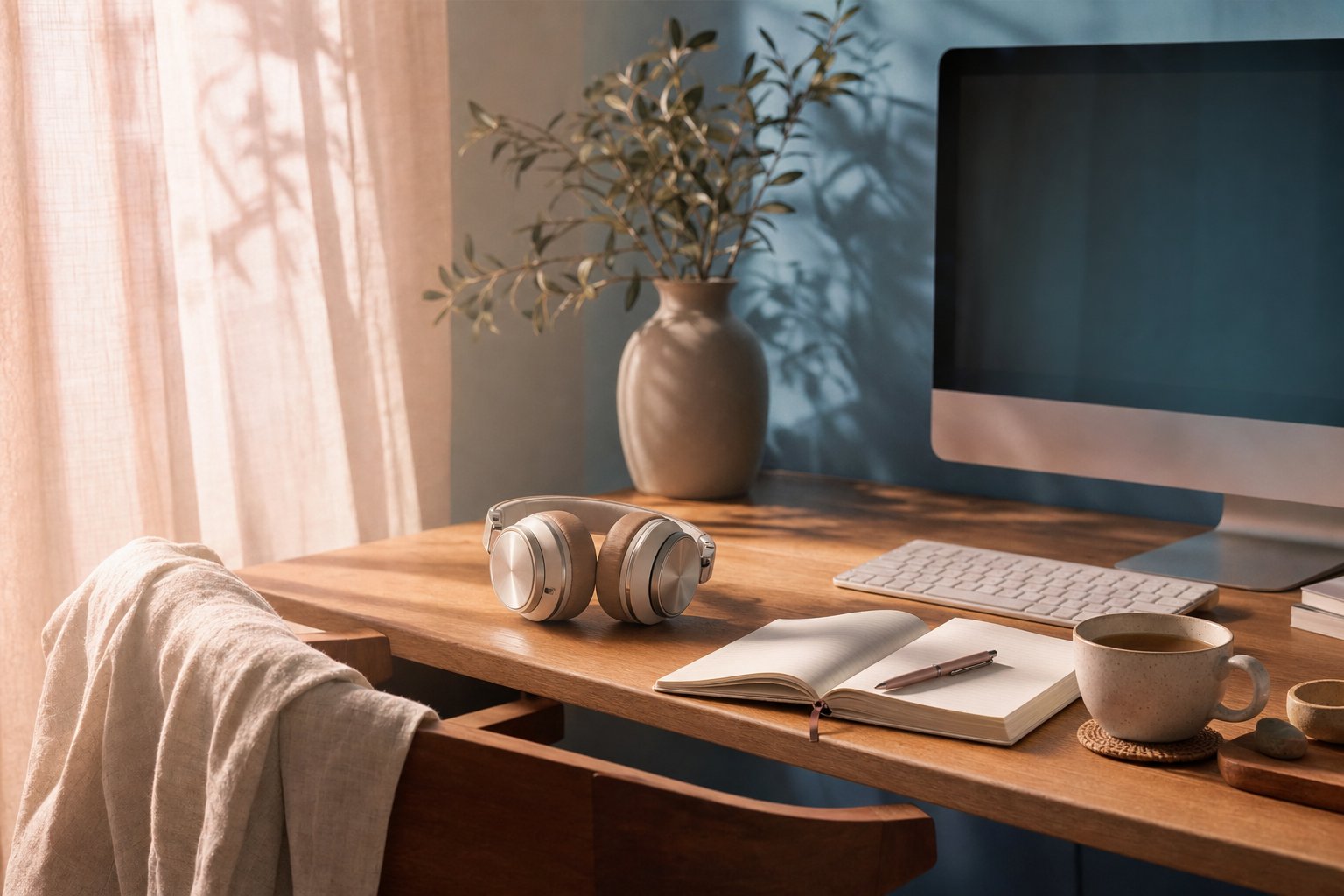
- A binaural beat exists only as the difference between what the left ear and the right ear receive, so a focus beat requires headphones; an isochronic pulse carries the same rhythm inside a single channel and plays through any speaker.
- Every properly labelled beat track states two separate numbers: the beat frequency (10 Hz, 16 Hz, 40 Hz) and the carrier tone you actually hear, which usually sits between 100 and 400 Hz.
- Beta beats between 13 and 20 Hz suit effortful work that needs holding, alpha between 8 and 12 Hz suits reading, reviewing and planning, and 40 Hz gamma suits short, sharp bursts of twenty minutes or less.
- Theta (4 to 8 Hz) and delta (0.5 to 4 Hz) belong to the drift-off and deep-sleep hours rather than to a working block, which is why a sleep track played at a desk slackens attention instead of steadying it.
- Daytime carriers sit brighter than night-time ones — roughly 200 to 400 Hz — while the volume stays below speech level and the beat runs unbroken for the whole 25- to 50-minute block.
- A track title is never proof of a beat: if the label does not state a beat frequency in Hz, treat the recording as background music for working rather than as a binaural beat.
Binaural Beats for Focus Are Two Numbers and a Pair of Headphones
A binaural beat is built from two tones that sit slightly apart from each other — one in your left ear, one in your right. Your hearing resolves the gap between them into a slow, even pulse that neither tone contains on its own. That pulse is the beat frequency, and it is the number that decides where a track belongs: a deep-work block, a reading session, or a night of sleep. Everything else in the recording — the pad underneath, the rain on top, the piano, the warmth of the tone — is dressing around those two signals.
So a focus track carries two numbers, and they do different jobs. The beat is the difference between the ears, counted in single or low double digits: 10 Hz, 16 Hz, 40 Hz. The carrier is the pitch you actually hear, usually somewhere between 100 and 400 Hz. A track labelled “16 Hz beta on a 320 Hz carrier” tells you both — a brisk sixteen-per-second rhythm riding a bright, alert tone. Read the label rather than the title, because a title on its own never proves a beat or a tuning, and a great many “focus music” uploads contain no beat at all.
One consequence outranks every other setting in this guide: the pulse lives in the difference between your ears, so it only exists in headphones. Play a binaural focus track through a laptop speaker and both channels reach both ears, the difference collapses, and what remains is a pleasant drone — fine as background, no longer a beat. Earbuds, over-ears and on-ears all work; what matters is that each ear receives its own channel at the same volume. Switch off spatial audio and head tracking, which blend the channels back together, and skip any track you only have as a mono mix.

The speaker-friendly version: isochronic pulses
When headphones are out — a shared office, a call you need to hear coming, a day when your ears ache — the isochronic pulse is the same rhythm built a different way. Instead of splitting the work between two ears, the recording switches a single tone on and off at the chosen rate, so the pulse is already baked into the file and survives any speaker. It is a blunter, more audible tick than a binaural beat: some people settle into it immediately at a desk, others find it too present to ignore. Try both before you decide which one your working hours get. For the setup details either way, our guide to listening to binaural beats correctly goes through the practicalities.
Which Beat Frequency Suits Which Kind of Work
Focus is not one state, and that is why a single track on repeat serves you badly across a whole day. Writing a difficult paragraph, reading forty pages, clearing an inbox and sitting down for twenty minutes of hard thinking feel different from the inside, and they want different pulses underneath them. Three bands cover almost all of it. Pick the band from the shape of the work, then pick the track from the label.
Beta, 13–20 Hz: effortful work that needs holding
Beta runs from roughly 13 to 30 Hz, and the lower half of that range — 14 to 20 Hz — is the working end for a desk. A 16 Hz beat is brisk and unmistakably awake: a steady rhythm just fast enough that attention has something to lean against, slow enough that it never becomes a tick you count. This is the band for work that resists you, the kind where the difficulty is staying in the chair: drafting, debugging, building a model, grinding through a stack of admin. Start at 14 Hz if 16 feels too insistent, and climb no higher than 20 — above that the pulse reads as pressure rather than momentum.
Alpha, 8–12 Hz: reading, reviewing, planning
Alpha sits between 8 and 12 Hz and feels completely different: calm but wide awake, the state where attention is open rather than clamped. It suits the work you do with your shoulders down — reading long documents, reviewing someone else's draft, planning a week, sketching an outline, studying. A 10 Hz beat is the natural centre of the band and the easiest place to start; our guide to 10 Hz alpha music describes the character of that rate in more detail. Alpha is also the band to reach for when a beta beat has left you wired: drop to 10 Hz for the next block and the day evens out.
Gamma, around 40 Hz: short, sharp bursts
Gamma is the fastest band in regular use, and 40 Hz is the number listeners reach for by name. At that rate the pulse stops reading as a rhythm and becomes a texture — a fine, bright shimmer sitting under the work. Keep gamma sessions short: twenty minutes, twenty-five at most, for one specific hard thing you have already defined before you press play. It is a poor choice for a three-hour stretch and an excellent one for the single task you have been circling all morning. Our guide to the 40 Hz gamma frequency covers that tone on its own.
Theta and delta belong to the other end of the day
The two slowest bands are the ones people queue by accident, because the biggest, longest tracks online are made for nights. Theta runs from 4 to 8 Hz and matches the drowsy, drifting minutes before sleep; delta runs from 0.5 to 4 Hz and matches the deep hours. Played at a desk they do exactly what they are built to do, which is slacken attention rather than steady it. Save them: binaural beats for sleep maps the night-time versions, and sleep music frequency sorts out the tunings, pure tones and beats that belong after lights out.
Carrier, Volume and Block Length
Choose a brighter carrier for daytime
The carrier is the pitch you actually hear, and it sets the mood of a track more than the beat number does. Night tracks keep carriers low — 100 to 250 Hz, warm and grounded, easy to sink under. Daytime is the opposite: a carrier around 200 to 400 Hz sits clear and awake in the room without turning shrill. If a focus track feels heavy and you cannot say why, the beat is usually right and the carrier is too low. Many well-made tracks tuck the carrier under a soft pad or a layer of noise so the tone never sits exposed for an hour.
Set it below speech level
Every working beat belongs under the volume of conversation — present when you listen for it, easy to forget when you are inside the task. This is the single most common adjustment people need to make. A beat loud enough to admire is loud enough to become the thing you are paying attention to, which is the opposite of the point. Match the two sides carefully, too: if one earbud is quieter than the other, or one is dead, the difference between the ears is no longer what the recording intends.
Start it with the block and leave it running
Treat the beat as the frame around a block rather than something you fiddle with inside one. Press play, work for 25 to 50 minutes, stop when the block stops. Switching tracks mid-block, hunting for a better one, or restarting the same file three times costs you the thing you queued it for. Pick the band from the work, pick one track, let it run to the end of the block, then take the break in silence — the contrast is part of what makes the next block land.
The quickest way to find your own numbers is to generate them rather than search for them. The Frequency Studio produces beats free in the browser with the carrier and the beat rate under your fingers: open the alpha preset for the calm, open 8–12 Hz range or gamma for the fast 40 Hz shimmer, nudge the carrier until the tone sits comfortably in your ears, and keep the combination that disappears fastest once you start working.
A Five-Day Plan to Find Your Focus Beat
Day one — baseline. Work two normal blocks with no audio at all and note in one line where attention actually went. Without that line you will credit or blame a beat for things the day was doing anyway. Day two — alpha. Put a 10 Hz beat under two reading or reviewing blocks at a volume below speech, with a carrier near 300 Hz. Day three — beta. Put a 16 Hz beat under two blocks of the work that normally resists you, same volume, same carrier range. Day four — gamma. One twenty-minute 40 Hz burst against a single task you defined before pressing play, and silence for the rest of the day. Day five — build the day. Give each block the band its work asks for: alpha for reading, beta for the grind, one gamma burst if there is one hard thing left. By the end of the week you are not searching for a focus playlist any more. You have two or three numbers, a carrier you like, and a volume that stays where you set it.
What to Layer and What to Leave Out
A focus beat works best as one layer of a very small stack. Underneath, a noise bed earns its place when the room is the problem rather than your attention — the steady rain of pink noise or a flatter white noise covers conversation and corridor sound that would otherwise pull your head up. On top, nothing with words. Lyrics compete directly with reading and writing, and a vocal line is the fastest way to lose a block you had already won.
Before the first block of the day, one deliberate reset beats any amount of track-hunting: four rounds of the 4-4-4-4 count in box breathing for calm takes ninety seconds and puts you in the chair ready to start. If you want to train the attention itself rather than frame it, concentration meditation is the long game that makes every beat work better. And if beats are not your texture at all, there are two good alternatives: healing music for focus for music without a pulse in it, and calm music for studying for longer study sessions. If your attention runs on an ADHD pattern — long drifts, sudden hyperfocus, a loud internal channel — the ADHD music playlist guide maps what to play and when for that shape of day.
Frequently Asked Questions
What is the best binaural beat frequency for focus?
There are three answers, because focus is not one state. For effortful work that you have to stay inside, use a beta beat between 14 and 20 Hz, with 16 Hz as the natural starting point. For reading, reviewing, planning and studying, use alpha between 8 and 12 Hz, with 10 Hz at the centre. For one short, hard task, use 40 Hz gamma for twenty minutes. Pick the band from the shape of the work in front of you rather than looking for a single number that covers the whole day.
Do binaural beats for focus work without headphones?
No — a binaural beat exists only as the difference between what each ear receives, so through a speaker the two channels mix, the difference collapses, and the pulse disappears into a drone. Use headphones or earbuds with both sides at equal volume, and switch off spatial audio and head tracking, which blend the channels. If headphones are not an option, play an isochronic track instead: it switches a single tone on and off at the chosen rate, so the pulse is inside the recording and survives any speaker.
How long should I listen to a focus beat in one sitting?
Match the audio to the work block rather than to a clock: 25 to 50 minutes is the useful range for beta and alpha, and the beat should run unbroken from the start of the block to the end of it. Gamma is the exception — keep 40 Hz sessions to twenty minutes or so against one defined task. Take the break in silence. The contrast between a block with a beat under it and a break without one is part of why the next block starts cleanly.
What is the difference between the beat frequency and the carrier?
The beat is the difference between the two tones, and it is always a small number — 10 Hz, 16 Hz, 40 Hz. Nobody hears a 16 Hz pitch; you hear its rhythm. The carrier is the tone that actually reaches your ears, usually between 100 and 400 Hz, and it decides whether a track feels warm or bright. For daytime work, keep the carrier in the upper part of that range, around 200 to 400 Hz. A properly labelled track states both numbers separately.
Can I use a sleep binaural beat during the day if I turn it up?
Volume will not change what the number does. A 2 Hz delta track or a 6 Hz theta track is built for the drift-off and deep-sleep windows, and at a desk it loosens attention rather than holding it — turning it up only makes that more noticeable. Keep the slow bands for the end of the day and give working hours alpha, beta or a short gamma burst instead.
How do I tell whether a track really contains a binaural beat?
Read the label, not the title. A genuine beat track states its beat frequency in Hz, and usually its carrier as well; many uploads named “focus frequency” or “deep work music” contain no beat at all and are simply instrumental music, which is a fine thing to play but a different thing to choose. One quick check: a binaural beat heard on a speaker flattens into a plain drone, while the pulse of an isochronic track stays audible. If no number is stated anywhere, assume none.