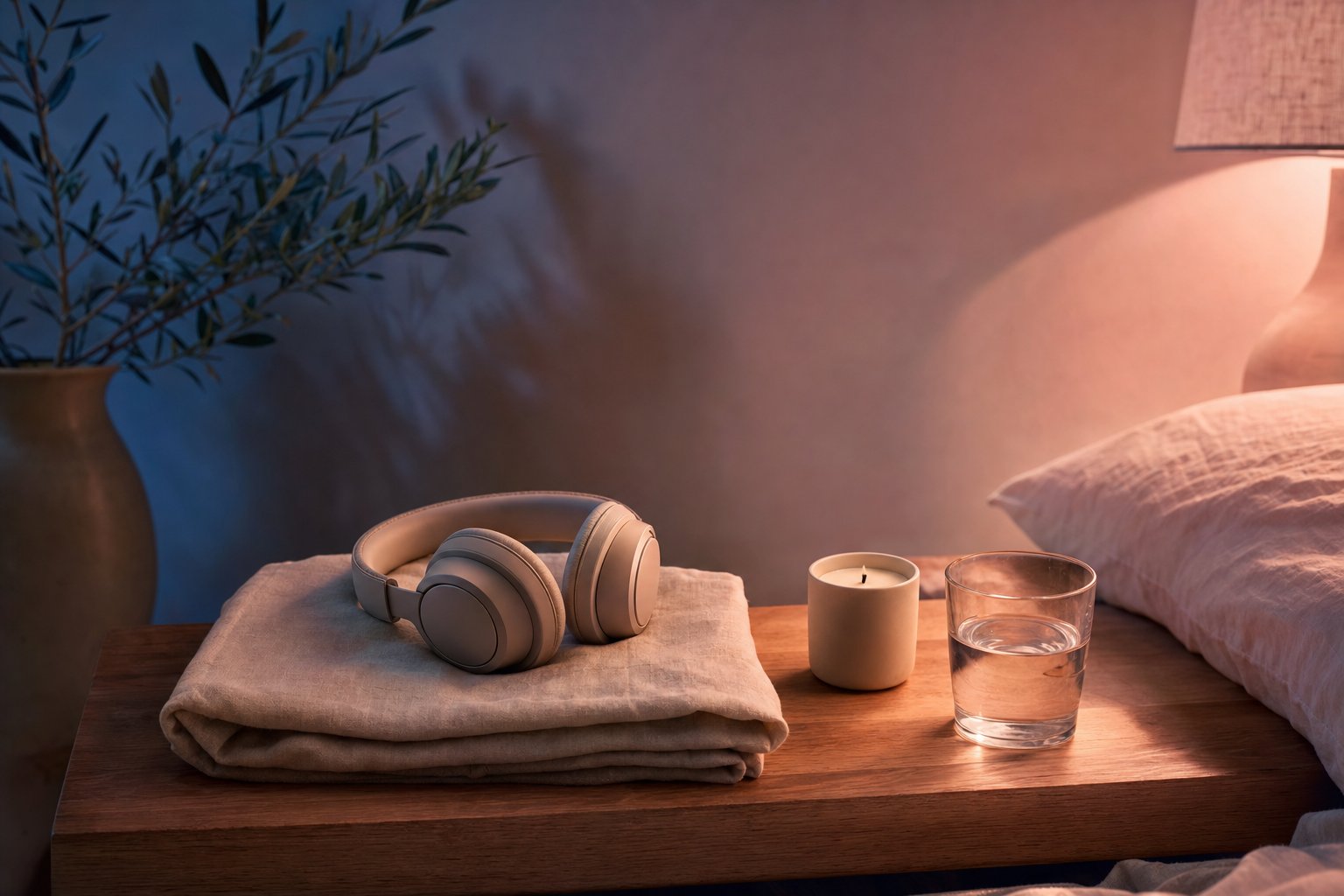

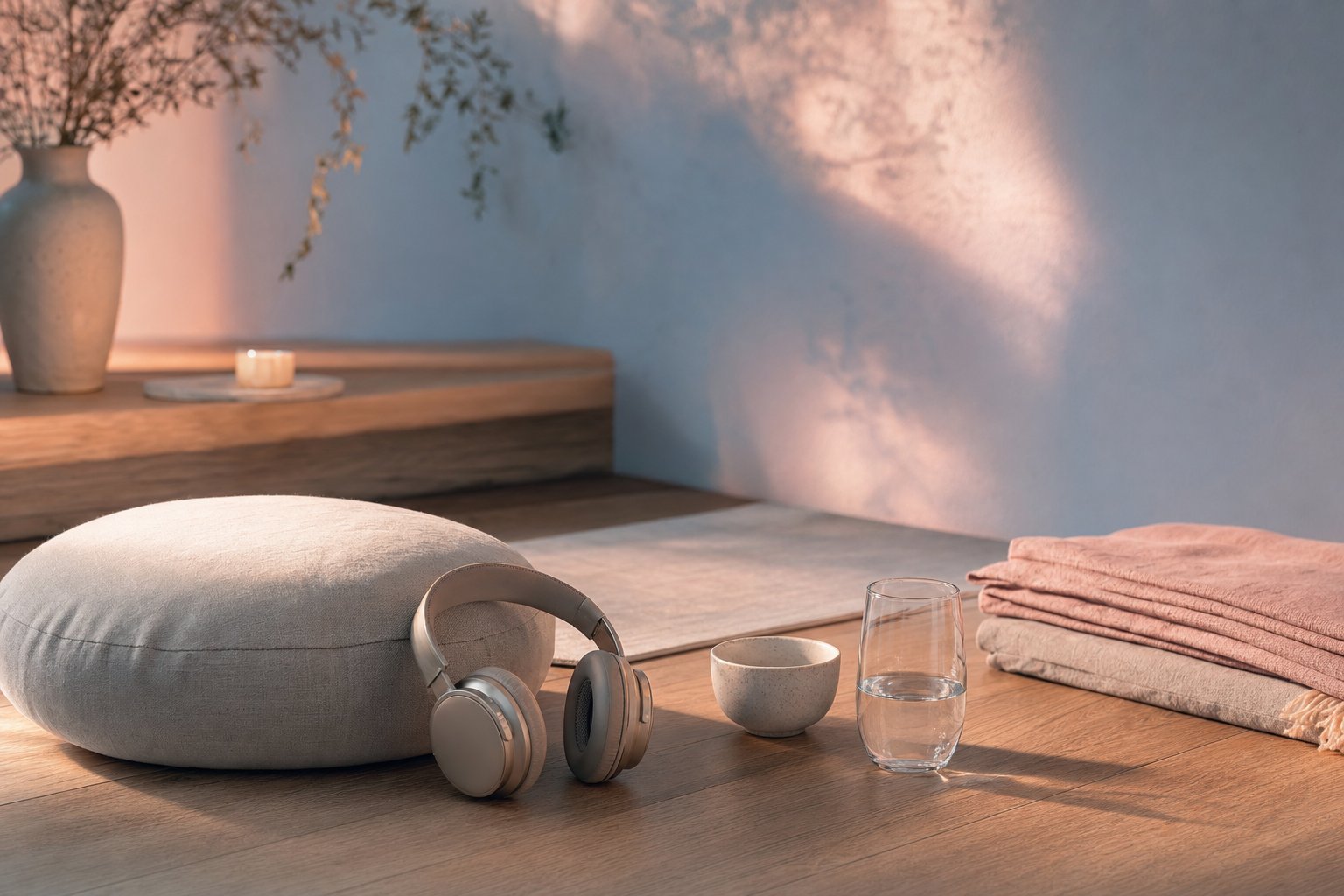
- A binaural beat is the difference between what the left ear and the right ear receive, so a beat-led meditation needs headphones with each side at matched volume; an isochronic pulse carries the same rhythm inside one channel and plays through any speaker.
- Every properly labelled track states two separate numbers: the beat frequency in single digits (4 Hz, 6 Hz, 10 Hz) and the carrier tone you actually hear, which usually sits between 100 and 400 Hz.
- Theta beats from 4 to 8 Hz suit the deep inward sit, alpha from 8 to 12 Hz suits open awareness and the morning ten minutes, and delta from 0.5 to 4 Hz suits the lying-down body scan.
- Beta between 13 and 30 Hz and 40 Hz gamma hold attention up rather than let it down, which makes them desk frequencies rather than meditation frequencies.
- Session length follows the technique: ten minutes for a breath count, twenty for a body scan or an open-awareness sit, thirty to forty once a longer practice is familiar, with the beat volume kept under the level of speech.
- A title is never proof of a beat: if the label states no beat frequency in hertz, treat the recording as calm music to sit with and generate your own beat instead.
A Binaural Beats Meditation Is Two Numbers You Choose Before You Sit
A binaural beat is built from two steady tones a few hertz apart — one in your left ear, one in your right. Your hearing resolves the gap between them into a slow, even pulse that neither tone contains on its own, and that pulse is the number that decides a meditation: 4 Hz, 6 Hz, 10 Hz. It gives the breath something unhurried to fall in behind and holds the pace steady once the mind starts wandering, which is what turns a restless ten minutes of sitting into a sit that settles.
Every properly labelled track therefore carries two separate numbers, and they do completely different jobs. The beat frequency is the difference between the ears, always in single digits. The carrier is the pitch you consciously hear, usually somewhere between 100 and 400 Hz. A track labelled "6 Hz theta on a 136.1 Hz carrier" tells you both — a slow six-per-second pulse riding a warm, low tone. Read the label rather than the title. A great many hour-long uploads named "deep meditation frequency" state no beat at all; they are lovely music to sit with, and they are a different thing to choose.
Four decisions cover the whole practice: the band, the carrier, the volume and the length. Make all four before you sit, because deciding them with your eyes closed is how a session becomes twenty minutes of auditioning tracks. The fastest way to settle them is to generate the beat yourself — The Frequency Studio builds one free in the browser, with the carrier and the beat rate under your fingers, so you can open the theta preset and keep the combination that disappears fastest once you stop listening on purpose.

The pulse lives between your ears, so headphones decide everything
One fact outranks every other setting here: the beat exists in the difference between the two channels, so it exists only in headphones. Play a binaural track through a speaker and both channels reach both ears, the difference collapses, and what is left is a pleasant drone — fine as background, no longer a beat. Earbuds, on-ears and over-ears all work; what matters is that each ear receives its own channel at matched volume. Switch off spatial audio and head tracking, which blend the channels back together, and skip any file you only have as a mono mix. Our guide to listening to binaural beats correctly covers the rest of the setup.
The speaker-friendly version: isochronic pulses
When headphones are out — a shared room, sore ears, a sit on the floor with the sound in the room rather than on your head — an isochronic pulse is the same rhythm built a different way. Instead of splitting the work between two ears, the recording switches a single tone on and off at the chosen rate, so the pulse is already inside the file and survives any speaker. At slow theta and delta rates it reads as a soft, regular swell rather than a tick. Try both in a week and keep whichever one your attention stops noticing sooner.
Which Beat Band Suits Which Kind of Sit
Meditation is not one state, which is why a single track on repeat serves a whole practice badly. A ten-minute breath count in the morning, a twenty-minute body scan on the floor, and a long inward sit in a dark room feel different from the inside and want different pulses underneath them. Pick the band from the practice, then pick the track from the label.
Theta, 4–8 Hz: the deep, inward sit
Theta runs from 4 to 8 Hz and feels slow, loose and dreamlike while you stay awake at the edges. This is the band most people mean by a meditation beat: 6 Hz sits at the natural centre and suits a breath-led sit, a long exhale practice, yoga nidra or a guided descent where you want attention to sink rather than stay sharp. A 4 Hz beat at the bottom of the band goes further down and suits the last sit of the evening. Theta rewards length — twenty to forty minutes — and it rewards a low carrier. If you intend to keep one beat for your regular practice, this is the one to start from, and our guide to binaural beats for deep rest and restoration maps the slow bands hour by hour.
Alpha, 8–12 Hz: open awareness and the morning ten minutes
Alpha sits between 8 and 12 Hz: calm and wide awake, attention open rather than clamped. This is the band for a morning sit you have to get up from and carry into the day, for open-monitoring practice where you watch whatever arrives instead of narrowing onto the breath, and for the ten minutes you take between two hard tasks. A 10 Hz beat is the easiest place to begin, and our guide to 10 Hz alpha music describes the character of that rate. Alpha leaves you level and clear; a delta beat at nine in the morning leaves you heavy for an hour.
Delta, 0.5–4 Hz: the lying-down body scan
Delta is the slowest band in regular use, and a 2 Hz beat is barely a rhythm at all — a long swell you feel more than count. It belongs to practice done lying down, where sliding into sleep at the end is a feature rather than a failure: a bedtime body scan, a wind-down sit, a session you leave running after you stop listening on purpose. Keep the carrier low and warm and let the file run unbroken. If your practice is explicitly aimed at the hours after lights out, binaural beats for sleep maps those hours, and meditating lying down covers the posture that makes a delta sit work instead of collapse.
Beta and gamma stay at the desk
The two fastest bands end up in a meditation session by accident, usually because a playlist mixed them in. Beta between 13 and 30 Hz steadies effortful work, and 40 Hz gamma suits short, sharp bursts of concentration. In a sit they do exactly what they are built to do, which is hold attention up rather than let it down. Keep them for the working day: binaural beats for focus maps the daytime versions band by band.
Set the Carrier, the Volume and the Length
The carrier is the part you actually hear
The carrier decides the mood of a sit far more than the beat number does, because it is the only half of the pair you consciously notice. Between roughly 100 and 250 Hz a tone reads as low, round and easy to sink under, which suits theta and delta. Higher carriers read brighter and more open, which suits an alpha sit in daylight. The frequency traditions live here too, and the choice is yours to make by ear: 136.1 Hz, the OM frequency, is a grounded carrier that pairs naturally with a slow beat, while brighter tones sit better under 10 Hz in the morning. Pick the tone you want to spend twenty minutes inside, then set the beat from the practice.
Volume sits under the sound of the room
A meditation beat belongs below the level of speech — present when you listen for it, easy to forget once you stop. This is the single most common adjustment people make after their first session. A beat loud enough to admire becomes the thing you are paying attention to, which is the opposite of the point. Match the two sides carefully as well: if one earbud runs quieter than the other, the difference between the ears is no longer what the recording intends.
Length follows the technique
Ten minutes suits a breath count and a morning sit. Twenty suits a body scan or an open-awareness session. Thirty to forty suits a long theta practice once it is familiar, and a delta sit lying down runs as long as you like because the end of it is sleep. Set the length before you start rather than watching a timer, use one unbroken file instead of a playlist, and finish in silence rather than switching straight to something else — the quiet afterwards is part of what makes the sit land.
Four Sits That Run on a Beat
The ten-minute breath count on 6 Hz
Headphones on, sitting upright, 6 Hz theta on a carrier near 136 Hz, volume under the room. Spend the first minute doing nothing about your breathing at all, then count exhales to ten and start again, letting each exhale stretch until it matches the pace of the pulse. When the count disappears, pick it up from one without comment. Ten minutes, then take the headphones off before you open anything else.
The twenty-minute body scan on 4 Hz
Flat on your back, knees supported, 4 Hz on a low carrier between 100 and 200 Hz. Move attention from the soles of your feet to the crown in slow sweeps, one breath per region, letting the slow beat set the speed so you stop rushing the legs. Twenty minutes covers the body twice. This is the version that carries straight into sleep if you run it at night, which is why the file should be long enough to outlast you.
The twenty-minute open-awareness sit on 10 Hz
Upright, eyes closed or softly open, 10 Hz alpha on a brighter carrier, in daylight. Instead of narrowing onto the breath, let whatever arrives — sound, thought, sensation — pass through without being followed. The alpha pulse keeps the room steady underneath while attention stays wide. Twenty minutes leaves you settled and upright rather than groggy, which is what the rest of the day asks for. On days when concentration is the thing you want to train instead, concentration meditation covers the one-pointed version.
The mantra sit with a tone underneath
A repeated phrase and a slow beat work well together, because the beat holds the tempo of the repetition so you do not drift into speeding it up. Use 6 Hz theta, keep the carrier low, and repeat on the exhale at whatever length suits the phrase. Our collection of mantras for meditation gives you twenty-one to choose from, including the short ones that fit a single breath.
A Week to Find Your Own Numbers
Day one is a baseline: one sit with no audio at all, and a single line written down afterwards about how it went. Without that line you will credit a beat for things the week was doing anyway. Day two, 6 Hz theta for twenty minutes with a low carrier. Day three, 10 Hz alpha for ten minutes in the morning. Day four, 4 Hz lying down for a body scan. Day five, keep the beat that suited you best and change only the carrier — once low and warm, once brighter — because the carrier is usually what makes a sit feel wrong when the beat is right. Day six, same beat and carrier, double the length, and note where attention drifted. Day seven, build the shape you will actually keep: a short alpha sit in the morning, a longer theta sit in the evening. By the end of the week you are not hunting for a meditation playlist. You have two numbers, a carrier you like, and a volume that stays where you set it.
What to Layer Underneath and What to Leave Out
A meditation beat works best as one layer of a very small stack. Underneath, a noise bed earns its place when the room is the problem rather than your pace — the steady rain of pink noise covers traffic and corridor sound that would otherwise keep lifting attention. On top, nothing with words. A vocal line pulls attention forward and is the fastest way to lose a sit you had already won.
Two minutes of deliberate breathing before the beat starts is worth more than any amount of track-hunting: four rounds of the 4-4-4-4 count in box breathing for calm puts you on the cushion already slowing. And on days when sitting still is not available, our guide to grounding techniques covers the short resets that settle the same system standing up.
Frequently Asked Questions
What is the best binaural beat frequency for meditation?
There are three answers, because meditation is not one state. For a deep, inward sit — breath-led practice, a long exhale session, yoga nidra — use theta between 4 and 8 Hz, with 6 Hz as the natural centre. For open awareness and a morning sit you have to get up from, use alpha between 8 and 12 Hz, with 10 Hz as the easiest starting point. For practice done lying down where sliding into sleep at the end is welcome, use delta between 0.5 and 4 Hz, with 2 Hz as the place to begin. Choose the band from the practice rather than looking for one number that covers everything.
Do binaural beats work for meditation without headphones?
A binaural beat exists only as the difference between what each ear receives, so through a speaker the two channels mix, the difference collapses, and the pulse flattens into a drone. Use headphones or earbuds with both sides at equal volume, and switch off spatial audio and head tracking, which blend the channels back together. If headphones are not an option, play an isochronic track instead: it switches a single tone on and off at the chosen rate, so the pulse sits inside the recording and survives any speaker — which makes it the practical choice for a shared room or a floor sit.
How long should a binaural beats meditation be?
Match the length to the technique. Ten minutes suits a breath count or a morning sit, twenty suits a body scan or an open-awareness session, and thirty to forty suits a longer theta practice once it is familiar. A delta sit lying down runs as long as you like, because its end is sleep. Set the length before you start, use one unbroken file rather than a playlist so no track change interrupts you, and finish in silence instead of switching straight to something else.
What is the difference between the beat frequency and the carrier tone?
The beat is the difference between the two tones and is always a small number — 4 Hz, 6 Hz, 10 Hz. Nobody hears a 6 Hz pitch; you feel its rhythm. The carrier is the tone that actually reaches your ears, usually between 100 and 400 Hz, and it decides whether a track feels low and grounded or bright and open. Keep the carrier in the lower part of that range for evening and lying-down practice, and go brighter for a daytime alpha sit. A properly labelled track states both numbers separately, which is exactly why the label is worth more than the title.
Can I use binaural beats with a guided meditation?
Yes, and the order matters: let the beat run underneath at a volume below the voice, so the guidance stays easy to follow and the pulse sets the pace of the pauses. Theta at 4 to 6 Hz sits well under a slow guided descent or a body scan. What does not work is two rhythmic layers at once — a beat plus music with its own tempo, or a second beat at a different rate — because attention splits between them. One beat, one voice, nothing else.
How do I tell whether a track really contains a binaural beat?
Read the label, not the title. A genuine beat track states its beat frequency in hertz, and usually its carrier as well. Many uploads named "deep meditation frequency" or "theta healing music" contain no beat at all and are simply instrumental music, which is a fine thing to play and a different thing to choose. One quick check: a binaural beat heard through a speaker flattens into a plain drone, while an isochronic pulse stays audible. If no number appears anywhere on the label, assume there is none and generate your own instead.